Super VHS review verdict: it’s worth $69 if your problem is digital audio that sounds too clean, too sharp, and too finished, and you want to fix that in one plugin instead of five. Your sample loop sits there sounding like a stock library. Your synth is crisp in all the wrong ways. You could chain a saturator, a bitcrusher, a chorus, a pitch wobbler and a reverb, but by the time you’ve gain-staged all of that, the vibe is gone and the session is a mess.
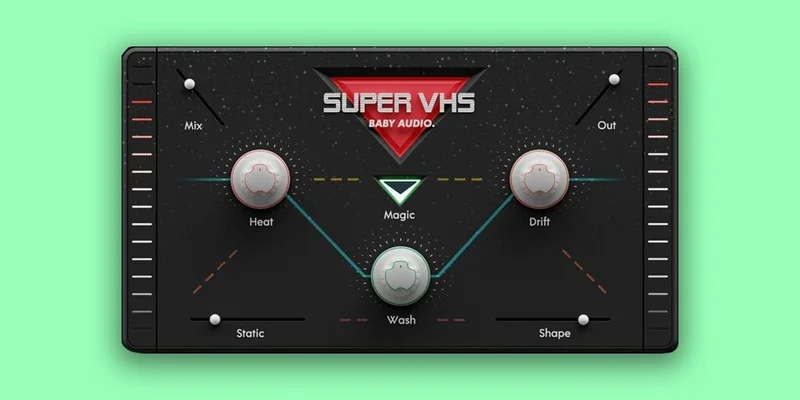
Baby Audio built Super VHS for that exact moment. It’s a six-stage lofi chain with one knob per stage.
It’s built for beatmakers, lofi producers and anyone who wants old-tape attitude quickly. If you want surgical control, keep reading anyway. We’ll tell you where it falls short.
The Problem This Solves
Modern plugins are too accurate. That’s the frustration. You record a clean sample, run it through a clean chain, and end up with something that sounds like it came off a laptop speaker demo.
Lofi isn’t one effect. It’s a pile of small flaws stacked up: a bit of hiss, tape-style warmth, a crunchy low sample rate, a wobbly pitch, a chorus that smears the stereo image, and a murky room. Real hardware from the 1980s did all of that at once without asking.
Rebuilding that ITB usually means six plugins and an hour of tweaking. Most people give up around plugin three and slap a vinyl crackle on top. Hard pass on that approach.
Super VHS puts the whole pile behind one interface. That’s the entire pitch, and it’s a good one.
How the Six-Stage Chain Is Laid Out
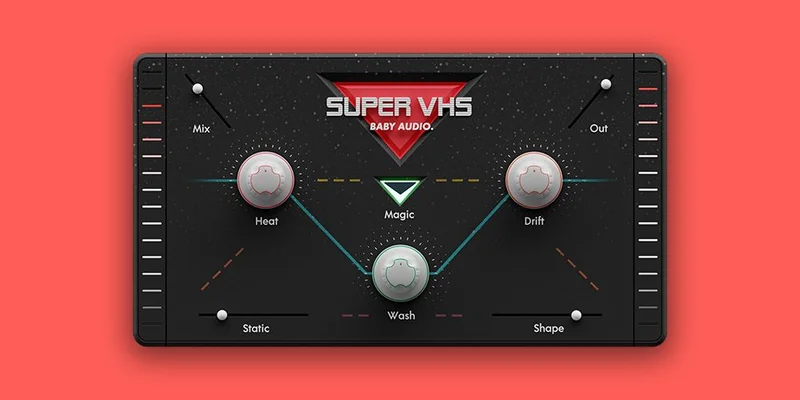
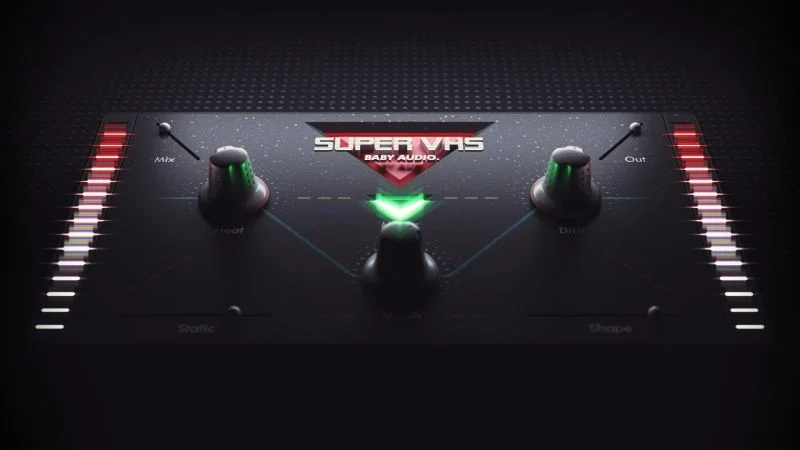
Super VHS contains six effects: STATIC, HEAT, SHAPE, MAGIC, DRIFT and WASH. Each one has a single knob, and each knob drives several parameters underneath.
Baby Audio says the plugin is like sending your sounds back in time to a worn-out VHS tape. They also say it isn’t one-size-fits-all, and that a little often goes a long way. We agree with that last part completely.
There’s a MIX control for wet/dry balance and an OUTPUT control for the global level. Under the hood there’s also a high shelf EQ attenuation, a bit-crusher and a limiter that you can’t see or adjust.
That hidden processing matters. It’s why owners report that the plugin reins in the high end and tightens the mids even with no knobs touched. More on that below.
STATIC: The Hum Generator
STATIC synthesizes hum from a pink noise oscillator mixed with a digital saw wave. It’s the first stage, and it’s the one people tend to ignore.
Don’t. Pink noise has equal energy per octave, so it sits as a soft wash across the whole spectrum instead of a thin hiss on top. The saw wave adds a pitched buzz underneath, like mains hum leaking into an old recording.
Push it lightly on a drum bus and the gaps between hits stop feeling like digital silence. That’s the whole trick. Silence in 1980s gear was never silent.
One knob, though. You can’t separate the noise from the hum or shape either one. If your project needs a specific hum frequency, you’ll want a dedicated tool.
HEAT: The Saturation Stage
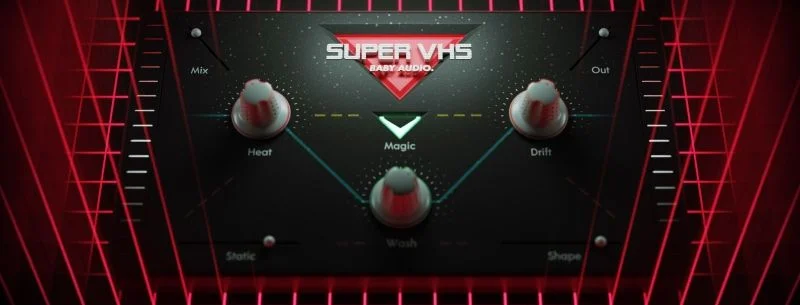
HEAT applies warm saturation inspired by consumer-grade tape machines from the early 1980s. Owners report it’s among the best saturation they’ve heard in a plugin dirt box. That’s a strong claim, and it’s the review quote we’d pull for the box.
What does “warm” mean here? Think of the high end rounding off and low-mid harmonics building up as you drive it harder. It thickens a thin sound instead of just making it louder.
Put it on a flat sampled piano and turn it up slowly. Somewhere in the first third of the knob, the piano goes from a recording of a piano to a record of a piano. That’s satisfying.
The limit is the same as everywhere else: one knob. You can’t pick the saturation curve or set where it bites.
SHAPE: The Sample Rate Reducer
SHAPE is a sample rate reducer inspired by 1980s 8-bit samplers. This is where Super VHS gets crunchy.
Lower sample rates fold high frequencies back down as aliasing, which gives that gritty, metallic edge you hear on old drum machines and early sampling keyboards. It’s the sound of hardware running out of room.
Here’s our biggest gripe. Owners report that the bitcrush comes on too strong at the first notch of the Shape slider, with an abrupt jump from normal to crunch. We find that annoying, and so do the people who’ve used it.
You want a subtle shave on a hi-hat. Instead you get a step. The transition isn’t smooth, and owners wish it were. If you mostly use SHAPE as a light touch, this will frustrate you. If you want full crunch, it’s fine.
MAGIC: The Juno-Style Chorus
MAGIC is a lush Juno-style chorus modeled with a darker and more detuned tone. “Lush” here means a doubled, slightly detuned copy swirling in the stereo field, and the darker voicing keeps it from sounding glassy.
Owners love the detuning. One reviewer calls it seriously satisfying and says it transforms audio loops for the better. We believe it. Chorus on a dull chord loop is one of the oldest cheap upgrades in production.
Drop it on a dusty keys loop and pull the knob up until the chord starts to lean sour. That slightly off-tune lean is the whole lofi aesthetic, and MAGIC gets there fast.
The wish list is short but real. Owners want more individual control over chorus intensity. Right now it’s one knob, and what you hear is what Baby Audio decided.
DRIFT: Pitch and Time Wobble
DRIFT uses an internal LFO to create pitch and time fluctuations. The range runs from natural to supernatural, according to the developer.
Natural is the useful end. A slight, slow pitch sway makes a loop feel like it’s playing off a stretched cassette. Push it further and you get seasick, warbling, out-of-tune weirdness that suits ambient and experimental work.
It’s a clever stage because pitch instability is the single biggest tell of old media. EQ and saturation can’t fake it.
We’d suggest keeping DRIFT low on anything melodic that has to sit against other instruments. Wobble on a lead is charming. Wobble on a bassline fighting a kick is a mix problem.
WASH: The Grainy Hall Reverb
WASH is a grainy, unnatural hall reverb inspired by VHS-era digital rack effects. It doesn’t try to sound like a real room. It sounds like a cheap 1980s rack unit doing its best.
That’s the point. Owners report that WASH brings really nice space to sounds. The grain keeps it from sounding polished, so it blends into the lofi texture instead of fighting it.
Send a snare through it and you get a tail that’s more smoke than echo. The tail is the thing: it hangs back and smudges the hit rather than extending it cleanly.
If you need a believable hall for an orchestral cue, this isn’t it. That’s not a flaw. It’s a different job.

What Happens With Every Knob at Zero?
Here’s the underrated bit. Owners report that even without touching any knobs, Super VHS reins in the high end and tightens the mids for a more workable sound.
That comes from the hidden processing: the high shelf attenuation, the bit-crusher and the limiter. So the plugin colors your signal the moment it’s inserted.
For lofi work, that’s helpful. A harsh sample gets a gentler top end automatically. For anything that needs to stay transparent, it’s a catch.
Don’t insert it as a “bypassed” placeholder and assume nothing changes. Your ears will tell you otherwise.
What Owners Report About Stability and Workflow
Not everything is smooth. Some users report audio going completely silent in FL Studio until the plugin was reloaded. That’s a real workflow snag, and if FL is your DAW, you should know it’s been reported.
Owners also report that Super VHS doesn’t work well as a bus effect for all instruments. The algorithms respond very differently to different sounds, which Baby Audio itself says. A setting that flatters a drum loop can wreck a bass.
Our advice: use it on individual sources and loops first. Print or bounce stems before you commit.
There are no presets, and control documentation is limited. You’ll learn by ear. For a six-knob plugin that’s manageable, but a few starting points would have saved time.
Strengths and Weaknesses
The strengths are real. HEAT is excellent by owner accounts. MAGIC’s detune is a joy. WASH adds space that suits the genre. And the whole chain is fast: six stages, one window.
The weaknesses are real too. One knob per effect means you can’t dial in. SHAPE jumps instead of gliding. There are no presets. The documentation is thin. And it isn’t a direct VHS tape emulator, so if you want a faithful head-and-tape simulation, this isn’t that.
Think of it as a lofi character box, not a restoration lab. It makes an opinionated sound and gets out of the way.
That’s a strength and a limit at once. Whether it’s a strength depends entirely on whether you like the opinion.
Value for the Price
At $69, Super VHS is a fair deal if you’d otherwise build this chain yourself. Six stages of lofi processing in one plugin, with a single MIX and OUTPUT, saves real time.
But “fair” isn’t “cheap,” and cheaper or free options exist. The VHS Audio Degradation Suite in Reaktor is free and offers more granular control. If you’re comfortable in Reaktor and want to tweak deeply, that’s a serious argument against paying.
Paying makes sense when speed matters more than depth. If you finish beats fast and want a sound in ten seconds, $69 buys that.
If you like to tweak every parameter, you’ll feel boxed in. Be honest about which producer you are.
Who Should (and Shouldn't) Buy This
✅ Buy if you make lofi, chillhop or retro-leaning beats and want a one-window shortcut to 1980s grit. ✅ Buy if you work with loops and samples that sound too clean and need instant character. ✅ Buy if you prefer fast, opinionated plugins over deep, fiddly ones.
❌ Skip if you need fine control over each stage, since every effect is one knob. ❌ Skip if you want a faithful VHS tape emulation, because this plugin isn’t one. ❌ Skip if you mostly work in FL Studio and can’t tolerate a reported silence bug that needs a plugin reload.
Specs & Technical Details
| Spec | Detail |
|---|---|
| Developer | Baby Audio |
| Price | $69 |
| Plugin Format | Mac: AU, VST, VST3, AAX. Windows: VST, VST3, AAX |
| OS Support | Mac (OS X 10.7 or later, 64-bit, Intel or M1 Apple Silicon) / Windows (Windows 7 or later, 32-bit or 64-bit) |
| Activation | Internet authorization required; Rent to Own and Beatport Studio memberships revalidate online every 30 days |
| CPU Usage | N/A |
| Trial Available | N/A |
| Version Reviewed | N/A |
Score Breakdown
| Category | Score | Notes |
|---|---|---|
| Sound Quality | 4.5/5 | HEAT and MAGIC earn strong owner praise; WASH fits the genre |
| Value for Money | 4.0/5 | Saves a six-plugin chain, but alternatives with more features exist |
| Ease of Use | 4.5/5 | One knob per stage, six stages, no menu diving |
| Features | 3.5/5 | Broad chain, but no presets and no fine control per effect |
| CPU Efficiency | N/A | No CPU figures to report, so we leave this unscored |
| Overall | 4.2/5 | A fast, characterful lofi box held back by blunt controls |
Alternatives to Consider
XLN Audio RC-20
RC-20 offers about ten times more features, according to the people who compare them. If you want depth, layered effects and more places to tweak, that’s the pick. It’s the opposite philosophy: more control, more time spent.
Chow Tape Model
Chow Tape Model provides closer VHS tape emulation. If your goal is a believable tape machine rather than a stylized 1980s lofi chain, start here. It’s a different job from Super VHS.
VHS Audio Degradation Suite in Reaktor
This one is free and offers more granular control. The catch is that you need Reaktor and the patience to use it. If budget is the issue, try it before you spend a cent.
Our Verdict
Buy Super VHS at $69 if you want 1980s lofi attitude in one window and you’d rather make music than build chains. HEAT, MAGIC and WASH earn their keep, and the plugin makes loops sound lived in within seconds.
Be ready for the rough edges: a harsh first notch on SHAPE, no presets, thin documentation, and a single knob per stage that caps how far you can push your own taste.
If you need precision, go to RC-20. If you need free, go to Reaktor. If you need fast, this is the one.
It’s a lofi shortcut, and it’s wrong for anyone who wants to build the sound themselves.
Related reviews: Narcotic · KSHMR Essentials Review
Frequently Asked Questions
Is Super VHS a true VHS tape emulator?
No. It's a six-stage lofi chain inspired by 1980s gear, including consumer tape machines, 8-bit samplers and VHS-era rack effects. If you want a closer tape emulation, Chow Tape Model is the one people compare it to.
What does Super VHS do with all the knobs at zero?
It still changes your sound. Owners report it reins in the high end and tightens the mids, thanks to hidden processing that includes a high shelf attenuation, a bit-crusher and a limiter. Don't treat it as transparent.
Does Super VHS work in FL Studio?
Yes, it's listed as compatible, but some users report audio going completely silent in FL Studio until the plugin is reloaded. Save your project before you rely on it in a session.
Does Super VHS need an internet connection?
Yes, for authorizing the software. If you use Rent to Own or a Beatport Studio membership, it also needs to connect to the internet every 30 days to validate.