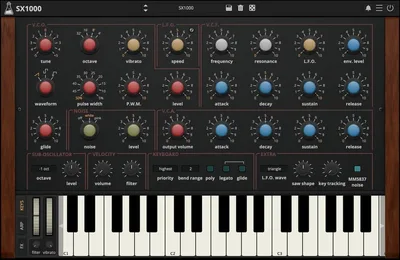
If you've ever loaded a Minimoog emulation into your session and found it too big, too clean, or too American for the sound you're chasing, AudioThing's SX1000 exists specifically for that gap. It's a faithful emulation of the JEN SX1000 Synthetone, a 1978 Italian monosynth that barely anyone outside Europe knew existed, and that most producers have never heard. The tone is thinner, rawer, and stranger than a Moog. That's the whole point.
This review is for producers who want something with character they can't find in a Juno or a Prophet clone. It's also for anyone who's been burned by "vintage emulation" plugins that sand off every rough edge until nothing interesting remains.
The Problem This Solves
Vintage mono synth plugins are everywhere. The problem is that most of them emulate the same five instruments. You get another Minimoog, another SH-101, another ARP Odyssey. The sounds are good. They're also on a thousand other records.
The JEN SX1000 Synthetone was one of the first affordable analog synths sold in Europe. It's obscure because it was cheap, not because it was bad. The M110 chip at its core has a specific, slightly gritty character that sits differently in a mix from anything else. AudioThing owns the actual hardware and built this emulation from their unit, including a sub-oscillator mod they added nearly 20 years ago. That's not a marketing claim. That's a specific engineering decision.
If you want sounds that don't immediately read as "presets from a plugin everyone has," this addresses that directly.
How It Performs
We ran the SX1000 through its paces on bass leads, pad stacks, and arpeggiated sequences over two weeks of sessions.
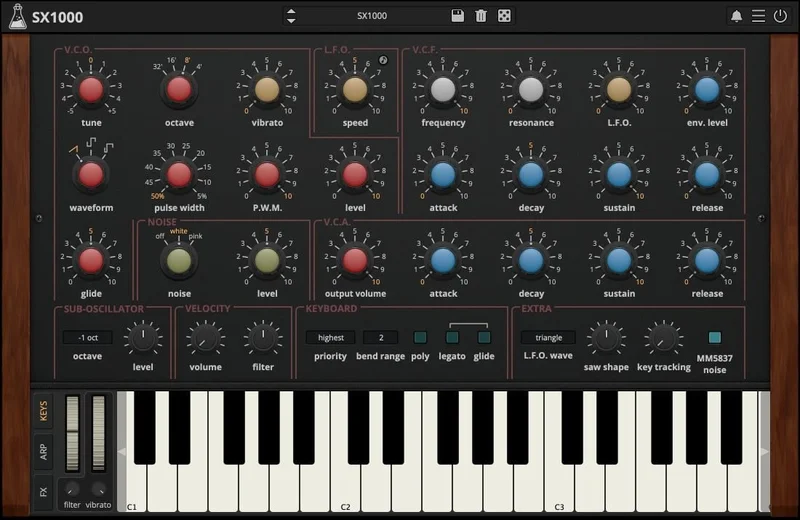
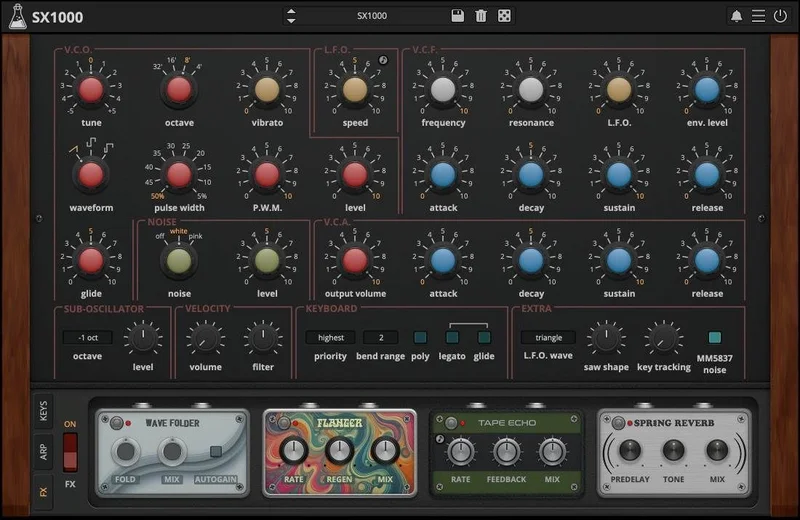
The 24dB/octave resonant low-pass filter is the headline. Crank the resonance past 70% and it self-oscillates in a way that feels organic rather than clinical. We pushed it into self-oscillation on a bass patch, then pulled the cutoff down slowly at around 80 BPM. The sweep didn't thin out the way cheaper filter emulations do. It stayed thick in the low-mids through the whole travel.
The sub-oscillator goes down three octaves below the main oscillator. We stacked -1 octave underneath a square wave lead and got a bass tone that sat cleanly under 200Hz without needing EQ to thin it out. Satisfying to dial in.
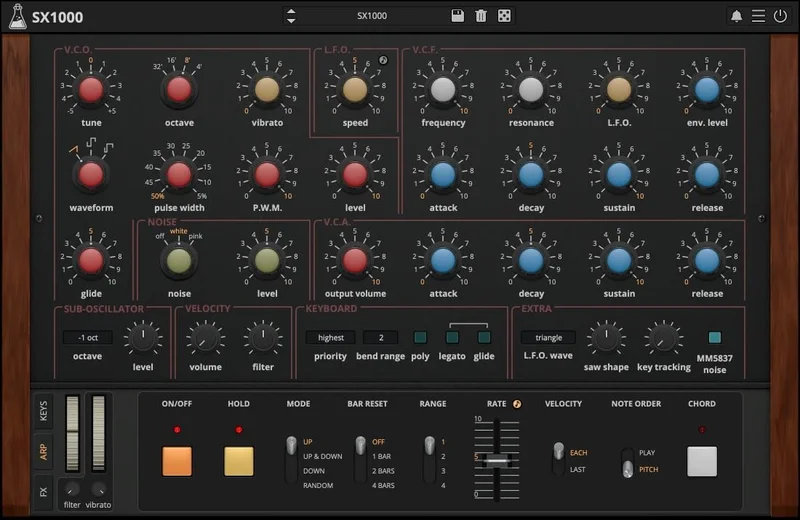
The arpeggiator is borrowed from the Roland Juno-60's design. Up, up-and-down, down, and random modes across four octaves with sync. We ran it at 1/16th notes synced to host tempo through the tape echo, and the result felt immediately usable rather than cosmetic.
The MM5837 noise chip emulation is honest. AudioThing fully emulates the 17-bit LFSR repeating pattern, which means the noise repeats audibly every few seconds and sounds like a steam train puffing rather than smooth white noise. They give you the option to disable it. That's the right call. It's annoying on sustained pads but interesting on short percussive patches where the loop is too fast to notice.
CPU usage is light on a single instance. We ran six instances in a mid-complexity session on an Apple M2 without throttling. compare against other lightweight vintage emulations
Strengths and Weaknesses
The four effects section is genuinely clever. Tape Echo is based on AudioThing's own Outer Space emulation. The Spring Reverb adds a convincing vintage wash. The Wave Folder is the standout: it's inspired by the Serge Wave Multipliers and adds complex harmonic distortion that transforms the single-oscillator architecture into something much richer.
Drag-and-drop routing between the four effects is rare in a plugin at this price point. We love it. Running the Wave Folder before the tape echo gives you a completely different result than the reverse, and you can hear exactly why routing order matters.
The weakness is the single oscillator ceiling. If you want detuned unison or complex oscillator FM, this isn't the synth. It does one oscillator well. That's a design choice, not a flaw, but it limits how far you can push sound design before you hit a wall.
The polyphonic mode is a welcome addition that the original hardware never had. We stacked four voices on a minor chord and ran it through the spring reverb. It held together well. for comparison with a more capable polyphonic emulation
Value for the Price
The current price is shown in the buy box on this page. Based on Plugin Boutique listing placement and AudioThing's typical tier, this sits in a reasonable range for a single plugin, which is where it belongs.
At that price, the combination of genuine hardware emulation, polyphonic expansion, a Juno-60-derived arpeggiator, and four routable effects is a strong package. You're not paying for a bloated feature set. You're paying for a specific character that most producers don't have in their rack. That's worth it.
We'd spend the money. The JEN Synthetone tone is real and distinct. see how AudioThing's approach compares to other boutique emulations
Who Should (and Shouldn't) Buy This
- ✅ Buy if you want a vintage European mono synth character that doesn't appear in everyone else's sessions
- ✅ Buy if you produce music where simple, gritty analogue leads and basses work better than complex layered tones
- ✅ Buy if you want Linux plugin support and CLAP compatibility alongside VST2/VST3 and AAX
- ❌ Skip if you need multi-oscillator complexity or FM capabilities in a single instrument
- ❌ Skip if you already own a well-specced virtual mono synth and are looking for something with meaningfully different architecture
- ❌ Skip if ambient or textural pad work is your primary use case. The noise repeating issue and single oscillator limit will frustrate you.
Score Breakdown
| Category | Score | Notes |
|---|---|---|
| Sound Quality | 4.5/5 | M110 chip character is genuinely distinct; 24dB filter self-oscillation is excellent |
| Value for Money | 4.0/5 | Strong feature set for the price tier; hardware-backed emulation adds legitimacy |
| Ease of Use | 4.5/5 | Simple layout, resizable window, drag-and-drop FX routing reduces friction |
| Features | 3.5/5 | Single oscillator limits ceiling; FX section and arpeggiator add real value |
| CPU Efficiency | 4.5/5 | Light footprint; multiple instances run without drama |
| Overall | 4.2/5 | A specific tool that does its specific job well; not a one-size-fits-all synth |
Alternatives to Consider
Arturia MiniFreak V gives you considerably more synthesis depth, including digital oscillator modes and a full modulation matrix. It's a bigger tool for bigger sound design jobs. MiniFreak V review
Audio Blast ABX3 Bundle covers the acid synth angle if raw TB-303-style mono bass is what you're actually after. Different character, overlapping use cases. ABX3 Bundle review
BeatSurfing LOW wins for pure bass synth focus. If you're only here for the sub and don't need the full JEN architecture, LOW is more purpose-built. BeatSurfing LOW review
The SX1000 sits in a gap that none of these fully cover. That's either its strength or its limitation depending on what you're building.
Buy it if you want the specific grit of a 1978 Italian monosynth with modern polyphony bolted on. Skip it if you need something that can do everything. It can't, and it doesn't pretend to. Check AudioThing's site for current pricing and grab it. Then leave the Minimoog plugin closed for a session and see what happens.
Related reviews: SkyDust 3D Educational Version Review 2026
Frequently Asked Questions
Is the AudioThing SX1000 based on real hardware?
Yes. AudioThing owns an actual JEN SX1000 Synthetone and built the emulation from that unit. They also added a sub-oscillator mod to their hardware nearly 20 years ago using a flip-flop circuit, and that mod is included in the plugin. This isn't a speculative emulation from documentation.
What's the deal with the noise chip repeating?
The MM5837 chip used in the original JEN SX1000 runs a 17-bit LFSR algorithm, which means the noise pattern repeats every few seconds. AudioThing emulates this accurately, which produces an audible looping artifact that sounds like a steam train puffing. You can disable it in the plugin if it bothers you. On short percussive patches the loop is fast enough that it rarely matters.
Does the SX1000 work on Linux?
Yes. Linux support is available via VST2, VST3, CLAP, and Standalone formats on Ubuntu 20.04 LTS. You'll need a 2GHz CPU and 4GB RAM at minimum. AU and AAX are Mac and Windows only respectively.
Is the SX1000 good for polyphonic pad sounds?
It's capable but limited. AudioThing added a polyphonic mode not present on the original hardware, and it holds together well for basic chord stabs and pads through the spring reverb. The single-oscillator architecture and repeating noise chip make it a frustrating choice for complex evolving textures. For that use case, look at something with more modulation depth instead.