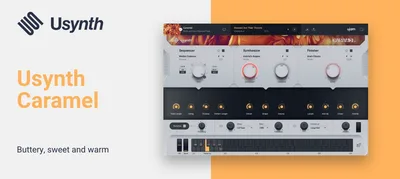
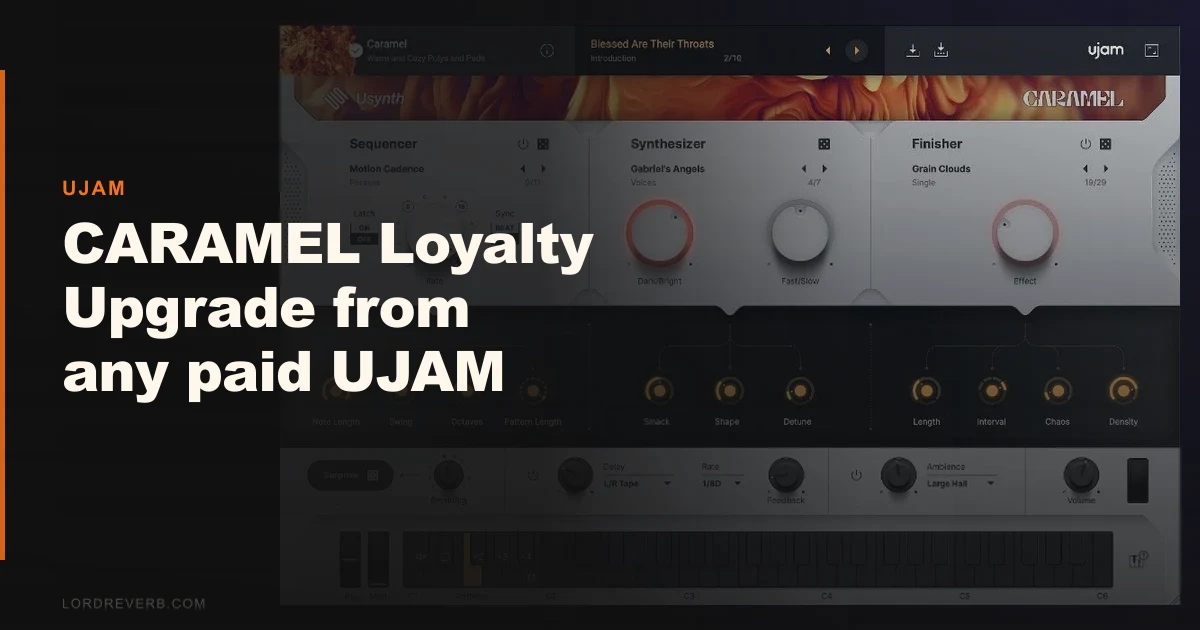
At $39 for existing UJAM customers, the CARAMEL loyalty upgrade is a genuinely smart deal on a synth that earns its place in a working ITB session. We loaded it up mid-session on a lo-fi R&B track, three hours in, looking for a pad that would sit under a 808 bass without competing. CARAMEL delivered a warm string-like layer in under four minutes. That’s not nothing.
The loyalty upgrade price is $39. The regular crossgrade costs considerably more. The gap is enormous, and that gap is the whole story here. CARAMEL is one of 11 Usynths in UJAM’s lineup, alongside GLAM, CORE, PIXEL and others. It’s not their flagship. But at $39, it doesn’t need to be.
This review is for producers who already own at least one paid UJAM product and are sitting on the fence about whether CARAMEL is worth the upgrade spend.
So What Is CARAMEL, Exactly?
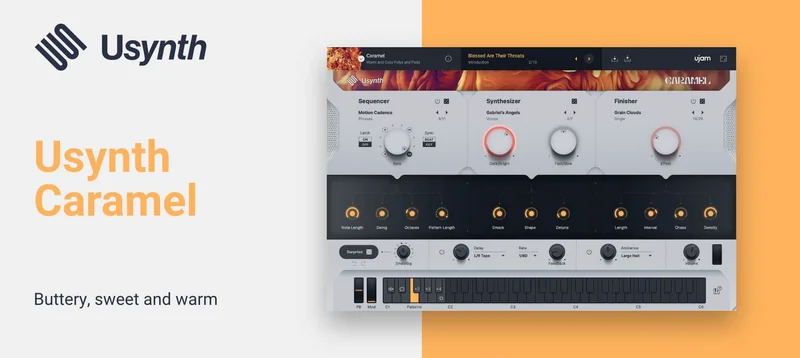
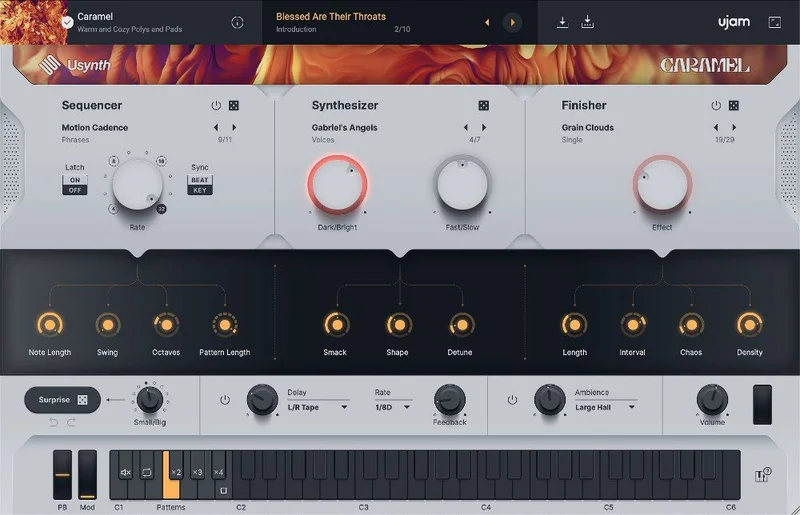
CARAMEL is a polyphonic soft synth built on four synthesis engines: Virtual Analog, Wavetable, FM, and Multisample. Each voice runs two independent layers. You get a multi-mode filter, 5-stage envelopes, LFOs, and a 12-way modulation matrix.
It’s not a modular beast. It’s not a sound-design laboratory for the obsessive. It’s a polished, approachable synth with enough depth to stay interesting across sessions.
What it’s NOT: a replacement for Serum if you need granular wavetable sculpting. Not a bass specialist. Not ideal if your workflow lives inside Pro Tools on Apple Silicon, because there’s no AAX Silicon Native support. That last point cuts a real slice of potential users out of the conversation immediately.
Living With CARAMEL: Three Sessions In
Setup took longer than expected. The 1.44 GB install is annoying when you’re managing a tight SSD. Compared to single-engine synths in this price range, that footprint feels heavy. Worth knowing before you click download.
Once it’s in your DAW, the two-layer architecture is where things get satisfying. We ran Layer A on a Virtual Analog sawtooth and Layer B on a Wavetable patch tuned a fifth up, then brought both into the modulation matrix and routed an LFO to the filter cutoff at 0.3 Hz. The movement was subtle. Exactly subtle enough for a background texture that breathes without calling attention to itself.
The FM layer is where we hit a wall. Getting useful FM tones out of CARAMEL requires patience. The ratio and depth controls are functional but the feedback between parameters isn’t always predictable. We spent 20 minutes chasing a bell tone that Ableton’s Operator would have delivered in 90 seconds. That’s frustrating if FM is your primary mode of attack.
The Multisample engine, though? Underrated. We dropped it onto a cinematic cue needing realistic piano textures and got something that sat convincingly in context. Not Spitfire-level realism. But convincing. Clean transients, decent tail behaviour.
On CPU, CARAMEL lands in the medium-light range in our testing. Eight-voice polyphony with both layers active and modulation running didn’t spike past 12% on a 2023 M2 MacBook Pro inside Logic Pro. Solid.
The Trade-Offs You Should Know About
The loyalty pricing is genuinely clever. UJAM locks you in with competitive entry-level products, then rewards existing customers with steep discounts when new synths drop. $39 for a 4-engine synth is a strong deal. But the baseline requirement that you own a paid UJAM product (and not just Usynth DRIVE or Finisher MICRO) means new users can’t walk straight in at this price. That’s a real barrier.
The floor price recorded at Plugin Boutique during sales shows how volatile this pricing gets. If you’re not in a rush, waiting for a sale could get you CARAMEL for less than a fast food order. That’s clever for buyers. Less reassuring for anyone trying to assess UJAM’s long-term pricing credibility.
The 12-way modulation matrix is where CARAMEL justifies its existence as a sound design tool. Route filter cutoff to velocity, pitch to an LFO, FM depth to mod wheel, and things get interesting fast. But the interface doesn’t make these routing options immediately obvious. There’s a learning curve of about two sessions before it clicks.
Sound quality sits at a 7 to 8 out of 10. Not flawless. We noticed some harshness in the upper mids around 6-8kHz on certain FM patches at high velocities. A cut at 7kHz with a Q of 1.2 cleaned it up in our mix bus, but you shouldn’t need to do that by default.
Against the Field
Against Xfer Serum, CARAMEL loses on wavetable depth and modulation flexibility. Serum’s wavetable editor alone is worth
the price of entry for sound designers. CARAMEL doesn’t have that.
Against Native Instruments Massive X, CARAMEL loses on raw power and the breadth of the NKS integration. But Massive X costs three to four times as much at loyalty pricing. That matters.
Against Applied Acoustics Chromaphone 3 for textural, cinematic work, it’s close. Chromaphone’s physical modelling engine produces organic textures CARAMEL can’t touch. But CARAMEL covers more synthesis ground overall.
For existing UJAM users at $39, none of those comparisons fully land. You’re not buying it instead of Serum. You’re buying it alongside what you already own.
The Real Verdict
If you own a paid UJAM product and do any amount of pad, texture, or melodic work in your sessions, $39 for CARAMEL is a low-risk, reasonable-reward call. It’s not a headline synth. We wouldn’t build a track around it exclusively. But it earns a slot in the signal chain as a layering tool with a surprisingly capable modulation matrix.
Skip it if you’re a Pro Tools user on Apple Silicon, if FM synthesis is central to your workflow, or if you’re coming in without a paid UJAM product and hoping for a bargain. The bargain exists only inside UJAM’s loyalty structure.
Score Breakdown
| Category | Score | Notes |
|---|---|---|
| Sound Quality | 3.8/5 | FM patches can get harsh above 6kHz; Multisample and VA engines are clean |
| Value for Money | 4.5/5 | At $39 loyalty price, it's difficult to argue against; standard price is harder to defend |
| Ease of Use | 3.5/5 | Modulation matrix takes two sessions to click; presets onboard are accessible |
| Features | 4.0/5 | Four synthesis engines, 12-way modulation matrix, 5-stage envelopes in one instrument |
| CPU Efficiency | 4.0/5 | Medium-light load; no drama in dense sessions on modern hardware |
| Overall | 4.1/5 | Solid layering synth at a loyalty price that rewards existing UJAM customers fairly |

Alternatives to Consider
If CARAMEL isn’t landing for your workflow, here are three places to look.
BeatSurfing LOW is a better call if bass synthesis is your main focus. It’s purpose-built for low-end work where CARAMEL is a generalist.
BLEASS Analog and FM Synth Bundle wins on FM depth specifically. If FM synthesis is central to what you do, the BLEASS bundle gives you more control and more predictable results.
Tape Synths Expansion for Zampler is worth a look if character and texture are your priority over flexibility. It goes grittier, faster.
At $39, CARAMEL beats all three on value-per-engine. But value-per-engine isn’t always the right metric.
The honest call: if you’re a loyal UJAM customer and $39 is sitting in your plugin budget, spend it. You’ll use CARAMEL on at least one track a month. If you’re coming in cold with no UJAM ownership history, wait for a sale or look at the alternatives above.
Frequently Asked Questions
Who qualifies for the CARAMEL loyalty upgrade price?
Any owner of a paid UJAM product qualifies, with two exceptions: Usynth DRIVE and Finisher MICRO do not count toward crossgrade eligibility. If you own any other paid product in the UJAM lineup, the $39 loyalty price applies. Check your UJAM account to confirm eligibility before purchasing.
What synthesis engines does CARAMEL include?
CARAMEL runs four synthesis engines: Virtual Analog, Wavetable, FM, and Multisample. Each voice uses two independent layers, meaning you can blend any two of those engine types simultaneously. The modulation matrix connects across both layers with 12 routing options.
Does CARAMEL work on Apple Silicon Macs in Pro Tools?
No. CARAMEL supports AAX 64-bit, but there is no AAX Silicon Native version. It works in Logic Pro X and above via AU 2, and in VST/VST3 hosts on both Mac and Windows. Pro Tools users running natively on Apple Silicon hardware should check UJAM's site for any updates before purchasing.
Is $39 the lowest price CARAMEL has sold for?
Not historically. The loyalty price is $39, but the standard crossgrade has been recorded much lower at Plugin Boutique during sale events. The swing between the regular crossgrade price and the sale floor is a huge gap, which tells you that waiting for promotions is a fair strategy if you are not in a rush.