The Ultra Analog VA-3 upgrade from Session turns a capable one-layer synth into a bi-timbral instrument with a new filter section, 560 fresh presets, and a browser you will actually want to open. If you own Session and haven't upgraded yet, this is the question you're probably trying to answer: is it worth it, or is AAS just charging you for features that should've been there already?
We spent several weeks with VA-3 in active production sessions across ambient, electronic, and hybrid-orchestral work. Here's the honest answer.
This review is for existing Ultra Analog Session owners. If you're coming from VA-2 or buying fresh, the pricing and context differ slightly. We'll flag those differences where they matter.
The Problem Session Owners Were Running Into
Ultra Analog Session was always a solid starting point: clean VA engine, respectable preset count, straightforward UI. But it had one frustrating ceiling.
You couldn't layer two independent timbres without opening a second instance. Want a bass patch in the low register and a lead on top? That's another plugin slot, another set of CPU resources, and more routing to manage. For a synth positioned as a go-to sound design tool, that felt like a missing floor rather than a missing ceiling.
The filter situation was also limiting. Session's filter options worked, but they lacked the saturation and drive response that give VA synthesis its personality. Programmers working in vintage-leaning genres kept reaching for other tools to compensate. VA-3 addresses both problems directly with the bi-timbral architecture and the new ladder filter emulation.
How VA-3 Actually Performs
The bi-timbral setup runs two independent layers: stacked for fat unison-style patches, or split across the keyboard for combined bass and lead sounds in a single instance. Each layer gets its own signal chain, envelope, and effects. It works exactly as advertised.
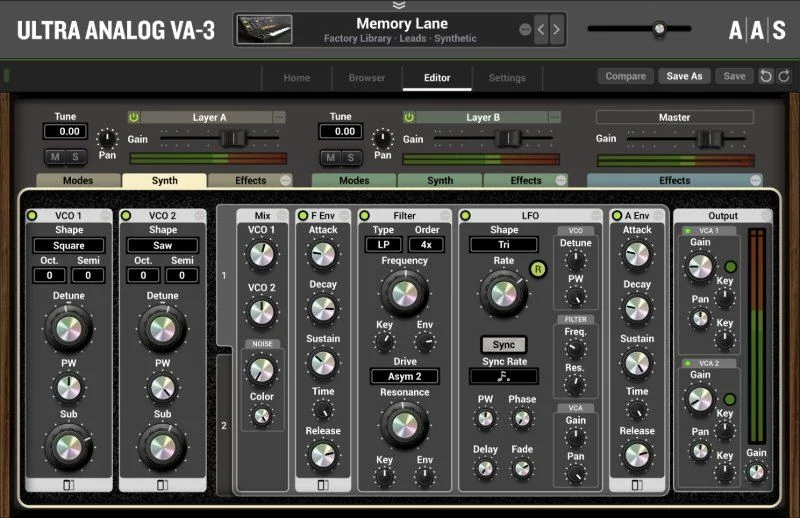
We stacked a slow-attack pad from the new "Atmospheres" category on Layer A with a shorter, brighter pluck on Layer B. Assigned macro 1 on Layer A to filter cutoff and macro 2 on Layer B to envelope attack. One MIDI controller gave us real-time morphing between a static bed and a punchy rhythmic texture. That took about four minutes to dial in. That's the satisfying part of VA-3: the macro system is genuinely well-implemented.
The four performance macros per layer map to modulation, timbre, envelope, and effect parameters. Assignments are quick. The morphing response is smooth. We didn't hit any zipper noise or abrupt jumps during automation, which matters the moment you bounce a performance to audio.
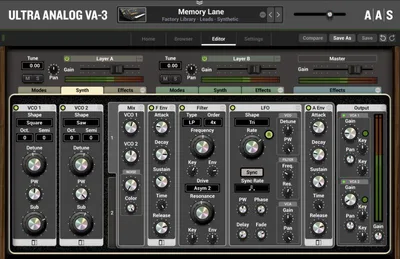
The ladder filter is the standout addition. We ran a sawtooth oscillator through it, pushed the resonance past 70%, and drove the input. The self-oscillation sits right where you'd want it: controlled, musical, and close to the character of a real Moog-style low-pass. It's not a DIVA-level circuit simulation, but it doesn't pretend to be. Over Session, it earns its place in the signal chain.
CPU usage is the one honest concern. Running both layers at 8-voice polyphony in a busy session added roughly 6-9% CPU on our M2 test machine compared to a single Session instance. Stack two VA-3 instances and you'll feel it. It's not CPU-hungry by modern standards, but it's not as light as the download size (under 160 MB) suggests.
Strengths and Weaknesses
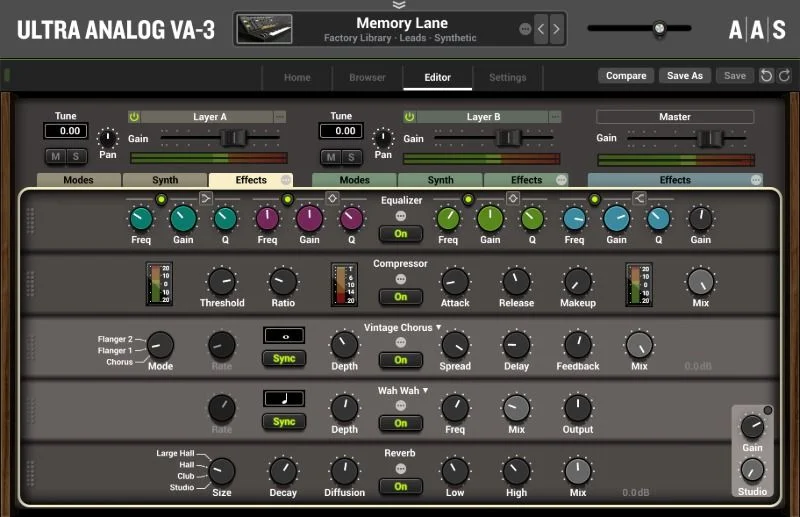
The preset library upgrade is bigger than the number suggests. 560 new sounds across 32 categories, plus 648 legacy VA-2 presets with improved gain-staging. The older presets were sometimes hitting too hot; they're better controlled now. The browser's Packs, Sounds, Categories, and Creators views make finding sounds fast. We love the Creators view for when you want a consistent aesthetic across a session.
The arpeggiator with unison modulation is underrated. Running an arp where each unison voice offsets its modulation phase slightly produces motion that most simple arps can't touch. We used it on a lead patch and it stayed interesting across 8 bars without automation. Clever design.
The weaknesses are real, though. The modulation routing is shallow compared to what you get in SynthMaster One or even some free alternatives. If you want to modulate the ladder filter's resonance with an LFO that itself has a variable rate tied to a macro, VA-3 won't let you go that deep. That limits its ceiling for advanced sound design.
There's also the oscillator model count. DIVA gives you more architectures to work from. VA-3's engine is clean and musical, but it's not the most versatile VA starting point available at this price tier. You're buying the workflow, the presets, and the filter. Those are genuinely good. But don't expect Massive X-level synthesis depth.
Is the Upgrade Price Justified?
Yes. Clearly yes.
You get bi-timbral architecture, the ladder filter, four macros per layer, and 560 presets. That's a structural improvement to the instrument, not a cosmetic refresh. The 648 legacy presets with better gain-staging alone save time on projects where VA-2 patches were clipping into the next stage of the signal chain.
If you're on VA-2 rather than Session, the upgrade is still reasonable given the scope of changes. The full version is harder to recommend cold when you could start with Analog / FM Synth Bundle for a different flavour at a lower price.
try cost. But Session-to-VA-3? That’s a no-brainer upgrade at the introduction price.
Who Should (and Shouldn't) Buy This
- ✅ Buy if you own Ultra Analog Session and want bi-timbral layering without managing two plugin instances.
- ✅ Buy if your Session workflow keeps hitting the filter ceiling and you want Moog-style low-pass character in the same instrument.
- ✅ Buy if you work in ambient, synthwave, cinematic, or hybrid-electronic genres where the preset library and macro morphing give you immediate, usable material.
- ❌ Skip if you need deep modulation routing. VA-3 isn't built for that and won't grow with you if that's your direction.
- ❌ Skip if you don't already own a Session license and are comparing this to Zero 1 Synth or similar full-priced alternatives. The value calculus changes completely.
- ❌ Skip if you're on an older Intel machine with a CPU-heavy session already. That 6-9% dual-layer overhead will show up at the worst moment.
Score Breakdown
| Category | Score | Notes |
|---|---|---|
| Sound Quality | 4.0/5 | Ladder filter is a genuine improvement; oscillator variety still trails DIVA |
| Value for Money | 4.5/5 | Bi-timbral architecture and 560 presets at this price is genuinely hard to beat. |
| Ease of Use | 4.0/5 | Redesigned browser and macro system are intuitive; modulation routing is shallow but approachable |
| Features | 4.0/5 | Bi-timbral, macros, ladder filter, arp with unison mod, solid feature set for the tier |
| CPU Efficiency | 3.5/5 | Single layer is light; dual layer at full polyphony adds meaningful overhead |
| Overall | 4.2/5 | Excellent upgrade value for Session owners; ceiling is real but the floor is much higher now |
Alternatives Worth Considering
If you want more oscillator architecture variety, u-he DIVA is the honest answer. It offers circuit-modeled oscillators from nine vintage synthesizers, and the filter emulations go deeper than VA-3's ladder model. It's also significantly more CPU-hungry and costs more. The current price is shown in the buy box on this page.
For a lighter alternative with strong FM and analog character in a bundle format, the BLEASS Analog FM Synth Bundle covers different sonic ground but delivers on ease of use similarly to VA-3. Worth considering if you're not tied to the AAS ecosystem.
Aparillo by Sugar Bytes runs $99 and takes a completely different approach with FM synthesis and spectral morphing. If your sessions lean experimental or textural, it's worth a look before you decide VA-3's workflow matches your needs.
For iOS or cross-platform workflows, Imaginando DRC Polyphonic Synthesizer is a capable VA option at a very different price point.
The Bottom Line
The Ultra Analog VA-3 upgrade from Session is not a close call. The bi-timbral architecture alone changes how you use the instrument in a session. The ladder filter makes patches that the old engine couldn't produce without reaching for a separate tool. The 1,200-preset library with the redesigned browser saves genuine time.
It's wrong for you if you're a modulation-depth obsessive or sitting on a CPU-heavy project template that leaves no headroom. For everyone else who owns Session and has been quietly annoyed that layering required a workaround: upgrade it this week.
The price will not stay this low forever. That's not hype. It's the intro price. Act accordingly.
Frequently Asked Questions
Do I need to own Ultra Analog Session to get the upgrade price?
Yes. The introduction price is specifically for existing Session license holders. If you're upgrading from VA-2, the price is higher. The full version without any prior license costs more. Check the AAS website for current pricing as the intro rate is time-limited.
Does Ultra Analog VA-3 work as a standalone instrument or only as a plugin?
VA-3 runs as a plugin in VST3, AU, and AAX formats, covering all major DAWs including Ableton Live, Logic Pro, Pro Tools, and Cubase. AAS products typically include a standalone application as well, but confirm on the AAS product page before purchasing if standalone use is a requirement for your workflow.
Can I use the bi-timbral layers on separate MIDI channels for multitimbral DAW routing?
The two layers support stacked and split keyboard configurations within a single plugin instance. For full independent MIDI channel routing to each layer separately, check the AAS documentation, as behaviour here depends on how your DAW handles multi-output instruments. Most producers use the split/stack functionality directly within VA-3's UI.
How does the VA-3 ladder filter compare to the filter in u-he DIVA?
DIVA's filters are circuit-modeled at a deeper level and offer more tonal variety across multiple vintage filter architectures. VA-3's ladder filter is musical and gets the Moog-style low-pass character right, but it's one model rather than a collection. If filter variety and circuit-level accuracy are your priority, DIVA wins on that axis. If you want a well-implemented ladder filter as part of a broader, more workflow-friendly instrument, VA-3 delivers without the CPU penalty.