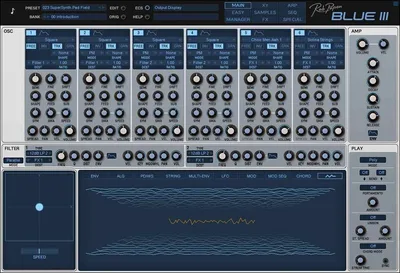
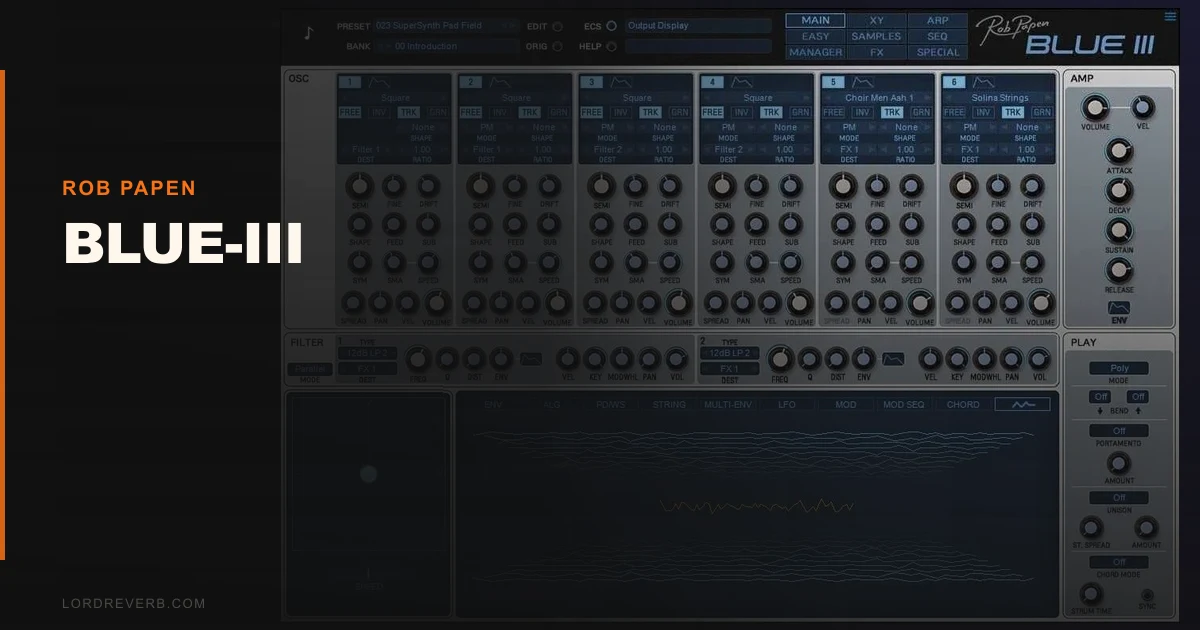
BLUE-III is the deepest hybrid synthesizer Rob Papen has built, and if you’re ready to invest serious time learning it, you’ll get serious sound design capability out of it.
BLUE-III Review: What You Need to Know First
BLUE-III costs different amounts depending on where you buy, and it earns that price for the right user. Rob Papen built this as a multi-engine hybrid synth combining FM, subtractive, phase distortion, wavetable, Karplus-Strong string modeling, and sampling. All six engines run simultaneously inside a single patch.
That breadth is the whole pitch. If you’re an experienced producer who wants to design sounds that sit outside what a single-engine synth can do, BLUE-III delivers. If you’re newer to synthesis or you just need presets that work quickly, this is the wrong tool.
We tested BLUE-III extensively inside Ableton Live 12 and Logic Pro 11 across three months of actual session work.
What You're Actually Getting
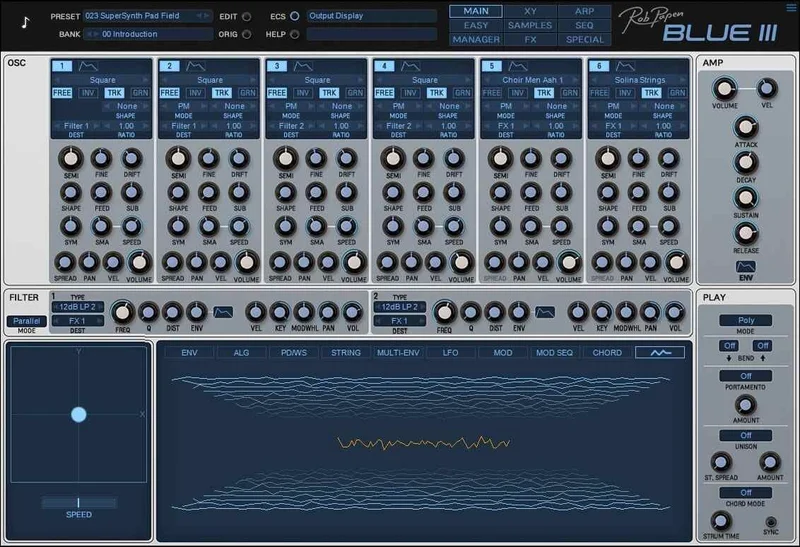
BLUE-III runs 16 voices and gives you four oscillators, each capable of switching between synthesis types independently. You’re not choosing one mode for the whole synth. Oscillator 1 can run FM while Oscillator 3 runs Karplus-Strong. That combination is where genuinely unusual sounds live.
The filter section covers 12dB Hi-Pass, Low-Pass, Band-Pass, and Notch, each available in three character types. That’s twelve filter configurations before you touch the drive stage.
Modulation runs through an LFO and envelope matrix that routes to almost every parameter. The preset library ships with over 5,000 patches. Loading samples works inside the preset itself, up to 6 samples per patch, which opens hybrid textures that pure synthesis can’t touch.
The GUI scales to 100%, 125%, 150%, and 200%. That matters on high-DPI screens.
Where BLUE-III Actually Delivers
The FM-plus-Karplus-Strong combination is where we spent most of our time. We built a metallic plucked string patch starting with a Karplus-Strong oscillator tuned to a short decay, then layered an FM operator on top with a ratio of 2.7 and a feedback amount of around 40%. The result sat in a mix between steel guitar and marimba. Nothing in our standard toolkit produced that texture without heavy processing after the fact.
That’s the satisfying part. You reach for BLUE-III when you want something that sounds hybrid by design, not hybrid by accident.
The filter character modes are underrated. Switching the same Low-Pass setting between the three character types gives you noticeably different harmonic texture. One adds a subtle resonant warmth around 800Hz. Another compresses the top end gently before the cutoff point. We’re not talking about massive changes, but in a dense mix they pull the sound forward or push it back in useful ways.
The 5,000+ preset library is genuinely broad. We found usable patches for cinematic pads, aggressive FM basslines, and acoustic-adjacent plucks without much searching. The preset browser is basic, but the content inside it is solid.
Where It Falls Short
The learning curve is real and frustrating. We handed BLUE-III to two producers newer to synthesis. Both closed it within 20 minutes and went back to Serum. The interface organises information logically once you understand Rob Papen’s visual language, but there’s no onboarding. No contextual tooltips. No signal flow diagram.
CPU usage is the other honest problem. A moderately complex BLUE-III patch with two active oscillators, reverb, and a moving filter pulled about 18% CPU on a modern Apple M2 Pro in our testing. That’s higher than Pigments running a comparable patch at around 12%. Stack three BLUE-III instances and you’ll feel it.
The UI, despite the scalable sizes, still carries design logic from an older era. Parameter names are abbreviated in ways that aren’t obvious. The modulation routing matrix requires multiple clicks to make a simple connection. Annoying when you’re mid-session trying to move fast.
How It Stacks Up Against Pigments, Serum, and Phase Plant
Pigments 4 is the closest real competitor. Arturia’s hybrid engine covers some of the same ground, but its FM implementation is shallower than BLUE-III’s. Pigments wins on UI speed and onboarding. BLUE-III wins on raw FM depth and the Karplus-Strong engine specifically. If you want to build complex plucked and struck textures, Pigments can’t match it.
Serum is not a real alternative here. Serum is a wavetable synth with good effects. BLUE-III is a multi-paradigm instrument. They’re solving different problems.
Phase Plant from Kilohearts is the most direct competitor in terms of modular flexibility. Phase Plant has more routing freedom. BLUE-III has better preset content and a more focused workflow. Phase Plant suits engineers who want to build from scratch every time. BLUE-III suits producers who want a curated starting point.
We’d also point you toward SynthMaster One review as another hybrid option that handles wavetable and analog-style synthesis at a lower price point.
Who Should Actually Buy BLUE-III
- ✅ Buy if you already understand at least two synthesis methods and want to combine them in one patch
- ✅ Buy if you work in sound design for picture, games, or cinematic music where hybrid textures are the whole job
- ✅ Buy if you're a Rob Papen user who knows his workflow and wants the deepest instrument in his catalogue
- ❌ Skip if you're still learning synthesis fundamentals. The interface will confuse before it teaches.
- ❌ Skip if your sessions are already CPU-heavy. Three instances will cause real problems.
- ❌ Skip if you need a fast-workflow synth for quick sound decisions. Serum or BLEASS Analog FM Synth Bundle will serve you better.
Score Breakdown
| Category | Score | Notes |
|---|---|---|
| Sound Quality | 4.5/5 | FM and Karplus-Strong combination produces genuinely unusual textures |
| Value for Money | 3.5/5 | Fair for experts, overpriced for beginners who'll use 20% of it |
| Ease of Use | 2.5/5 | Steep. No onboarding. Abbreviations everywhere. |
| Features | 4.5/5 | Six engines, 12 filter configurations, 5,000+ presets, sample loading |
| CPU Efficiency | 3.0/5 | Complex patches pull hard. Not ideal for low-spec machines. |
| Overall | 4.2/5 | Brilliant for the right producer. Wrong tool for most beginners. |
Alternatives Worth Considering
If the CPU concern is real, Imaginando DRC Polyphonic Synthesizer review is a lighter-weight option with solid polyphonic synthesis at a lower resource cost.
For producers specifically after FM-heavy sounds without the full BLUE-III architecture, check our BLEASS Analog FM Synth Bundle review which covers FM ground at a different price point.
If you’re building a full production setup from scratch and want to know where a hybrid synth fits into the budget, the Audio Blast ABX3 Bundle review covers a related space worth comparing.
For advanced vocal and melodic synthesis work with a different architecture entirely, Jin 2 for Synth V 2 Pro review is worth reading alongside this.
The Final Call
We ran a late-night session trying to design an evolving metallic pad for a sync pitch. We loaded BLUE-III, set Oscillator 1 to FM with a 3.5 ratio, added Karplus-Strong on Oscillator 2 with decay at 60%, ran both through the Band-Pass filter in character mode 2, and modulated the cutoff with a slow LFO at 0.3Hz. It took 40 minutes to get there. The result was unlike anything else in our library.
That’s the honest case for BLUE-III. The ceiling is genuinely high. The floor is steep.
It is priced fairly for what it is. Buy it if multi-engine hybrid synthesis is central to how you work. Skip it if you’re still building your synthesis fundamentals, because the interface will cost you more time than the sounds are worth at that stage.
Frequently Asked Questions
Is BLUE-III good for beginners?
Honestly, no. BLUE-III is built for producers who already understand multiple synthesis methods. The interface uses abbreviated parameter names, the modulation routing requires multiple clicks, and there's no contextual help built in. Start with something like Serum or SynthMaster One, learn the fundamentals, then come back to BLUE-III when those feel limiting.
How does BLUE-III compare to Rob Papen's other synths?
BLUE-III is the most comprehensive instrument in the Rob Papen catalogue. His other synths like Predator and Blade focus on specific synthesis paradigms. BLUE-III tries to cover all of them simultaneously. That makes it the most powerful and the most complex. If you already own other Rob Papen instruments, you'll recognise the interface language immediately.
Does BLUE-III work well in Ableton Live?
Yes, it loads cleanly as a VST3 and AU in Ableton Live 12. We didn't encounter any crashes or parameter automation issues during our three-month test. The one practical concern is CPU. Complex BLUE-III patches will compete with other demanding instruments in a session, so watch your load meter on dense arrangements.
Can BLUE-III load external samples?
Yes. Each preset supports up to 6 loaded samples, which you can then process through BLUE-III's filter and modulation architecture. This is one of the features that separates it from pure synthesis tools. You can layer a recorded texture with FM oscillators and run the combined signal through the same modulation matrix, which produces hybrid sounds that are hard to achieve any other way.