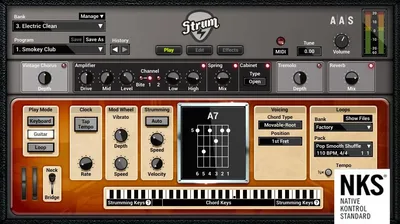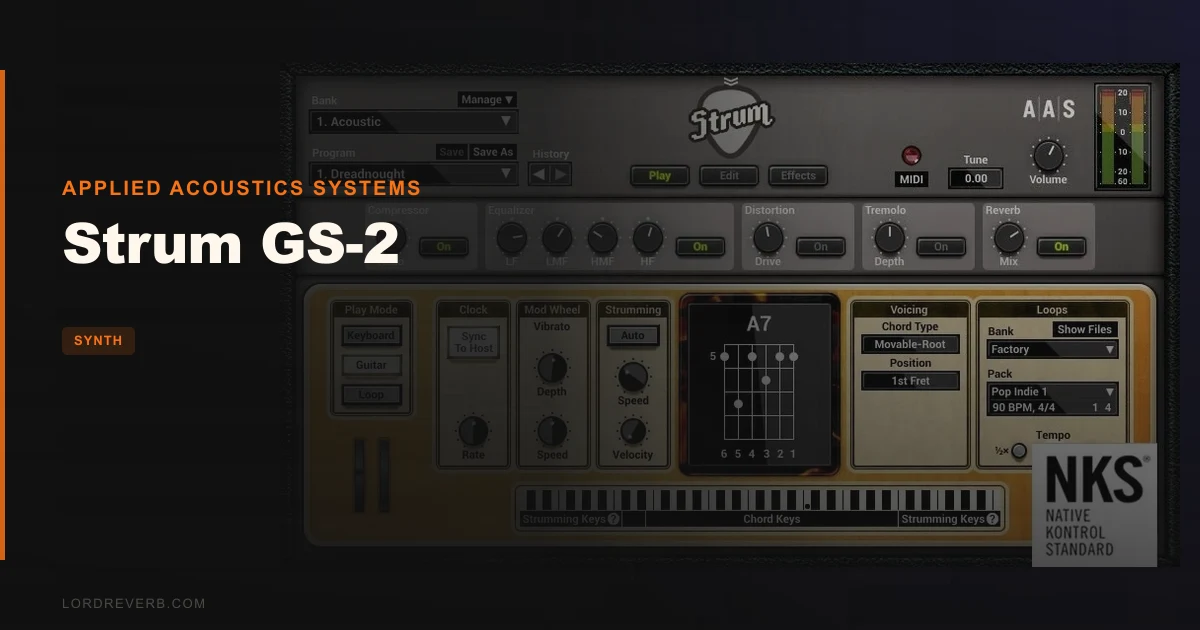
Strum GS-2 is most often stacked against sample-based guitar instruments like Native Instruments Session Guitarist, and here’s where we land: Strum GS-2 is the better tool for chord-based rhythm work, and the worse tool for convincing solo lines or lead guitar. That’s not a knock. That’s a scope definition you need before you spend $199.
Applied Acoustics Systems built this plugin around physical modeling, not samples. That means expressive, velocity-smooth chord strumming with almost no RAM overhead. It means you can design a guitar body and pickup combination from scratch. It also means the raw tone needs work before it sounds like something you’d hear on a record. We tested it across pop, folk, and indie rock sessions. Here’s exactly what we found.
How It Compares Out of the Box
Session Guitarist Electric Sunburst loads a Stratocaster and sounds immediately convincing on a solo track. Strum GS-2 loads a preset and sounds like a very good approximation of a guitar. There’s a difference, and isolated listening reveals it fast.
The modeling engine is genuinely clever. Physical modeling means the strings, bridge coupling, body resonance, and pick interaction are all computed in real time. No velocity layers switching between recorded samples. The dynamics feel smooth and natural when you’re playing chords.
But “natural” doesn’t mean “photorealistic.” Solo the guitar in your DAW on the first load and you’ll notice a slight plasticky quality to the attack, especially on electric presets. Blend it into a mix with some bass, drums, and keys, and it mostly disappears. That’s the pattern here: Strum GS-2 is a mix ingredient, not a showcase instrument.
Performance Deep Dive
The physical modeling architecture covers over 200 guitar configurations total, split across 63 acoustic presets, 40 acoustic experimental, 80 electric clean, 34 electric crunch, 25 electric distortion, and 11 electric DI options. That’s a real spread.
We loaded three instances simultaneously in Logic Pro at a 256-sample buffer. CPU usage was light, staying under 8% combined on an M2 MacBook Pro. The disk footprint is under 75MB installed. For context, Native Instruments Session Guitarist Electric Sunburst installs at around 2.6GB. That size difference matters if you’re on a tight drive.
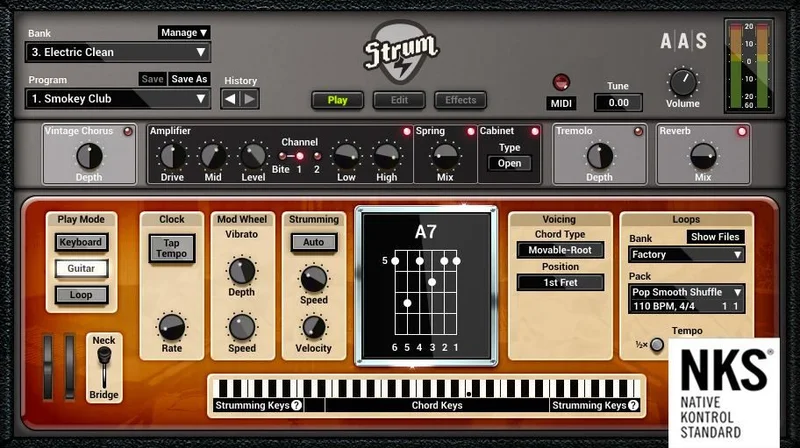
The chord recognition system handles 84 chord types, covering open, movable, and drop voicings. We played a Dm7 in root position on the keyboard and it voiced the chord across the fretboard the way an actual guitarist would play it. Not a piano chord spread across the keyboard. An actual guitar voicing with realistic string intervals. That system alone justifies serious attention.
The MIDI loop library runs 707 loops: 406 acoustic across 58 packs and 301 electric across 43 packs. Drag-and-drop to your DAW timeline works cleanly in Logic, Ableton, and Reaper. We spent about 20 minutes finding a fingerpicked acoustic pattern for a bridge section that would’ve taken a session player two takes. That’s satisfying.
We hit one frustrating snag. Pitch wheel slides and hammer-on articulations work well for lead melody lines, but switching between chord mode and keyboard lead mode mid-session required menu navigation we didn’t love. It broke the flow.
Where It Wins
The RAM and disk advantage is real. Under 256MB per instance versus gigabytes for sample-based competitors means you can run Strum GS-2 on a laptop session without thinking twice.
The chord voicing engine is the standout feature. We’ve used a lot of guitar plugins and most of them require you to manually input guitar-correct voicings or use proprietary chord editors. Strum GS-2 figures out the voicing from what you play on the keyboard. Play a C major triad in closed position and it voices an open C chord. Play an F major and it generates a correct barre chord shape. That’s brilliant for producers who know harmony but not fretboard theory.
The onboard effects are legitimately useful. The EQ and compressor handle most of the “get this guitar sitting in a mix” work without needing to stack third-party plugins. We cut around 200Hz by 3dB and added a touch of 5kHz air and the acoustic presets sat cleanly in a folk mix without muddying the low mids.
The body and pickup modeling is also underrated. Swapping from a single-coil configuration to a humbucker changes the harmonic response noticeably, with the humbucker pushing more upper-mid presence around 2-4kHz and smoothing the pick attack.
Where the Competition Wins
Sample-based plugins win on isolated realism. If you’re producing a track where the guitar is front and center in a sparse arrangement, Strum GS-2 will disappoint. The modeling artifacts become audible when there’s nothing else covering them.
We ran an A/B test: the same fingerpicked acoustic pattern in Strum GS-2 versus a comparable pattern in a sample-based alternative. In a full mix, we struggled to tell them apart. Soloed, the Strum GS-2 sounded like a plugin and the sample-based version sounded like a mic’d guitar. That gap matters depending on your production style.
NKS compatibility is listed, which is useful. But we wish AAS had moved to VST3 by now. The plugin still ships as VST2, which some DAWs are beginning to deprecate. That’s a workflow annoyance heading into 2027.
The interface is clean but not fast to learn. The three-panel layout (Play, Edit, FX) makes sense once you know it. Getting there takes a few sessions.
Who Should Buy Which
✅ Buy Strum GS-2 if you produce tracks with guitar rhythm beds and need chord progressions that sound guitarist-voiced without hiring anyone.
✅ Buy it if your sessions are disk and RAM constrained. Under 75MB installed is genuinely useful.
✅ Buy it if you want to design custom guitar tones from the body up, not just load samples.
❌ Skip it if your guitar parts need to hold up as the primary instrument in a sparse, isolated arrangement.
❌ Skip it if you’re already deep into a sample-based library workflow and switching modeling engines doesn’t appeal to you.
❌ Skip it if VST3 support is non-negotiable for your 2026 DAW setup.
Score Breakdown
| Category | Score | Notes |
|---|---|---|
| Sound Quality | 3.0/5 | Convincing in a mix, noticeably synthetic in isolation |
| Value for Money | 3.5/5 | $199 is fair if chord voicing and modeling fit your workflow |
| Ease of Use | 3.5/5 | Chord recognition is fast; mode-switching mid-session is clunky |
| Features | 4.0/5 | 707 MIDI loops, 84 chord types, body/pickup modeling, onboard FX chain |
| CPU Efficiency | 4.5/5 | Physical modeling costs almost nothing compared to sample-based competitors |
| Overall | 3.5/5 | Excellent rhythm guitar tool; not a sample-library replacement |
Alternatives to Consider
If the out-of-box realism gap bothers you, Native Instruments Session Guitarist series is the direct counter. The sample libraries are gigabytes larger but the isolated tone is more convincing. You lose the physical modeling flexibility and gain photorealism. Different trade.
If you’re already in the AAS ecosystem and want to explore what their physical modeling engine can do across other instrument types, Applied Acoustics Systems Chromaphone 3 sound bank review is worth reading before your next purchase. Same modeling DNA, different application.
For producers who want to expand what Strum GS-2 can do immediately, 95 presets for AAS Good Folks Strum GS-2 review covers a preset bank that meaningfully changes the first-load experience. We’d check that before building your own patches from scratch.
If you’re building out a broader plugin toolkit and Strum GS-2 is part of a bundle consideration, Audio Blast ABX3 bundle review covers a different approach to multi-instrument value that’s worth comparing on price-per-feature grounds.
The Bottom Line
Strum GS-2 is a rhythm guitar specialist that earns its place in a production toolkit, not as a guitar replacement, but as a guitar-adjacent composing tool. The chord voicing system is clever enough to change how you write progressions. The MIDI loop library is deep enough to shortcut a full afternoon of programming. The physical modeling runs light enough that you won’t think about it.
But you need to layer it. We found the sweet spot was blending Strum GS-2 at around 70% volume against a direct-recorded acoustic DI or even a simple guitar impulse response running in a separate reverb send. The modeling handled the rhythm and voicing. The IR handled the room. Together, they sounded like a session player. Separately, the Strum GS-2 track sounded like a plugin.
At $199, it’s the right buy for producers who work regularly with guitar parts and don’t play guitar themselves. It’s the wrong buy if you expect to solo the track and fool anyone.
Related reviews: Spacelab Review · Can M-Tron Pro IV Replace a Real Mellotron in 2026?
Frequently Asked Questions
Does Strum GS-2 work with Apple Silicon Macs?
Yes. Version 2.4.1 runs natively on Apple M1 and later processors under macOS 10.11 or higher. We tested it on an M2 MacBook Pro without Rosetta translation and had no stability issues across Logic Pro and Ableton Live sessions.
How many chords does Strum GS-2 recognize?
The chord library covers 84 chord types, including basic triads and extended chords, available in open, movable, and drop voicings. You play the chord on your keyboard and the plugin voices it as a guitarist would play it on a fretboard. It's one of the more convincing keyboard-to-guitar translation systems we've tested.
Is Strum GS-2 better than sample-based guitar plugins?
For rhythm parts and chord beds buried in a mix, it competes well and wins on CPU and disk footprint. For isolated lead guitar or sparse arrangements where the guitar is front and center, sample-based plugins sound more realistic. The honest answer is: use Strum GS-2 for writing and rhythm work, and consider a sample library if solo realism is critical.
Can you drag the MIDI loops directly into your DAW?
Yes. All 707 MIDI loops across acoustic and electric packs support drag-and-drop into the host DAW timeline. We confirmed this works in Logic Pro, Ableton Live, and Reaper. You can then edit the MIDI to fit your arrangement once it's in the timeline, which makes the loop library genuinely flexible rather than just a preset playback system.