Modular synthesis in software has a specific and annoying problem. You get either too little (a preset synth dressed up with patch cables that don’t really change anything) or too much (VCV Rack, which is brilliant and will eat your afternoon every time you open it). The middle ground, real modular architecture, polyphonic, playable, DAW-native, priced like a plugin, barely exists. Multiphonics CV-3 + Packs by Applied Acoustics Systems is the most serious answer to that problem we’ve tested.
This review is for producers and sound designers who already understand what a modular signal chain is, want 8-voice polyphony without a Eurorack mortgage, and need something that fits inside their DAW session without a separate runtime environment.
The Problem Modular Software Usually Fails to Solve
Most “modular” plugins fake it. They give you a routing matrix or a handful of modulators, but the synthesis core is still fixed underneath. You can move things around, but you can’t rebuild them.
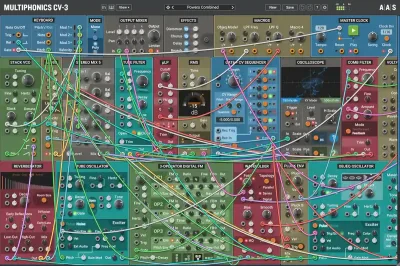
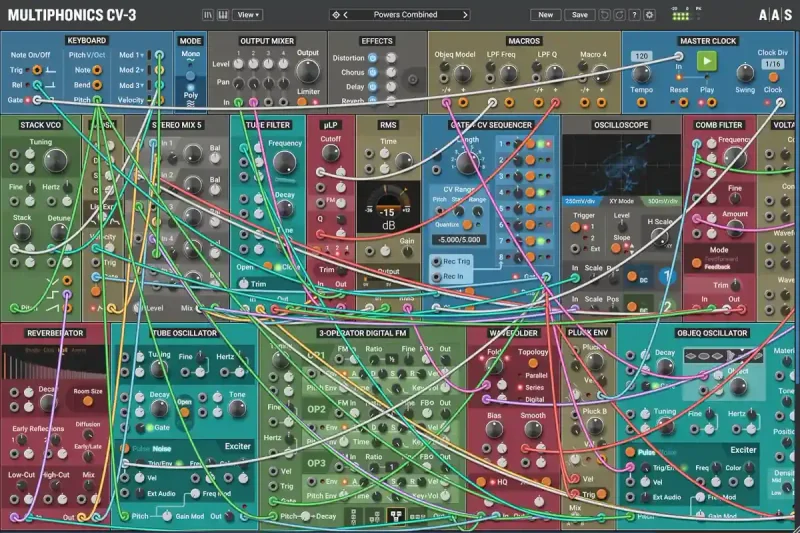
CV-3 doesn’t fake it. You’re building from actual modules: oscillators, filters, envelopes, LFOs, effects, routing utilities. The patching is drag-and-drop inside the plugin window. What separates it from VCV Rack isn’t depth, it’s integration. CV-3 loads as a VST3, AU, or AAX plugin. Your patch saves with your session. Your automation lanes work. Your CPU budget is predictable.
The polyphony is the real differentiator. Eight voices, full MPE. That combination is hard to argue with.
How CV-3 Actually Performs in a Session
We built a patch from scratch: Objeq Oscillator into a resonant filter, modulated by a slow-moving LFO tied to MPE pressure data, with reverb on a send. On a single voice, CPU sat around 4% on an Apple M2 Pro in Logic Pro at 256 samples. Scaled to 8 voices with a complex effects chain, we saw that climb to 18-22%. Not light, but not catastrophic. Compare that to u-he Bazille, which hits similar numbers on complex patches.
The Objeq Oscillator is the star. It models resonant objects, plates, strings, tubes, with physical accuracy. We played a slow chord through it with 800ms of release. The result had harmonic decay patterns you don’t get from a wavetable or analog-modeled oscillator. Satisfying in a way that’s hard to fake.
The 3.1 update added 4 modules: FM Core Operator, REZ oscillator, a dedicated FM envelope generator, and a spectrum analyzer. The FM Core Operator stacks cleanly. We built a 4-operator FM patch in about 15 minutes using the module guides. That’s fast for FM from scratch.
The spectrum analyzer isn’t glamorous, but it’s clever. You patch it inline and watch your harmonic content change in real time as you adjust the FM ratio. We found it genuinely useful for dialing in the second partial without guessing.
Strengths and Weaknesses
The sound quality is the clearest strength. Physical modeling oscillators produce movement that static waveforms don’t. A bowed-string patch we loaded from the included library had micro-pitch variations across the 8 voices that made a simple pad feel like an ensemble. That’s the Chromaphone DNA showing.
The included patch library is better than we expected. The 3 packs cover different design territories. Some patches are deep sound design. Some are playable performance patches. Quality is consistent. We’d estimate 60-70% are directly usable without editing.
The weaknesses are real. The interface is overwhelming at first. We counted 47 available module types in the browser. There’s no “simple mode.” New users will spend an hour reading documentation before they build anything useful. The module guides help, but they don’t replace experience.
CPU under heavy polyphony is worth watching. A fully loaded 8-voice patch with 3 effects modules pushed us to 26% on a single instance. Stack two instances and you’re thinking about bouncing.
No standalone mode is annoying. You need a DAW open to hear anything.
Value for the Price
The CV-3 + Packs bundle price is defensible. You’re getting a modular synthesis environment, physical modeling oscillators that would cost you separately if you bought Chromaphone 3 (check our Chromaphone 3 sound bank review for context on what AAS physical modeling sounds like), FM modules, MPE support, and 100+ professional patches.
The launch price during that period was aggressive value. It is still fair for what is here. Upgrading from CV-1 or CV-2 at the upgrade price is an easy yes.
Who Should and Shouldn't Buy This
✅ Buy if you already understand signal flow and want polyphonic modular synthesis inside your DAW without managing a separate environment.
✅ Buy if you make music where texture and harmonic complexity matter more than instant playability, ambient, cinematic, experimental electronic.
✅ Buy if you’re upgrading from CV-1 or CV-2. Seventy-nine dollars for polyphony and the FM update is a straightforward call.
❌ Skip if you’re new to synthesis. You’ll hate it inside an hour and blame the plugin.
❌ Skip if you need a standalone instrument for live performance. This requires a DAW host.
❌ Skip if CPU headroom is tight. Complex patches are hungry, and you’ll hit the ceiling before you’ve built your best patch.
Score Breakdown
| Category | Score | Notes |
|---|---|---|
| Sound Quality | 4.5/5 | Physical modeling oscillators produce harmonic complexity that most plugin synths can't replicate |
| Value for Money | 4.0/5 | The full bundle price is fair and the upgrade is an easy decision for existing users. |
| Ease of Use | 3.5/5 | Module guides help, but 47 module types with no simplified entry point is a genuine barrier |
| Features | 4.5/5 | 8-voice polyphony, MPE, FM modules, physical modeling, and a solid patch library in one plugin |
| CPU Efficiency | 3.5/5 | Single-voice patches are fine; complex 8-voice configurations will tax mid-range systems |
| Overall | 4.3/5 | Best polyphonic modular plugin available at this price for users who already know what they're doing |
Alternatives to Consider
u-he Bazille is the closest direct competitor. It’s also a polyphonic modular plugin with deep patching. Bazille’s oscillators are more analog-focused. CV-3 wins on physical modeling textures. If you’re after classic FM or phase distortion tones rather than resonant-object sounds, Bazille is worth the comparison. Check current pricing at u-he’s site.
u-he ModulAir sits above both in terms of modular depth, closer to full Eurorack simulation. It’s also more expensive and more demanding on CPU. If CV-3 feels like it’s not deep enough six months from now, ModulAir is the upgrade path.
VCV Rack Pro is the free (or near-free) alternative for anyone who wants to go deeper into modular without the price tag. The trade-off is a separate runtime environment, no native AAX support, and a workflow that doesn’t save neatly inside your DAW session. We covered some of the synthesis territory that matters for making the choice between browser-based and DAW-integrated approaches in our Analog FM Synth Bundle review.
For producers more interested in bass synthesis territory than modular complexity, our LOW review covers a very different but complementary option. And if you’re thinking about sound design with looser hardware-adjacent textures, our Tape Synths Expansion review is worth your time.
Final Word
Multiphonics CV-3 + Packs is the best polyphonic modular plugin at this price. Not the easiest. Not the most instantly gratifying. The best, for producers who already understand what they’re asking it to do.
If that’s you, buy it. The 30-day trial removes the risk. If you’re still learning what an envelope generator does, this isn’t your next plugin.
Related reviews: Bit Zone Review 2026 · Chromaphone 3 Upgrade vs Staying on 1 or 2
Frequently Asked Questions
What's the difference between Multiphonics CV-3 and the CV-3 + Packs bundle?
The base CV-3 license includes the plugin itself and the built-in preset library. The CV-3 + Packs bundle adds 3 curated sound packs with 100+ additional patches from professional sound designers. The bundle makes the packs effectively free if you were going to buy the base plugin anyway. We'd recommend the bundle unless you plan to build exclusively from scratch.
Does Multiphonics CV-3 support MPE controllers?
Yes. CV-3 has full MPE support across all 8 voices. Pressure, slide, and per-note pitch data route into the modulation system just like any other CV source. If you're using a Roli Seaboard, Expressive E Osmose, or similar controller, CV-3 is one of the better plugin destinations available at this price point.
How steep is the learning curve on CV-3?
Steep enough to matter. Applied Acoustics Systems includes module guides inside the plugin, and reverse-engineering the included patches is a legitimate learning method. Expect to spend 3-5 hours before you're building patches you're happy with from scratch. If you have prior modular experience, you'll get there faster. If this is your first modular environment, budget more time and use the presets as your starting point.
Is Multiphonics CV-3 worth upgrading from CV-2?
At the upgrade price, yes. The 8-voice polyphony alone justifies it if you play chords or use MPE. The 3.1 FM update adds 4 modules that weren't available in CV-2, including the FM Core Operator and REZ oscillator, which open up a different category of sound design. If you're actively using CV-2, this isn't a minor update.