UVI Bit Zone earns its $79 asking price by doing one thing better than Diva, Omnisphere, or Sylenth1: capturing the exact character of a single, obscure analog polysynth from 1983 Italy and making it production-ready without apology. This isn't a general-purpose polysynth. It's a love letter to the Crumar Bit 99, and if that's what you need, nothing else comes close at this price. If you need a Swiss-army synth with deep modulation routing and complex synthesis from scratch, read on, because we'll tell you where it falls short too.
Bit Zone is built for producers working in synthwave, lo-fi, cinematic scoring, and any genre that wants that specific mid-'80s Italian DCO warmth: harmonically dense in the 200Hz to 2kHz band, with a natural filter rolloff that sits politely in a dense mix without needing surgical EQ. Beginners will love the presets. Sound designers will appreciate the raw waveform access. Everyone will appreciate the arpeggiator.
How It Compares Out of the Box
The first honest comparison is against u-he Diva. Diva is a synthesizer that models analog circuits virtually. Bit Zone samples a real Crumar Bit 99. Those are fundamentally different approaches, and the results sound different too.
We loaded a pad preset in Bit Zone alongside a comparable Diva Juno-60 model patch. Bit Zone's pad had that slightly rougher, thicker low-mid presence you get from CEM 3328 filters that Diva's smoother emulation softens out. Not better or worse. Different hardware DNA.
Against Sylenth1, Bit Zone wins on authenticity and loses on flexibility. Sylenth1 lets you build from scratch with full modulation. Bit Zone gives you a real instrument's character baked in from the start. Compared to Omnisphere, Bit Zone is a focused tool. a full library. Pick Omnisphere if you need everything. Pick Bit Zone if you need this.
Performance Deep Dive
Bit Zone is inspired by the Italian-born Crumar Bit 99, an obscure digitally-controlled 6-voice polyphonic analog synth released in competition to the popular 6-voice analog synths coming out of Japan at the time. That competitive spirit is baked into the recording methodology.
The Bit 99 was designed with 2 DCOs and 2 LFOs per-voice, per-voice CEM 3328 analog filters, and per-voice VCAs, making it exceptionally versatile. UVI didn't just sample the friendly presets. Sound designers pushed the instrument to its limits to create an impressive range of sounds, with both era-specific and contemporary styles in mind.
Every sample was recorded both with and without a hardware Yamaha SPX90 "Symphonic" chorus inline, allowing you to activate this defacto '80s effect at will in your own sound design. That dual-recording approach is brilliant. You're not running a chorus plugin over a dry sample. You're switching between two separate recordings of the hardware with and without that chorus circuit in the signal chain. The difference is audible, and it's satisfying in a way a plugin approximation just isn't.
UVI recorded over 29,000 samples from the Bit 99, packing Bit Zone with 370+ presets made from 160+ layers. More precisely: 29,568 samples, 378 presets, 168 layers. The library runs 16.02 GB in FLAC or 34.48 GB in WAV. Expect a 16.5 GB install minimum. That's the cost of the real thing.
CPU footprint on an M2 MacBook Pro sits light to moderate on a single instance. Stack four layered pads and you'll start to notice it, but we ran eight simultaneous instances in Ableton Live at 128-sample buffer without dropout. Comfortable for most sessions.
Where It Wins
The SPX90 dual-recording detail is where Bit Zone distances itself from every competitor in this specific niche. No other DCO polysynth emulation in this price range does this. You're not just getting a dry sample and a chorus knob. You're switching between two real recordings.
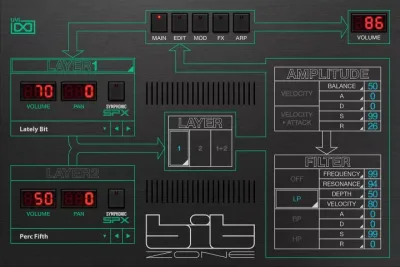
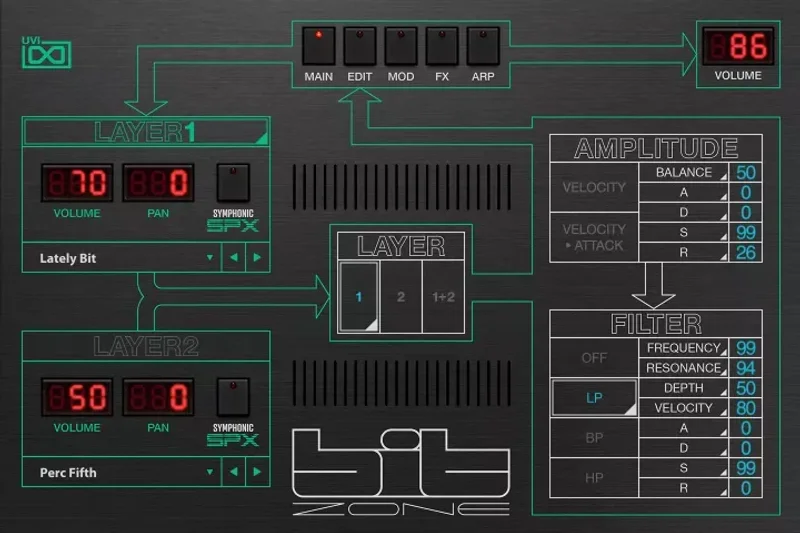
Bit Zone's aesthetic was adapted to closely follow the design cues of the hardware, giving you the feel of this uniquely styled instrument as you edit the dual-layer sounds including oscillators, envelopes, multimode filters, LFO and step modulator, dual arpeggiators and a featured effect section including EQ, drive, Thorus, ensemble, Phasor, delay, and Sparkverb.
We ran a 16-step arp sequence on the "Animated Arp" category patches. The dual arpeggiator locks rhythmically in ways that would take ten minutes of manual MIDI editing to replicate. It's one of those workflow moments where you stop tweaking and start writing music. We love that.
Patch categories include Animated Arp, Animated Chord Step, Animated One Key, Bass, Bells, Brass, FX, Keys, Leads, Organ, Pads, Pluck, Polysynth, Strings, and Winds. That's 15 categories. Raw waveforms from the Bit 99 are also available for those wanting to create from scratch. That's a real differentiator for sound designers who want to go beyond preset-browsing.
Where the Competition Wins
Diva wins on modulation depth. Full stop. Diva's mod matrix is a sound designer's playground. Bit Zone's LFO and step modulator are capable, but you're working within the constraints of what UVI baked into the UI. You can't freely route LFO to filter cutoff with a custom curve the way you'd want to in a complex patch build.
Omnisphere wins on breadth. If you need one synth to cover everything from Moog bass to orchestral pads to granular weirdness, Bit Zone can't compete. It does one thing.
The UVI Workstation dependency is also frustrating. This isn't a standalone VST you drop in and forget. You're loading inside UVI Workstation or Falcon. That's an extra step in your signal chain every time. Sylenth1 and Diva open directly in your DAW. Small thing. Annoying every time.
There's also no trial version. $79 blind. For most people that's manageable, but we wish UVI offered a demo period here, especially given the install size commitment upfront.
Who Should Buy Which
- ✅ Buy Bit Zone if you produce synthwave, lo-fi, or cinematic music and want the Crumar Bit 99's specific CEM 3328 filter character without buying aging Italian hardware.
- ✅ Buy Bit Zone if you're building '80s-adjacent productions and want the SPX90 Symphonic chorus already baked into your samples at the recording stage, not bolted on afterward.
- ✅ Buy Bit Zone if you want a solid, ready-to-use preset library you can drop into tracks immediately, with enough edit depth to make patches your own.
- ❌ Skip Bit Zone if you need deep, freeform modulation routing. Get Diva instead.
- ❌ Skip Bit Zone if you want one synth that covers every style and every synthesis method. Omnisphere is the honest answer.
- ❌ Skip Bit Zone if the UVI Workstation dependency breaks your workflow. This one's non-negotiable on UVI's end.
Score Breakdown
| Category | Score | Notes |
|---|---|---|
| Sound Quality | 4.8/5 | Real CEM 3328 filter recordings from actual hardware, about as honest as sampled synthesis gets |
| Value for Money | 4.5/5 | $79 for 29,568 samples and dual SPX90 recordings is objectively good value; no trial stings a little |
| Ease of Use | 4.5/5 | UI mirrors the hardware design logic; UVI Workstation dependency is the only friction |
| Features | 3.8/5 | Dual arpeggiator and step modulator are outstanding; modulation routing depth lags behind Diva |
| CPU Efficiency | 4.0/5 | Comfortable for most sessions; heavy layering on slower machines may need bouncing |
| Overall | 4.3/5 | A highly focused, brilliantly recorded vintage polysynth instrument that earns its price but asks you to accept its constraints |
Alternatives to Consider
u-he Diva is the choice if modulation depth matters more than specific hardware DNA. It models multiple classic analog circuits and gives you a full mod matrix. The current price is shown in the buy box on this page. See how Diva compares in our analog synth breakdown
Arturia Pigments sits in a similar price bracket and covers wavetable, analog, and granular synthesis in one package. Less focused than Bit Zone, more flexible. Read our broader synth plugin coverage
UVI Tape Synths is worth considering if the appeal here is captured hardware character. It applies the same philosophy to a different source. Tape Synths Expansion review
If you're building layered synth textures and want something closer to a preset workstation than a deep modular tool, also check out Chromaphone 3 for a very different but equally focused approach to sound design.
At $79, Bit Zone is an easy recommendation for anyone who specifically wants the Crumar Bit 99's sound and doesn't want to spend three weekends tracking one down in working condition. If you need a general-purpose polysynth for sound design from scratch with deep modulation, it's the wrong tool and you'll feel that frustration within an hour. Know what you're buying: it's a brilliantly executed archive of one underrated piece of Italian hardware, made playable for 2026 sessions. That's a real thing. It's worth $79 if that's the thing you need.
Frequently Asked Questions
Does Bit Zone require a physical iLok dongle?
No dongle required. You need a free iLok account for license activation, but the license runs on your machine without any USB hardware. An internet connection is needed for the initial activation step.
Can I run Bit Zone directly as a VST in my DAW without UVI Workstation?
No. Bit Zone runs inside UVI Workstation or UVI Falcon. Those hosts then load as plugins inside your DAW. It's an extra step compared to standalone plugins like Diva or Sylenth1. If that workflow bothers you, factor it in before buying.
How large is the Bit Zone install and what format are the samples?
You'll need at least 16.5 GB of disk space for the FLAC version. The library contains 29,568 samples recorded at 44.1 kHz. A WAV version runs 34.48 GB. Make sure your sample drive has room before you start the download.
Is Bit Zone useful outside of '80s production styles?
More than most people expect. The CEM 3328 filter character sits well in contemporary lo-fi, cinematic scoring, and modern synthpop. The dual arpeggiator works for any rhythmic genre. The "Animated One Key" category in particular produces textures that land cleanly in modern trailer and ambient contexts without sounding retro-kitsch.