If you own Chromaphone 1 or 2 and the $79 upgrade to Chromaphone 3 is on your radar, our answer is yes: pay it, don't overthink it.
The Moment We Knew This Upgrade Had a Point
We were programming a percussion bed last winter. Chromaphone 2 was open. We had a kalimba-style resonator sitting in the low-mids, and we wanted a pitched arpeggio riding over it without opening a second instrument track and routing everything through a bus.
We couldn't do it cleanly. Not in one instance.
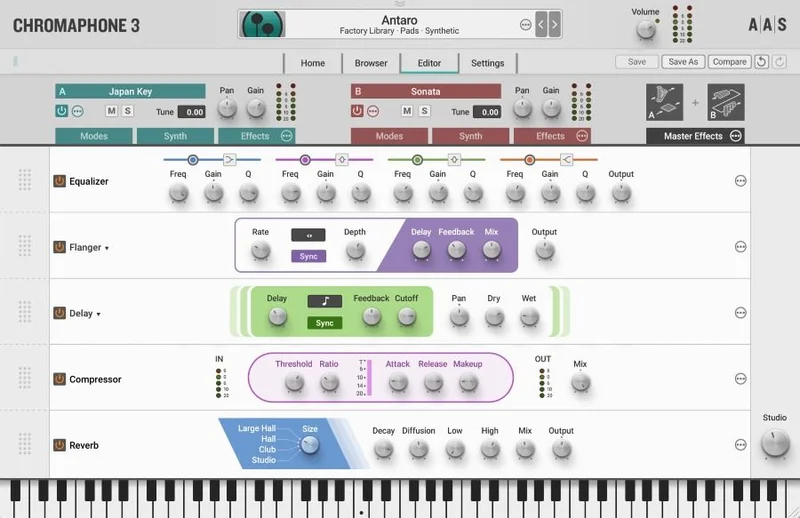
We opened Chromaphone 3 the next day and built exactly that patch in under eight minutes. Two independent synthesis engines, each with eight physically modeled acoustic resonators, each with its own effects chain, stacked in a single plugin slot. That was the moment the upgrade stopped feeling like a feature list and started feeling like a workflow fix.
This review is for Chromaphone owners sitting on version 1 or 2, weighing whether $79 moves the needle. It does. Here's why, and where it still falls short.
What It Is (and What It's Not)
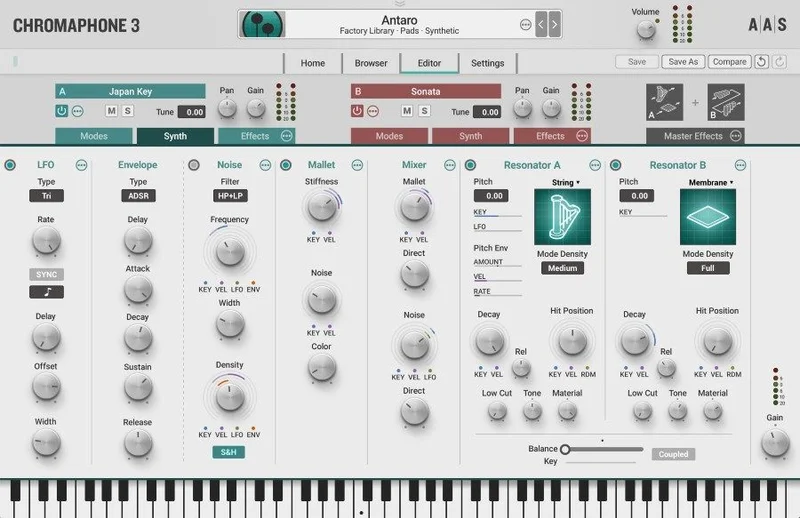
Chromaphone 3 is a physically modeled acoustic synthesizer. Applied Acoustics Systems models real resonating bodies: plates, strings, membranes, tubes, and beams. The sound engine hasn't been rebuilt from the ground up. It's the same physics-based DNA you already know.
What's new is structure. You now get two completely independent layers, each running its own resonator configuration and effects chain, plus a master effects chain sitting on top of both.
It's not a bread-and-butter subtractive synth. Don't reach for it when you want a classic Moog bass or a detuned supersaw lead. It's built for textural percussion, acoustic-hybrid sounds, plucked strings, mallet instruments, and layered tonal noise that's hard to get from oscillator-based synthesis. That's a specific lane, and it owns it.
Living With It
Setup took about four minutes. Authorization runs through AAS's license manager. No iLok dongle required, which we appreciate in 2026.
We tested in Logic Pro on an M2 Mac and in Ableton Live 12 on a Windows machine. Both installs were clean. NKS support worked correctly with our Komplete Kontrol S61 out of the box.
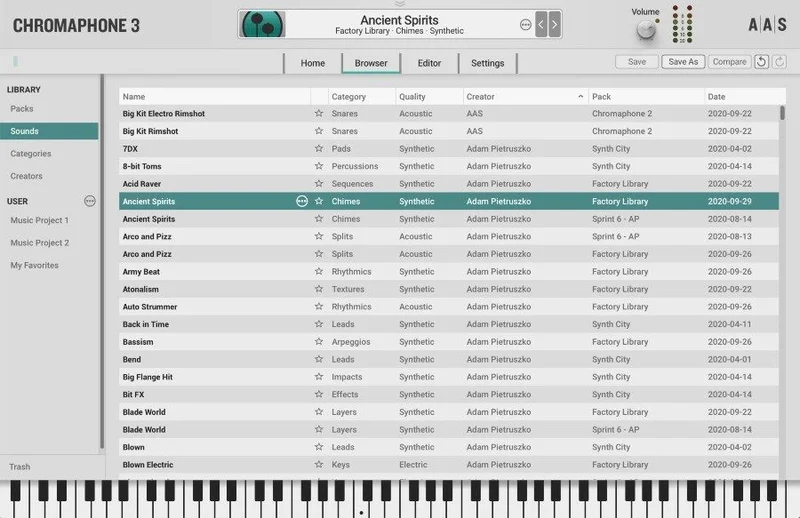
The redesigned browser is a real improvement. You can navigate by Packs, Sounds, Categories, or Creators. The 34 category tags span everything from arpeggios and percussion through leads, pads, keys, and effects. Browsing 1,097 presets sounds exhausting, but the filtering is fast enough that we found usable sounds within two minutes on most sessions.
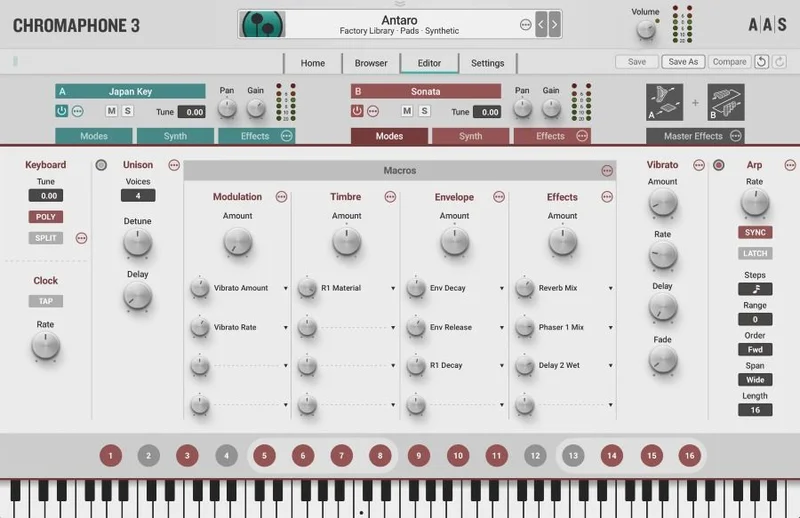
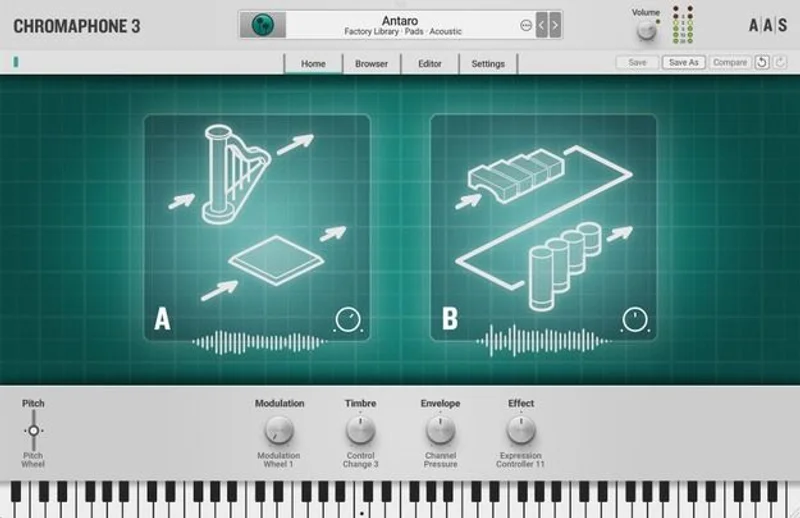
The four performance macros per layer are where we spent most of our time. Each macro can be mapped to timbre, modulation, envelope, or effect parameters. We assigned one macro to resonator damping and another to reverb wet mix on layer one, then ran both off a single MIDI expression pedal. Satisfying to dial in, and the results held up in the mix.
One quirk: patch loading occasionally hiccupped during complex modulation-heavy presets. Not a crash, but a half-second freeze that breaks session flow. Annoying. It happened three times across a week of testing. Not a dealbreaker, but we'd flag it.
The Home tab is essentially a splash screen. It does nothing useful. We wish AAS had used that space for quick-tip guidance or a signal flow diagram. It's the one part of the UI that feels unfinished.
The Trade-Offs
The multitimbral architecture is the headline feature, and it's legitimately useful. But it costs CPU. Running two fully loaded layers with per-layer reverb and a master compressor pushed our M2 Mac to roughly twice the CPU draw of a single Chromaphone 2 instance doing equivalent work.
That's a real consideration for laptop producers. On a modern desktop it's fine. On a 2019 MacBook Pro with a full session already open, you'll feel it.
The preset library expansion is harder to argue against. The 421 new sounds cover territory v2 didn't attempt, particularly in layered pitched percussion and drone textures. The 676 remastered v2 patches sound cleaner and sit better at unity gain. We tested a dozen of our saved v2 presets after migration, and all converted without issues.
Scala scale file support for microtonal work is a genuinely clever addition that the target audience will love and everyone else will ignore. If you work in non-Western tuning systems, this alone might justify the upgrade.
The missing MPE support is the frustrating gap. Chromaphone's physics-based engine would respond brilliantly to per-note pressure and slide. AAS hasn't implemented it. For now, you're working with standard MIDI.
Against the Field
The most direct competitor here is Native Instruments' Kontakt with a physical modeling library like Strum GS-2 or Reaktor Prism. Reaktor Prism is more experimental and CPU-heavier. Chromaphone 3 wins on immediacy and preset quality for acoustic-hybrid sounds.
Modartt Pianoteq 8 covers overlapping ground for keyboard-adjacent physical modeling, but it's purpose-built for piano and tuned percussion. Chromaphone 3 handles a much wider range of non-keyboard textures. Different tools for different jobs.
For the BLEASS Analog FM Synth Bundle, the comparison barely holds. FM synthesis and physical modeling serve different creative purposes. If you want classic electronic tones, FM wins. If you want acoustic-sounding hybrid textures, Chromaphone 3 isn't competing with FM, it's replacing a microphone and a resonating object.
At $79 for existing owners, nothing in this category offers more value for the specific sounds Chromaphone 3 makes well.
The Real Verdict
If you use Chromaphone regularly, pay the $79. The multitimbral architecture alone reconfigures how you build patches, and the preset library expansion gives you material to work with immediately.
If you're a Chromaphone 1 or 2 owner who barely opened it in the last two years, this upgrade won't change that. The core character is the same instrument. Chromaphone 3 makes active users more capable. It doesn't convert passive owners into regular users.
Hard pass for anyone not already in the AAS ecosystem. At its current price, better options exist for newcomers.
Score Breakdown
| Category | Score | Notes |
|---|---|---|
| Sound Quality | 4.5/5 | Physically modeled resonators produce textures that samples and subtractive synthesis can't replicate cleanly |
| Value for Money | 4.5/5 | $79 for existing owners is a fair price for the added architecture and library |
| Ease of Use | 3.5/5 | Browser is improved but deep modulation routing still requires time investment |
| Features | 4.0/5 | Multitimbral engine and dual effects chains are strong additions; MPE absence hurts |
| CPU Efficiency | 3.0/5 | Dual-layer instances with effects chains are genuinely heavy on older hardware |
| Overall | 4.2/5 | Excellent upgrade for active Chromaphone users; harder to recommend cold at full price |
Alternatives to Consider
If you want to stay inside physical modeling but explore a different sound palette, the Solids Chromaphone 3 Sound Bank is a smart next purchase after upgrading. It fills in the harder metallic and solid-body resonator territory that the factory library covers lightly.
For producers who work heavily with polyphonic synthesis and want something CPU-friendlier for melodic work, DRC Polyphonic Synthesizer covers electronic melodic territory without the physical modeling overhead. Different sonic character, but worth knowing about.
If your main use case is complex layered FM textures rather than acoustic modeling, BLEASS Analog FM Synth Bundle is the better $79 conversation to have with yourself.
The $79 upgrade to Chromaphone 3 is the easiest call we've made this year for existing AAS users. If you're not already in the Chromaphone family, start the free trial before committing to the full version. But if version 1 or 2 already lives in your signal chain, this upgrade makes it a better instrument. Pay it and spend the rest of your afternoon building something that sounds like a marimba hit a reverb tank at the bottom of the ocean.
Frequently Asked Questions
Can I upgrade directly from Chromaphone 1 to Chromaphone 3, or do I need to buy version 2 first?
You can upgrade directly from Chromaphone 1 to Chromaphone 3. AAS offers the $79 upgrade price to both version 1 and version 2 owners. You don't need to purchase version 2 as an intermediate step.
Will my Chromaphone 2 presets and patches transfer to Chromaphone 3?
Yes. Chromaphone 3 includes 676 remastered Chromaphone 2 presets as part of its factory library. Custom user patches you built in v2 should load without issues, though we'd recommend keeping your v2 installation until you've confirmed your most-used patches transfer cleanly.
Does Chromaphone 3 run as a standalone instrument or only as a plugin?
Chromaphone 3 runs both as a standalone application and as a plugin. It supports VST2, VST3, Audio Units, AAX Native, and NKS formats, covering all major DAWs including Logic, Ableton, Pro Tools, and Cubase.
Is the Chromaphone 3 upgrade worth it if I mostly use Chromaphone for simple single-resonator patches?
Honestly, it's a closer call if you're a light user who sticks to single-layer sounds. The sound engine hasn't fundamentally changed, so simple patches will sound very similar to v2. The multitimbral architecture and expanded preset library are the headline additions, and if you're not using either, the upgrade is nice but not urgent. Wait for a sale if that's your workflow.