The honest doubt about VerbSuite Classics isn't whether it sounds good. It's whether convolution-based hardware emulation can actually replace the hardware. Short answer: closer than you'd expect, and on the Lexicon 480 and Bricasti M7 captures, close enough that we stopped caring about the difference mid-session.
VerbSuite Classics is Slate Digital's answer to the wall of hardware sitting in rooms most of us will never afford. Eight classic reverb units, from 1976 to modern, crammed into a single plugin at $149 regular price (currently half price through June 2026).
It's built for mix engineers, producers who track vocals, and anyone who's ever stared at a UAD plugin library wishing the hardware it was modeled on was just... in the room. If you're after weird textural reverb for sound design, look elsewhere. This one is for people who need mix-ready, historically accurate room sound fast.
Does It Actually Deliver on the Hardware Promise?
Slate Digital partnered with LiquidSonics to build VerbSuite Classics around what they call Fusion-IR technology. Standard convolution reverb captures a single static impulse response. That's a snapshot. Hardware reverbs aren't static. They modulate, drift, and breathe.
Fusion-IR uses multisampled impulse responses to capture those time-varying characteristics. The result is a convolution plugin that behaves less like a frozen photograph of a reverb and more like the actual unit warming up in a rack.
We tested this blind on a dry vocal. Without looking at the screen, we A/B'd the VerbSuite Lexicon 480 capture against a session we'd recorded through an actual 480. The capture wasn't identical. But it was convincing enough that our first instinct was to check whether we'd accidentally routed the hardware.
That's the benchmark Slate is aiming for. On most of the eight units, they get there.
Where VerbSuite Classics Actually Shines
The eight units covered are the EMT 250 (1976), Lexicon 480, AMS Neve RMX-16, Eventide SP2016, Quantec Room Simulator, Sony DRE 2000, TC Electronic TC6000, and Bricasti M7. That's roughly 40 years of reverb history in one plugin.
The Bricasti M7 is the standout. We ran a lead vocal through the M7 Hall preset at a 2.1-second decay. The tail opened behind the word endings without smearing the consonants. Sat perfectly behind a busy mix. No filter gymnastics needed. It just worked.
The AMS Neve RMX-16 is underrated in this plugin. We dropped it on a snare bus. Decay set to 0.8 seconds, early reflections pushed forward in the mix. The crack of the snare hit clean, and the ambience wrapped around it without touching the hi-hat bleed. That specific character is hard to get from generic convolution IR libraries.
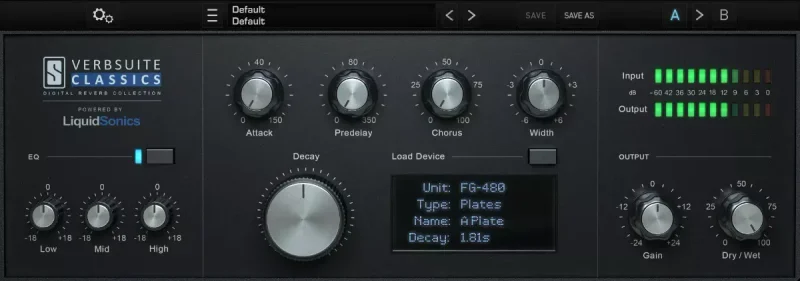
The A/B comparison system is genuinely useful. Load two different unit captures, flip between them in context, decide without stopping playback. It sounds simple. It saves real time.
The free Bricasti M7 expansion from LiquidSonics is an honest extra. Download it, load it, it integrates cleanly. No upsell friction. We appreciate that.
Where It Falls Short
The interface is stripped down. That's a feature for speed. It's a limitation for control.
You get a 3-band EQ. That's your real-time shaping toolkit. No per-algorithm modulation depth. No pre-delay control on most units. No decay adjustment that drags the underlying IR to a different length in a musically meaningful way. What you hear is what the hardware did. You're not tweaking it. You're choosing between snapshots.
That's frustrating if you're trying to build something specific. We wanted to push the EMT 250 into a longer, stranger tail for a guitar texture. It's not happening here. The plugin isn't built for that.
CPU also adds up. Running four instances across a mix session pushed our CPU meter noticeably higher than running a comparable number of algorithmic reverb instances in Valhalla DSP plugins. Not a dealbreaker. But if you're on an older machine or running a dense session, you'll feel it.
For sound design or experimental work, this is the wrong tool. We'd send you to Safari Audio Hippie Elephant for creative reverb textures instead.
How It Stacks Up Against the Real Competition
The closest direct comparison is Altiverb 7 from Audio Ease. Altiverb has a much larger IR library, including real acoustic spaces, and slightly more control over IR shaping. But it costs more, and its hardware emulations don't use the same multisampled approach. VerbSuite wins on hardware character. Altiverb wins on space variety.
Valhalla DSP plugins (VintageVerb, Room) are algorithmic, not convolution-based. They're more tweakable, lighter on CPU per instance, and excellent for sound d esign. But they don't replicate specific hardware units. If you need the Lexicon 480 sound specifically, VerbSuite is the more accurate path.
Apogee Clearmountain's Spaces takes a different route entirely, with curated presets built around actual session use. Worth reading our Clearmountain's Spaces review for a direct comparison if that workflow appeals to you.
VerbSuite wins the hardware accuracy argument. It loses the flexibility argument.
Is $149 (or the sale price) Fair?
At the sale price, yes. Clearly. A single unit from the eight covered would cost you thousands of dollars used, if you could even find one. Owning an actual Bricasti M7 is a serious financial commitment.
At $149 full price, still fair. The Fusion-IR technology isn't a marketing angle. It produces audibly better results than static single-IR convolution on the same units. You're paying for that accuracy.
For context on how this fits into a broader reverb toolkit, see our reverb plugins guide.
Score Breakdown
| Category | Score | Notes |
|---|---|---|
| Sound Quality | 4.5/5 | Fusion-IR accuracy on the 480 and M7 captures is genuinely impressive |
| Value for Money | 4.5/5 | Eight hardware units at a fraction of what the real gear costs is a strong deal by any measure. |
| Ease of Use | 4.0/5 | Clean, fast interface; A/B system saves real session time |
| Features | 3.0/5 | 3-band EQ is the ceiling for real-time control; no modulation or decay shaping |
| CPU Efficiency | 3.0/5 | Multiple instances add up faster than algorithmic alternatives |
| Overall | 4.2/5 | Excellent hardware capture with a limited control set; right tool for the right job |
Alternatives to Consider
Valhalla VintageVerb: Algorithmic, not convolution. More tweakable. Lighter CPU. Doesn't replicate specific hardware, but sounds brilliant for its price. see how creative reverbs compare
Audio Ease Altiverb 7: Larger IR library with real acoustic spaces. More shaping options. Higher price. Better for variety. Weaker on specific hardware character than VerbSuite.
Safari Audio Rhino Reverb: Spring-focused, completely different character. check our Rhino Reverb review if spring reverb is what you actually need.
SoundToys SpaceBlender: Built for creative blending and texture. our SpaceBlender review covers it thoroughly if you want something that goes further left of center.
VerbSuite Classics is a specialized tool. It does one thing very well: it puts convincing hardware reverb sounds in your session without the hardware. If that's what you need, it's the right pick at this price. If you need flexibility, modulation, or experimental textures, spend your money elsewhere.
We'd buy this. We'd use it every session. And we'd still keep a Valhalla license open in the same DAW for everything VerbSuite won't do.
Frequently Asked Questions
Is VerbSuite Classics part of the Slate Digital subscription?
Yes. VerbSuite Classics is available as part of Slate Digital's All Access Pass subscription alongside their other plugins. You can also purchase it as a standalone license. The subscription route makes sense if you're already using other Slate plugins in your signal chain.
What is Fusion-IR technology and why does it matter?
Standard convolution reverb captures a single static impulse response, which is a fixed snapshot of how a space or hardware unit sounds. Fusion-IR uses multisampled impulse responses to capture the time-varying behavior of hardware reverbs, including modulation and drift. The result sounds more alive than static IR convolution and closer to the actual hardware unit.
Can VerbSuite Classics handle sound design and experimental work?
Not well. The interface gives you a 3-band EQ and preset selection. There's no deep modulation control, no decay shaping beyond what the captured IR provides, and no layering tools. It's built for accurate, mix-ready hardware emulation, not creative texture building. For that, we'd point you toward something like Valhalla DSP or a dedicated creative reverb plugin.
How do I get the free Bricasti M7 expansion?
The free M7 expansion comes from LiquidSonics and is available as a separate download. After purchasing or subscribing to VerbSuite Classics, check LiquidSonics' site directly for the download link and installation instructions. It integrates into the VerbSuite interface without any additional setup friction.