
Will a plugin really sound like a spring tank, or is it a bright reverb with a vintage skin? Springer is worth a look at $129 if you want that dripping, wobbly character in the box, but you’re taking some of it on faith.
Here’s the catch. We found no independent reviews and no owner reports on how it behaves in a real mix. Everything we know comes from Antelope Audio’s own description and the control set.
That doesn’t make it bad. It makes it a bet.
If you make garage, surf rock or lo-fi music, the bet looks reasonable. If you want one reverb to cover vocals, drums and pads, look elsewhere.
Quick verdict
Springer scores 3.6 out of 5. It’s a focused spring-reverb plugin from Antelope Audio, and the control set suggests a tool built for shaping the spring itself, not just the tail. At $129, it’s a sensible pickup for guitar-heavy and lo-fi producers who already know they want this sound. The score stops short of 4 because we can’t point to a single independent verdict on how it sounds. If you need a do-everything reverb, skip it.
Does It Actually Deliver?
Springer is a native plugin for Mac and PC. No additional hardware required, which matters coming from a company with a hardware reputation.
The pitch: the true tone of spring reverb machines, plus control the original gear never gave you. Antelope also says it adds warmth and a lo-fi flavour to clinical production.
Those are claims, not measurements. We can’t tell you how the decay sounds on a snare or how the metallic chirp behaves on a transient.
What we can say is that the feature list backs up the ambition. It’s built around the spring, not around a generic reverb engine.
Where It Shines
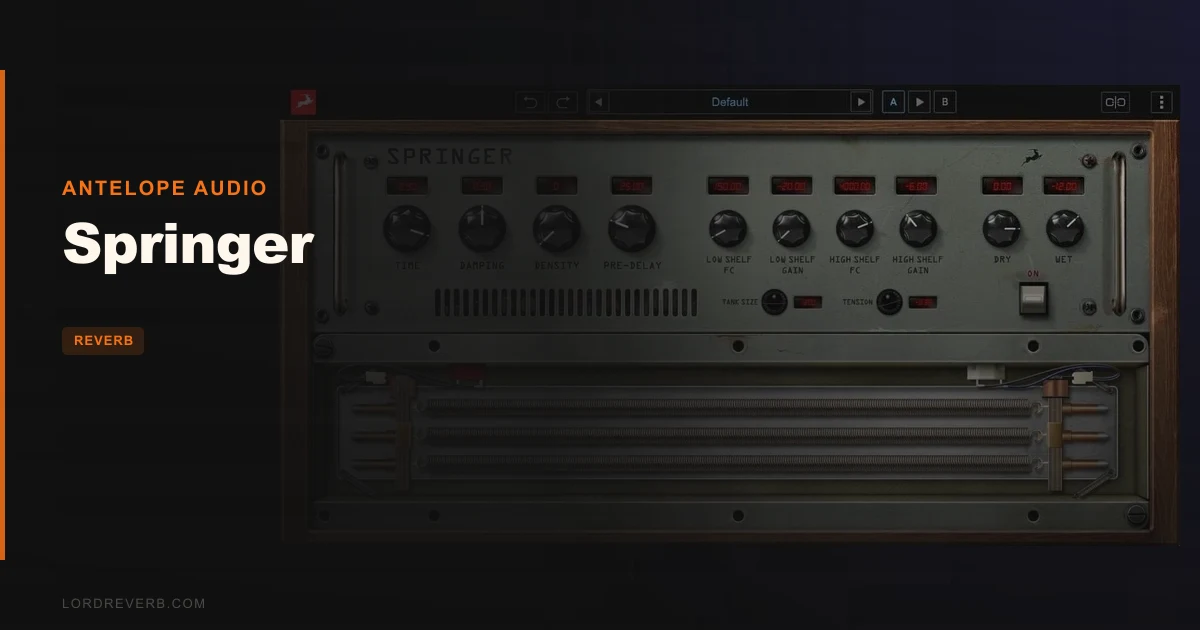
The spring controls are the draw. Tank size, tension and density sit alongside Pre-Delay, Damping and Tone. Most spring plugins hand you a decay knob and a mix knob. Here you can reshape the spring’s behaviour.
Picture a surf-style guitar that sounds flat in your mix. You push the tension and density until the splashy character appears, then pull Damping up to tame the top end before it fights your cymbals. That’s the kind of fix a deeper control set makes possible.
Antelope calls the controls deep but intuitive. We love that ambition, and we’d check it on your own material before trusting it.
The other win is scope. It’s aimed at garage, surf rock and lo-fi, and it says so. A plugin that knows its lane is easier to recommend than one pretending to cover everything.
Where It Falls Short
The biggest problem is the silence. No independent professional reviews exist, and we found no user commentary on sound or workflow. You can’t read a second opinion before you buy.
That’s frustrating at this price. A reverb lives or dies on how it sounds, and all we have is marketing copy.
It’s also narrow. A spring tank is a character effect. If your session needs a smooth hall on vocals and a tight room on drums, Springer won’t be that tool. Annoying if you wanted one purchase to do the lot.
And a deep control set cuts both ways. More knobs means more time dialling in before the sound clicks. We hate scrolling through presets hoping one fits, so expect to tweak.
Is the Price Fair?
At $129, Springer is priced as a specialist, not a bargain. That’s fair if spring character is central to your sound.
It’s harder to justify if you only reach for a spring reverb now and then. The unproven sound quality weighs on the price, too. Check for a demo before you commit.
Specs & Technical Details
| Spec | Detail |
|---|---|
| Developer | Antelope Audio |
| Price | $129 |
| Plugin Format | N/A |
| OS Support | Mac / Windows |
| Activation | N/A |
| CPU Usage | N/A |
| Trial Available | N/A |
| Version Reviewed | N/A |
Score Breakdown
| Category | Score | Notes |
|---|---|---|
| Sound Quality | 3.5/5 | Promising on paper, but unverified by independent review |
| Value for Money | 3.5/5 | Fair for a specialist, risky unheard |
| Ease of Use | 3.5/5 | Described as intuitive, but the control set is deep |
| Features | 4.0/5 | Tank size, tension, density, Pre-Delay, Damping, Tone |
| CPU Efficiency | N/A | No data available |
| Overall | 3.6/5 | A focused spring box worth auditioning, not buying blind |
Buy It or Skip It?
Buy Springer at $129 if spring reverb is part of your sound. Garage guitars, surf tones and lo-fi textures are exactly where it points. The spring-shaping controls give you room to go past what a hardware tank allows.
Skip it if you want one reverb for everything, or if you won’t spend money on a plugin nobody has reviewed yet. In that case, wait for a demo or for owners to start reporting back.
Right now it’s a good idea with a missing second opinion. Trust your ears, not the brochure.
Related reviews: Sparkverb Review 2026 · Neoverb Educational Version
Frequently Asked Questions
Does Springer need extra hardware?
No. It's a native plugin for Mac and PC, so you don't need any additional hardware to run it. It works inside your DAW like any other effect.
What can you adjust in Springer?
You get tank size, tension and density for the spring itself. You also get Pre-Delay, Damping and Tone for the usual reverb shaping. Together they let you change spring shape and behaviour.
What music is Springer built for?
Antelope Audio points it at garage, surf rock and lo-fi music. It also says Springer adds warmth and character to clinical productions. It's a character reverb, not a transparent one.
Are there independent reviews of Springer?
No independent professional reviews or user reports on its sound or workflow are publicly available. That's why the score stays cautious until independent verification emerges.