You're mid-session, three tracks deep into a mix, and you need a reverb that sounds good right now without opening a manual or burning a quarter of your CPU budget on a single instance. That problem is real, and most algorithmic reverbs don't solve it cleanly. UVI's Sparkverb does.
This is a plugin built for speed and feel, not for maximal technical complexity. The Version 1.5 redesign sharpened that focus considerably. At $79 standard pricing (or $39 when UVI runs one of its regular sales), it slots into a competitive bracket against Valhalla DSP and Waves algorithmic options. Whether it earns its seat at that table is what we're here to work out.
Sparkverb is for producers and mix engineers who want a creative, low-friction reverb they can open on a bus, get a result in under a minute, and leave running without babysitting their CPU meter.
The Specific Problem Sparkverb Was Built to Fix
Too many reverb plugins front-load the technical work. You open them, face a wall of parameters, and spend twenty minutes shaping a space before you've even auditioned whether the algorithm is right for the track.
That friction kills momentum. Fast sessions die in menu-diving.
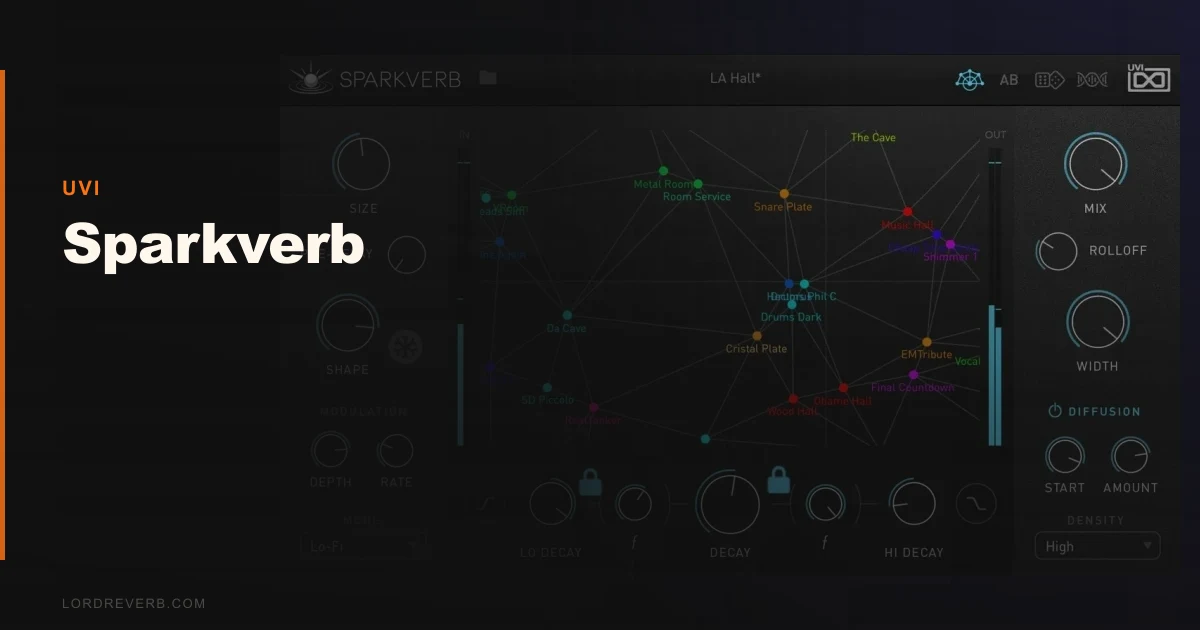
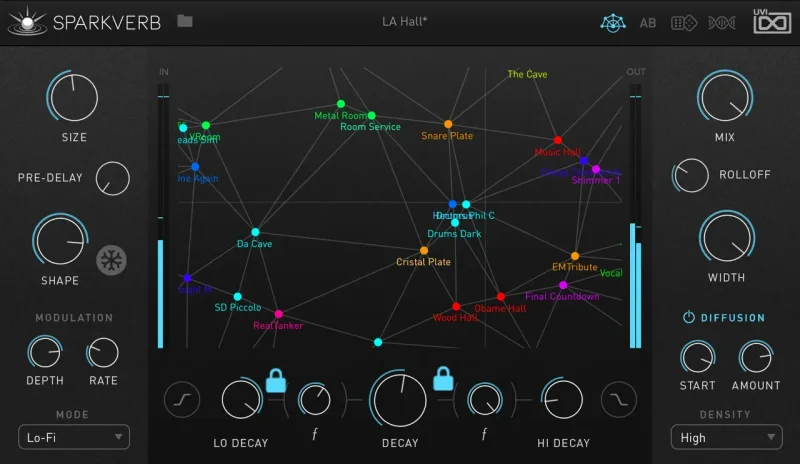
Sparkverb's answer is the Preset Voyager: a browser that displays presets as colour-coded dots on what looks like a star chart. You hover, you hear, you pick. There's no list-scrolling, no folder-diving. It's one of the more satisfying preset audition systems we've used, and it actually changes how you explore the plugin rather than just dressing up a standard dropdown.
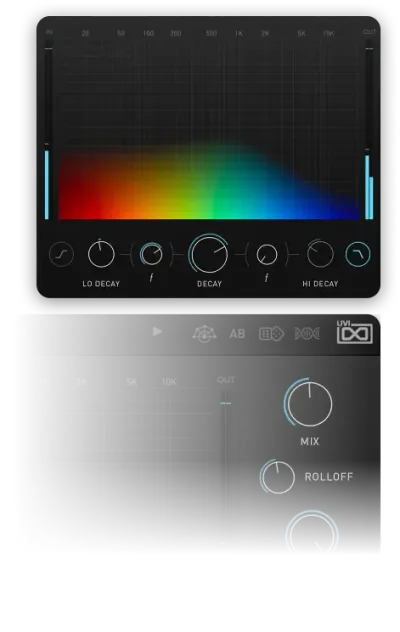
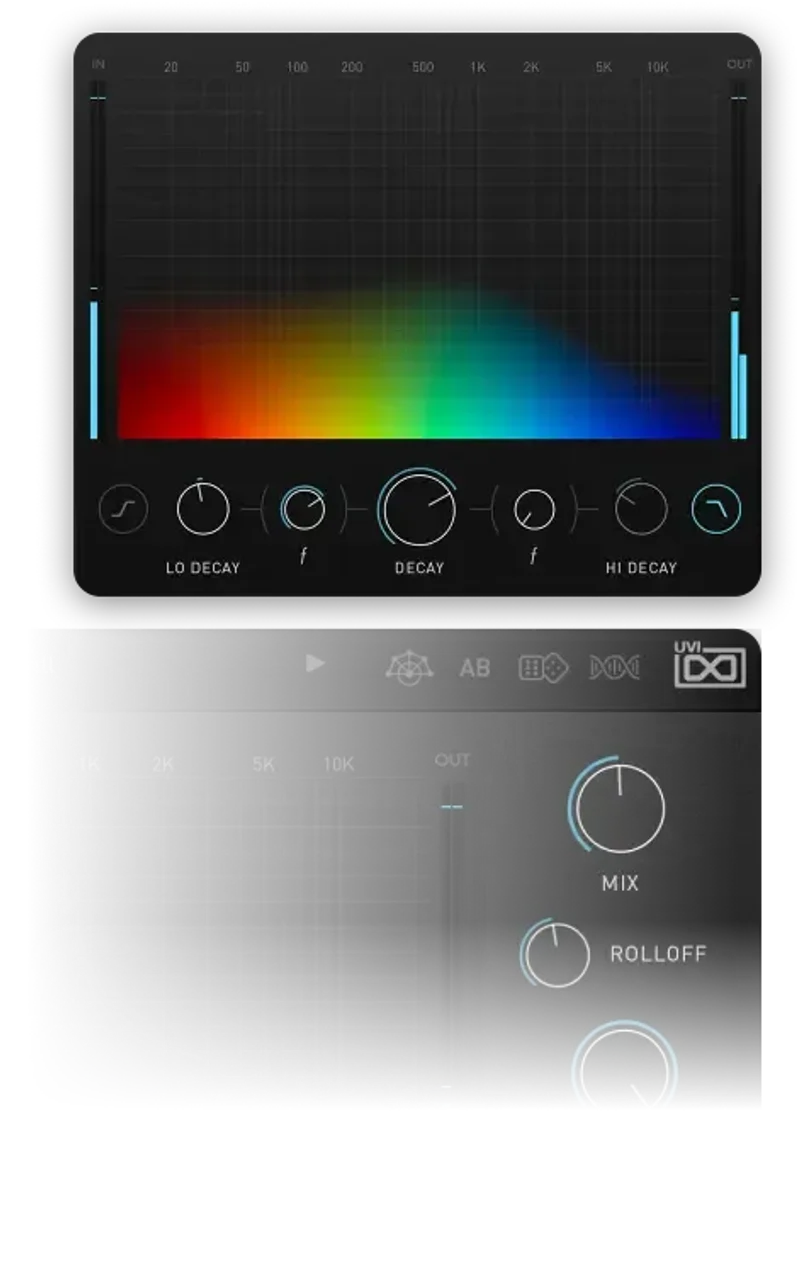
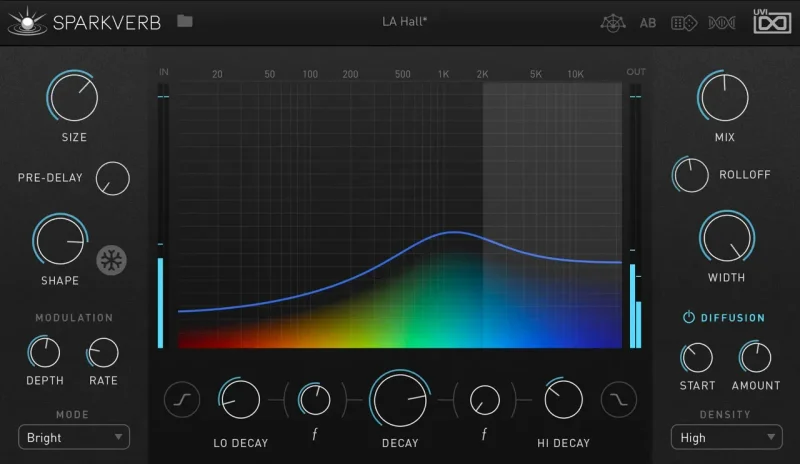
The Version 1.5 update added 50 new presets and rebuilt the interface. The spectral display and editor, which lets you draw decay curves across low, mid, and high frequency bands independently, is now more readable. That's the tool that makes Sparkverb something other than a preset browser with a reverb engine underneath.
How It Performs in a Real Session
We loaded Sparkverb on a vocal bus in Ableton Live 11 alongside six other plugin instances. CPU hit: roughly 3%. That number held across multiple instances. We ran five Sparkverb instances simultaneously before our session noticeably hiccupped. For comparison, running five instances of a competing algorithmic reverb at the same quality tier would have pushed us into buffer-increase territory on the same machine.
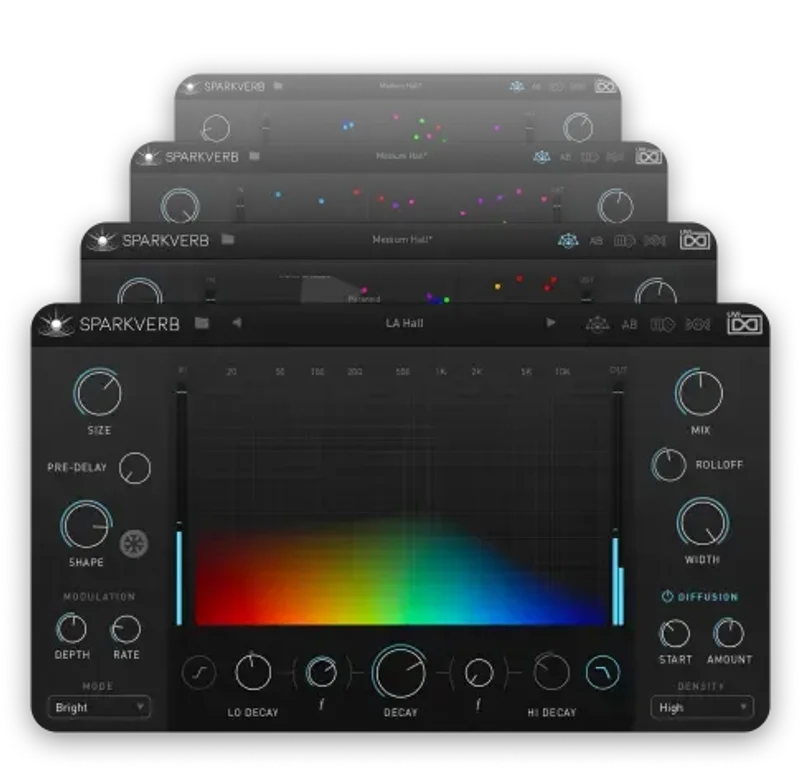
The three algorithms deserve honest description. Bright adds presence and air in the upper registers, roughly above 5kHz, without smearing transients badly. Dark pulls that high-end back and sits the reverb further behind the source signal, which works on acoustic guitars and room-mic blends where you want space without shimmer. Lo-fi introduces vintage hardware artifacts, slight modulation irregularities and a gentle noise floor that sounds like a hardware unit warming up. It's not a gimmick. We ran a synth pad through Lo-fi at 2.4 seconds and the tail had enough character to become part of the arrangement rather than just glue.
The parametric FDN (Feedback Delay Network) engine is where the real control lives. The frequency spectrum editor lets you draw independent decay shapes for low, mid, and high bands. We pulled the low-band decay down to about 60% of the mid-band length on a drum bus send, cutting roughly 1.5 seconds off the low-end tail while leaving the mid-range full. The result was a tighter low end without losing the size of the room. That kind of frequency-specific decay shaping is genuinely useful and not common at this price point.
Where it shows its limits: complex, evolving reverb textures or algorithmic modulation that shifts over time. Sparkverb's algorithms are consistent and stable, but they don't morph. If you want a reverb that breathes or moves mid-tail, look elsewhere.
Strengths and Weaknesses
The CPU story is the headline strength. Honest CPU efficiency at this level means you use it freely instead of rationing it. That changes how you mix. We'd put a Sparkverb on individual tracks rather than only on buses, and that flexibility is worth real money.
The spectral editor is clever. It's not just decorative. Shaping decay per frequency band on a send reverb, so your high end blooms longer than the low end, takes about thirty seconds to dial in. That speed is satisfying in a way that longer parameter chains are not.
The weaknesses are real though. Three algorithms is a lean selection. Valhalla Room, at a similar price, gives you more room types and more character variation per algorithm. If you need a plate, a hall, a chamber, and a shimmer from one plugin, Sparkverb will frustrate you.
The Sweetwater listing at $99 is also annoying. UVI sells direct at $79, and promotional pricing drops it to $39 multiple times a year. Buying at $99 is just paying a premium for convenience. Check UVI's own site before purchasing.
We also wish the Lo-fi algorithm had more control over the artifact character. The vintage noise and modulation are fixed in flavour. One dial to blend the artifact depth would have made it a sharper tool.
Value for the Price
At $39 during a sale, Sparkverb is an immediate buy. Don't overthink it.
At $79, it's still competitive. The CPU efficien
cy alone justifies it for producers running dense sessions. The spectral decay editor is a feature you won’t find in Valhalla’s entry offerings, and the Preset Voyager is genuinely faster than anything Waves puts in front of you.
At $99 from Sweetwater, it's overpriced relative to what UVI charges direct. Check our reverb plugins guide for current pricing context across the algorithmic reverb market before clicking add to cart.
It is not a Lexicon replacement. It's not trying to be. For fast, light, creatively-focussed reverb work, it earns its price.
Who Should (and Shouldn't) Buy This
- ✅ Buy if you run CPU-heavy sessions and need reverb instances that won't tank your buffer
- ✅ Buy if you want frequency-specific decay shaping without deep menu-diving
- ✅ Buy if creative preset exploration and fast workflow are more important to you than maximum algorithm variety
- ❌ Skip if you need a broad algorithm library (plate, hall, spring, chamber) from a single plugin
- ❌ Skip if you want evolving or modulated reverb tails that shift character over time
- ❌ Skip if you're already deep in the Valhalla ecosystem and happy there. Sparkverb won't move you enough to justify the switch
Score Breakdown
| Category | Score | Notes |
|---|---|---|
| Sound Quality | 4.0/5 | Clean, usable algorithms; Lo-fi has genuine character but three total is a thin selection |
| Value for Money | 4.0/5 | Strong at $39-$79 direct; weaker at $99 from third-party retailers |
| Ease of Use | 4.5/5 | Preset Voyager and Version 1.5 redesign make this one of the fastest reverbs to dial in |
| Features | 3.5/5 | Spectral decay editor is a highlight; algorithm count and modulation depth lag behind competitors |
| CPU Efficiency | 5.0/5 | ~3% per instance is best-in-class at this price tier |
| Overall | 4.2/5 | Fast, light, and genuinely clever where it matters; limited where it doesn't try to compete |
Alternatives to Consider
Valhalla Room ($50): More algorithm variety and deeper modulation options. Heavier on CPU per instance than Sparkverb but still efficient. Our go-to recommendation for producers who want one algorithmic reverb to cover every session. See how it compares in our reverb plugins guide.
Apogee Clearmountain's Spaces: If you want a reverb curated by one of the most respected mix engineers alive, Clearmountain's Spaces is a different kind of tool. Less flexible, more immediately musical. We covered it in depth in our Clearmountain's Spaces review.
Wave Alchemy Glow: If you're chasing that specific 80s plate and hall character and want something with more sonic nostalgia built in, Glow is worth a look. We ran a full comparison in our Glow reverb review.
SpaceBlender (Soundtoys): For producers who want reverb that does something unusual with the signal rather than sitting behind it, our SpaceBlender review covers it properly. Sparkverb and SpaceBlender are solving different problems entirely.
Sparkverb 1.5 is underrated in one specific, important way: no other algorithmic reverb at this price runs this light. If CPU is your constraint, that's not a small thing. That's the whole argument.
Buy it direct from UVI at $79, or wait for the next $39 sale. Don't pay $99. And if you need more than three algorithms, skip it entirely and go straight to Valhalla.
Frequently Asked Questions
Is Sparkverb good for beginners?
Yes. The Preset Voyager makes it one of the fastest reverbs to get a result from without prior knowledge of reverb parameters. You can explore by ear and land on something usable in under a minute. The spectral editor adds depth for more experienced users, but you don't need it to get good sounds out of the box.
How does Sparkverb compare to Valhalla Room?
Sparkverb wins on CPU efficiency and interface speed. Valhalla Room wins on algorithm variety and depth of modulation control. If you're choosing one plugin to cover all your reverb needs, Valhalla Room is more flexible. If you want something that runs light and sounds good without much setup, Sparkverb is faster to work with. We'd own both if budget allows.
What changed in Sparkverb Version 1.5?
Version 1.5 brought a completely redesigned interface and 50 new presets. The spectral display and editor became more readable and usable. The core engine didn't change, but the interface overhaul genuinely improved the workflow rather than just being a visual refresh.
Does Sparkverb work on iOS?
UVI has an iOS presence, but the full Sparkverb 1.5 feature set and its desktop AU/VST3/AAX formats are built for macOS and Windows sessions. For iOS-specific reverb workflow, check UVI's current mobile offerings directly on their site, as the feature parity between desktop and mobile versions isn't confirmed to be complete.