
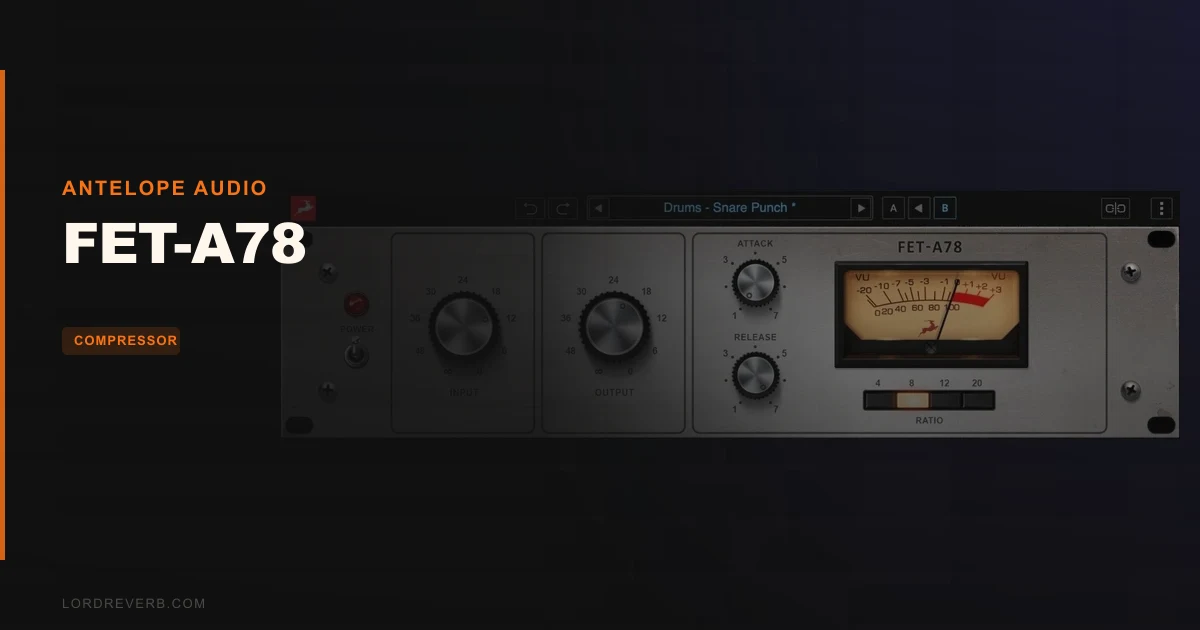
You've got a drum bus that won't sit still. The kick is forward, the snare is soft, the overheads are washing everything out, and every digital compressor you reach for either sounds clinical or introduces so many artifacts that you end up automating around the problem instead of fixing it. What you need isn't more plugins. What you need is character. That's the exact gap the Antelope Audio FET-A78 was built to fill.
The FET-A78 is a software model of one of the most recorded-on stereo peak limiters in studio history, built around the same field-effect transistor circuit architecture as the hardware. It runs as a native plugin on Mac and Windows, or in real-time with no perceptible latency on compatible Antelope Synergy Core interfaces. It's priced at $149 as a standalone purchase, and it's also part of the Antelope Cosmos subscription that covers 75+ native plugins.
This review is for producers who are tired of digital compression that clamps without coloring. If you're mixing in the box and you want that 1980s peak limiter sound that shaped pop and rock records for two decades, read on.
What Problem Does the FET-A78 Actually Solve?
The frustration isn't finding a compressor. There are hundreds. The frustration is finding one that adds something to the signal instead of just reducing its dynamic range mechanically.
FET compressors have a specific behavior. They're fast. They color the transients. They introduce harmonic content from the transistor circuit that softens the hard digital edge of modern recordings. The original hardware the FET-A78 is modeled on became a studio standard because it did all three things simultaneously, reliably, across stereo signals without phase problems or tonal imbalance between channels.
Software FET models often get the speed right and miss the color. Or they nail the color and the attack feel is wrong. Antelope's approach here is hardware emulation at the circuit level, modeling the FET elements as voltage variable resistors the way the original design intended, which is where the character actually lives.
If your digital chain sounds too clean in a way that's actually a problem, this is what the FET-A78 is for. Clean that doesn't breathe. That's the problem. This is one answer to it.
How the FET-A78 Performs in Real Sessions
We ran a drum bus through the FET-A78 with the ratio pushed to the most aggressive setting and the attack dialed fast. The initial transients from the kick still punched through. The snare body filled in underneath instead of getting squashed into the shell noise. That's the FET behavior working correctly: fast enough to catch peaks, slow enough to let the fundamental survive.
On a bass track with overly dynamic playing, we backed the attack off and let the slower release breathe. The low-mid body stayed consistent through the whole phrase. No pumping on the low end, no unwanted suck on the open notes. Reviewers who've used the hardware describe this same characteristic, and the plugin reproduces it without needing the interface.
On vocals, the FET-A78 is satisfying in a way that parallel compression rarely delivers from native plugins. We ran it at a moderate ratio with a medium attack and the coloration was present without being distracting. The vocal sat forward in the mix without needing an additional saturation stage to make it feel analog.
The four ratio modes are the primary musical decision point here. Slow attack plus a low ratio gives you glue. Fast attack plus the hardest ratio gives you a limiter that earns the name. The variable attack and release ranges cover the full spectrum from "barely touching it" to "hammering it into submission," and both extremes sound intentional rather than broken.
One honest note: we don't have CPU load metrics from Antelope's published specs, and that's annoying. For session work with 40+ tracks, not knowing the footprint before you commit $149 is a real limitation in the research phase. Users report it runs reasonably well as a native plugin, but we can't give you a number. That gap matters.
Strengths and Weaknesses, Honestly
The strength is the circuit authenticity. The signal-to-noise behavior of the FET-A78 model is clean enough for stereo bus work without introducing artifacts at high gain reduction, which is harder to achieve than it sounds. Antelope's engineers went to circuit-level modeling, not behavior approximation, and you can hear the difference on material you already know well.
The zero-latency Synergy Core mode is a clever differentiator. If you track through it on a compatible interface, you're monitoring through the compression character in real time. That changes how vocalists perform. That changes how a bassist feels their dynamics. It's not a feature for everyone, but for tracking engineers it's genuinely useful.
The weaknesses are real. Compatibility for the real-time Synergy Core mode currently sits with specific hardware: the Orion 32HD, Goliath HD, and Orion Studio Rev. 2017. Expansion to Goliath, Orion 32+, Zen Tour, and Zen Studio+ is listed as coming, but if you own those units right now, you're running native only.
No free trial. That's a frustrating call for a $149 plugin where the entire value proposition is "it sounds like the hardware." Sound is subjective. Buying blind at that price point is a harder ask than it needs to be.
There's also no mid/side mode mentioned in the available specs. For mastering engineers who want FET color with stereo width control, that's a gap. The Bettermaker Mastering Compressor handles that scenario better.
Is the Price Justified?
At $149 as a standalone plugin, the FET-A78 is in direct competition with some of the most credible FET compressor models available. Universal Audio's 1176 emulations sit in the same range but require UAD hardware unless you're on LUNA. The native field is competitive.
What tips it for us: if you're already in the Antelope ecosystem, the Cosmos subscription route makes this a trivially easy decision. Standalone, it needs to earn its place. For drums and bus work specifically, it does. For producers who mix exclusively in the box and don't own Antelope hardware, you're paying for a feature (Synergy Core) you can't use. That changes the math.
Compared to the Native Instruments Vintage Compressors R2, which covers multiple vintage compression styles in one package, the FET-A78 is a single-character tool. Deeper on one thing. Not broader.
Who Should (and Shouldn't) Buy This
- ✅ Buy if you own Antelope Synergy Core hardware and want to track through authentic FET compression with zero latency.
- ✅ Buy if you mix a lot of rock, pop, or hip-hop drums and want a bus compressor with character rather than clinical gain reduction.
- ✅ Buy if you're already subscribed to Antelope Cosmos, because at that point it's already in your library.
- ❌ Skip if you need a free trial before committing. No trial means no safety net here.
- ❌ Skip if you want mid/side or mastering-specific compression controls. This isn't built for that workflow.
- ❌ Skip if you're outside the Antelope ecosystem and you already own a credible 1176 model. The overlap is significant enough to question the double spend.
Specs & Technical Details
| Developer | Antelope Audio |
| Price | $149 |
| Plugin Format | VST3 / AU / AAX |
| OS Support | Mac / Windows |
| Activation | Antelope account / Synergy Core hardware (for real-time mode) |
| CPU Usage | N/A (not published by developer) |
| Trial Available | No |
| Version Reviewed | N/A (version not disclosed at time of review) |
Score Breakdown
| Category | Score | Notes |
|---|---|---|
| Sound Quality | 4.5/5 | Circuit-level FET modeling delivers genuine color without artifacts at high gain reduction |
| Value for Money | 3.5/5 | Competitive standalone, but Synergy Core value requires Antelope hardware you may not own |
| Ease of Use | 4.5/5 | Intuitive interface, four ratio modes, and variable attack/release with no steep learning curve |
| Features | 3.5/5 | Solid FET compressor feature set, but no M/S mode and hardware compatibility still expanding |
| CPU Efficiency | 3.0/5 | No published data; can't score what we can't measure, and that's a frustrating gap |
| Overall | 4.1/5 | A genuinely characterful FET compressor that earns its place on drums and bus, with caveats |
Alternatives to Consider
If you want FET compression without the Antelope ecosystem dependency, the Universal Audio 1176 emulations are the reference point. They're the hardware the FET-A78 is competing with sonically, and UAD's models are widely considered the benchmark. The catch is the UAD hardware requirement unless you're on LUNA.
For a bus compressor with more modern controls and a free trial option, the Kiive Audio Complexx is worth comparing. It takes a different approach to glue but hits a similar sonic goal with better trial access.
If you're looking at Antelope's own catalog for more color, the DRM-60 analog strip plugin covers compression plus EQ and saturation in a single channel strip, which is a different value proposition entirely.
For vintage compression variety in one purchase, the Mellowmuse CP2V covers multiple hardware characters and might make more sense if you're not specifically after the FET sound above everything else.
The Bottom Line
The FET-A78 is not the most flexible compressor in the room. It doesn't need to be. It does one thing with the kind of conviction that makes you stop adjusting and start mixing.
On a drum bus where everything else sounds like it's being managed, the FET-A78 sounds like it's being played. That's a meaningful difference when you've been fighting a session for three hours.
Buy it at $149 if drums and bus work are your priority and you want hardware character without the hardware price tag. Skip it if you need a trial, want M/S control, or already own a credible 1176 model and would just be duplicating your shelf.
The no-trial policy is the one thing we'd change. Everything else is hard to argue with.
Frequently Asked Questions
What is the FET-A78 based on?
The FET-A78 is modeled on a classic stereo peak limiter compressor that became a standard in top-tier studio facilities during the 1980s. The original hardware uses field-effect transistors as voltage variable resistors to create its signature fast, colored compression character. Antelope Audio built their model from circuit-level analysis rather than behavioral approximation. The asterisk in their own documentation confirms the plugin is not affiliated with or endorsed by any original hardware manufacturer.
Can I use the FET-A78 without Antelope hardware?
Yes. The native plugin version runs on Mac and Windows inside your DAW without any Antelope hardware required. The Synergy Core real-time mode, which runs the processing on the interface with no perceptible latency, does require a compatible Antelope device. If you don't own one, you get a fully functional native plugin but miss the zero-latency tracking feature.
Which Antelope interfaces support the Synergy Core real-time mode?
At the time of this review, Synergy Core real-time processing is confirmed for the Orion 32HD, Goliath HD, and Orion Studio Rev. 2017. Antelope has listed expansion to the Goliath, Orion 32+, Zen Tour, and Zen Studio+ as coming soon. If you own one of the latter units, check Antelope's current compatibility list before purchasing on that basis.
Is the FET-A78 good for mastering?
It works on the mix bus and handles stereo signals with matched limiters on both channels, which helps preserve stereo balance. That said, it doesn't offer a mid/side processing mode, which limits its application in mastering contexts where stereo width control during compression matters. For tracking, mixing, and bus work it's well suited. For mastering specifically, you'd want to compare it against purpose-built options before committing.