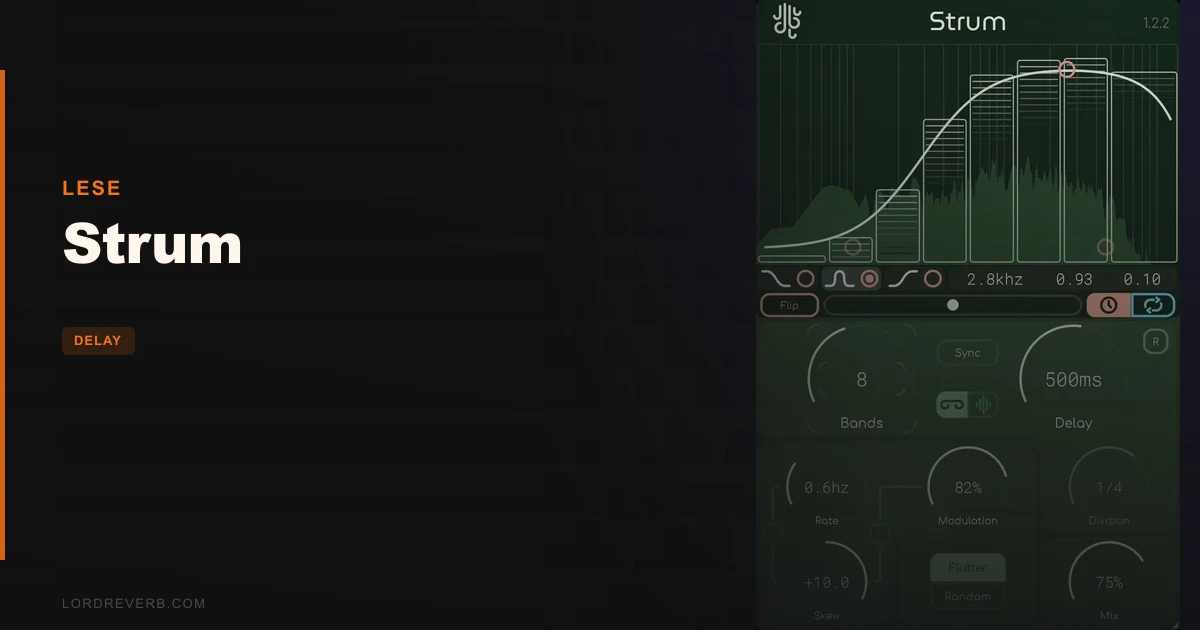
Strum by Lese is a multiband delay plugin that splits your signal into frequency bands and lets you set independent delay times and feedback for each one, and at $35 it's priced right for what it does.
We loaded it on a synth pad session that had gone flat. The pad sat too wide, too uniform. We threw Strum across the bus, synced the bands to the project tempo, staggered the delay times across four frequency bands, and suddenly the low mids were trailing behind the highs. The chord was strumming itself. That's the moment we stopped treating this as a curiosity and started treating it as a tool.
This isn't a reverb. It's not a standard stereo delay. It's a spectral delay, and it's built for producers who've wanted that sound without wiring up six mono delays on six separate EQ'd buses. If that's you, keep reading.
What Strum Is (and What It Clearly Isn't)
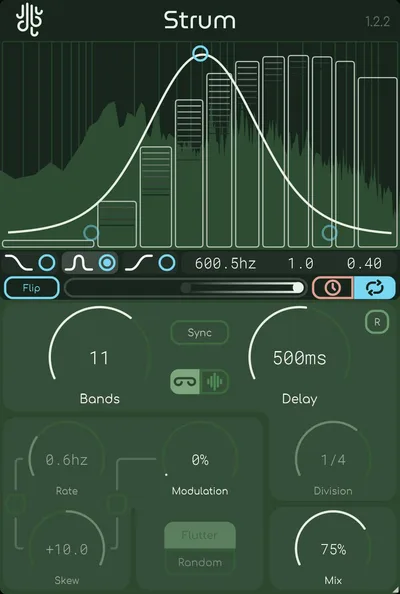
Strum is a multiband delay. That's the whole pitch. It takes your input, splits it into frequency bands using a proprietary filter bank with flat frequency and phase response, then lets you dial in unique delay time and feedback per band.
It is not an acoustic guitar simulator. It is not the Strum GS-2. If you searched "Strum review" looking for chord voicing and strumming patterns, that's a different product entirely. We cover that over at our Strum GS-2 review.
It's also not a do-everything delay. There's no built-in reverb tail, no saturation, no filtering on the repeats. What it does, it does cleanly. What it doesn't do, you'll need to handle elsewhere in your signal chain.
The sweet spot is electronic music, ambient, and any production where you want movement without automation. It's wrong for anyone after a transparent utility delay with one feedback knob.
Living With Strum Day to Day
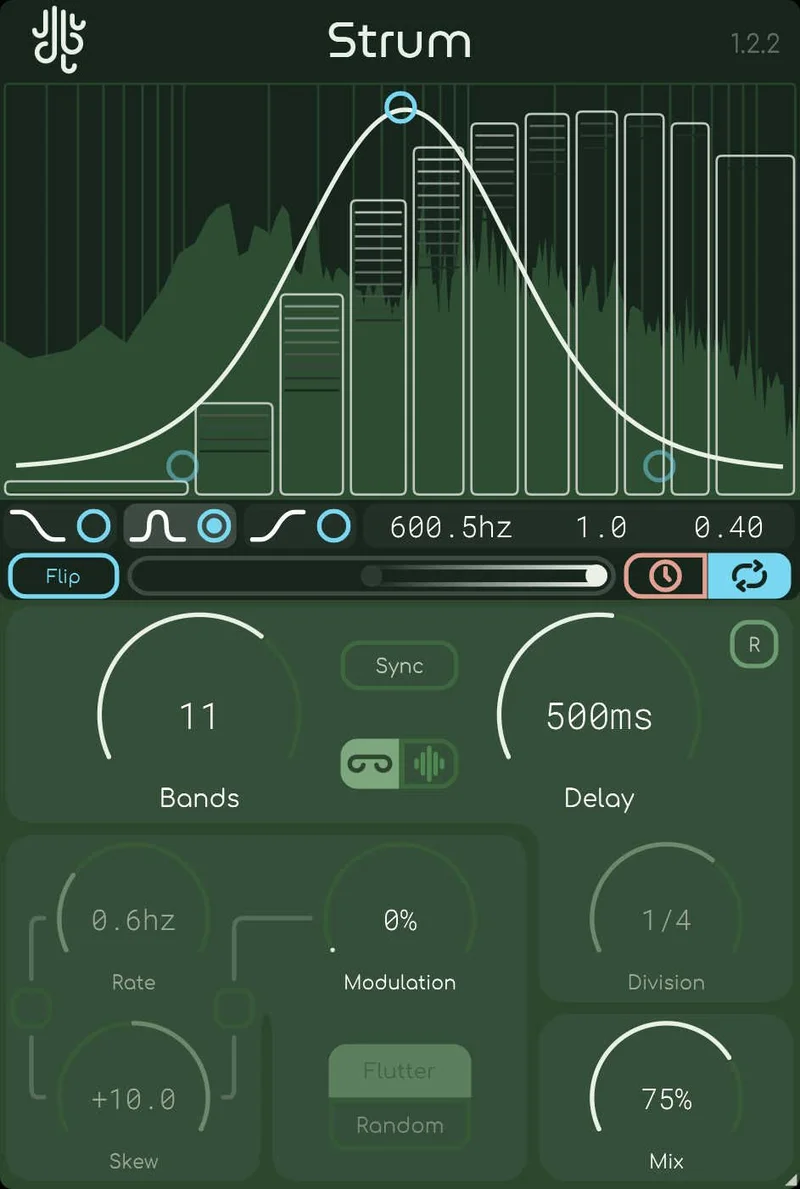
Setup is fast. Load it on a track or bus, open the Factor Band view, drag your crossover points into position like you're working an EQ, and you're running in under two minutes.
The Factor Band control system is the thing we keep coming back to. It works like an EQ node: click to place a point, drag to move the crossover frequency. If you've spent any time in a parametric EQ, you'll feel at home immediately. That familiarity removes friction when you're experimenting.
Sync mode is where Strum earns its keep. Flip from free to sync and each band's delay time locks to your DAW's tempo and time signature. We set the low band to a dotted eighth, the mid to a quarter, the high to an eighth, and the whole thing started breathing with the track. That's satisfying in a way that patching it manually never is.
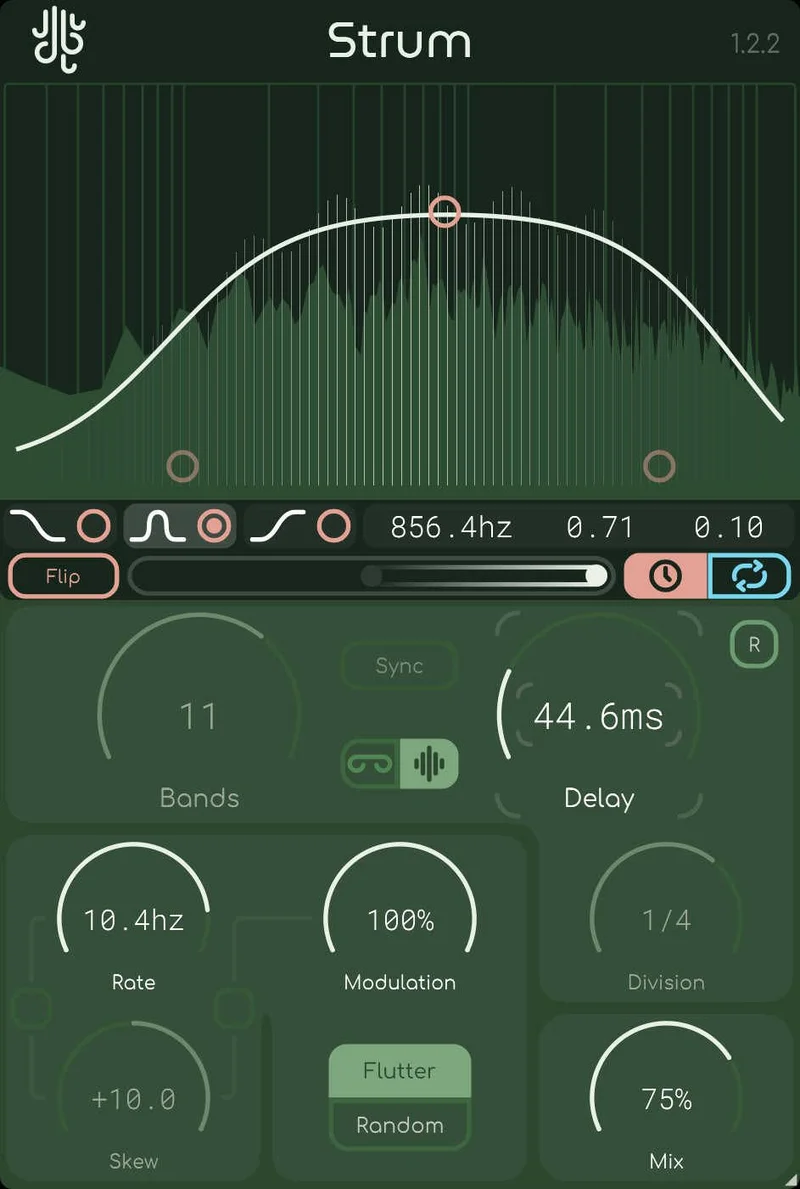
The modulation panel adds flutter or random variation to the delay times. Flutter gives you a tape-wobble feel. Random gives you a more unstable, organic movement. We wish there were more shapes here. An LFO with selectable waveforms would open things up. This is the section that feels underbuilt compared to the rest.
Modulation Skew is a clever addition. You can bias the modulation depth and rate by frequency, so high-frequency bands flutter more while low bands stay relatively stable. We ran it on a drum room bus and the top end shimmered while the low-mid body stayed grounded. It took about thirty seconds to dial in.
The overlay visual feedback changes as you adjust delay time and feedback. It's genuinely useful for seeing how the bands interact. If it gets cluttered, you can kill it from the Lese logo menu while keeping the crossover markers visible.
The Trade-Offs Worth Knowing
The dynamic crossover is a real win. Lese built it to be phase and frequency neutral, and we believe it. Drop Strum in with everything set to zero delay and you hear no coloration. That matters for mixing. You don't want your delay processor changing your dry signal just by existing in the chain.
But the lack of a built-in effects suite is a genuine limitation. Competing spectral delay tools sometimes include per-band filtering or saturation on the repeats. Strum doesn't. You get clean, pure delay per band, and anything else is your problem. For some workflows that's fine. For others, it's annoying.
The modulation section is the other frustration. Two modes: flutter and random. That's it. We kept wanting a sine wave option for clean vibrato-style movement. It's not there.
What you get in return is simplicity and a very low learning curve. This is a focused tool. It doesn't try to be everything. That focus makes it fast to use and very reliable. Whether that trade-off works for you depends entirely on what you're making.
Against the Field
The multiband delay space isn't crowded, but there are a few names worth knowing.
FabFilter Timeless 3 offers more modulation depth and a sleeker interface, but it doesn't do true multiband splitting the way Strum does. It wins on flexibility; Strum wins on focus.
We've tested the Halo Delay and the Imperial Delay. Both are excellent conventional stereo delays. Neither splits into frequency bands. If you want spectral delay behavior, they don't compete directly.
Eventide's spectral delay tools go deeper and cost significantly more. If you need complex spectral manipulation for film or post-production, spend the money there.
Strum is the pick for producers who want the concept without the complexity or the price tag. It's not trying to be Eventide. At $35, it shouldn't have to be.
The Real Verdict
Strum is a focused, well-built multiband delay that does what it promises without apology. The Factor Band system is clever, sync mode works exactly as advertised, and the dynamic crossover adds genuine signal integrity.
Skip it if you want one delay to do everything. Skip it if you're after tape saturation, built-in reverb, or rich modulation shapes on the repeats.
Buy it if you've ever wanted staggered frequency delays without building a Rube Goldberg patch in your DAW. At $35, the friction cost of not having it is higher than the price of owning it.
Specs & Technical Details
| Developer | Lese |
| Price | $35 |
| Plugin Format | VST3 / AU / AAX |
| OS Support | Mac (Intel & ARM) / Windows |
| Activation | N/A |
| CPU Usage | Light to medium |
| Trial Available | N/A |
| Version Reviewed | N/A |
Score Breakdown
| Category | Score | Notes |
|---|---|---|
| Sound Quality | 4.0/5 | Phase-neutral crossover keeps the dry signal honest; repeats are clean but not characterful |
| Value for Money | 4.5/5 | Multiband delay at this price point is hard to argue with |
| Ease of Use | 4.0/5 | Factor Band system is intuitive if you know EQ; otherwise there's a small learning curve |
| Features | 3.5/5 | Modulation section feels limited; no built-in effects on repeats |
| CPU Efficiency | 4.0/5 | Runs light enough to use on multiple buses without drama |
| Overall | 4.0/5 | A focused, honest tool that does one thing very well and nothing else |
Alternatives to Consider
If Strum's focused scope isn't quite what you need, here are three worth your time.
Applied Acoustics Systems Strum GS-2 is an entirely different product that shares a name. It's a physical modeling guitar instrument, not a delay. If you landed here looking for chord strumming and realistic guitar tones, that's your plugin. We reviewed it separately: Strum GS-2 Review.
Halo Delay by Antelope Audio is a serious stereo delay with a deep modulation engine. It doesn't do multiband splitting, but it covers everything else with more character. Read our Halo Delay review if you want to compare.
Imperial Delay by Boz Digital Labs is worth looking at if you want a full-featured single-band delay with more built-in control over the repeats. Our Imperial Delay review covers whether it's worth it at full price (short answer: on sale, yes).
None of these replace Strum for multiband spectral work. They're just better choices if spectral splitting isn't your goal.
If the multiband concept is right but you need inspiration starting points, the Good Folks Strum GS-2 preset bank won't help you here, but it shows how much the right presets can transform a delay-adjacent instrument.
Strum by Lese at $35 is one of those tools you either need or you don't. If you do need it, there's nothing else at this price that does it better. If you don't, no amount of clever engineering will make it useful for you. Buy it for what it is. Don't buy it hoping it'll become something else.
Related reviews: Modnetic
Frequently Asked Questions
Is Strum by Lese a guitar plugin?
No. Strum by Lese is a multiband delay processor. It splits your signal into frequency bands and applies independent delay times and feedback per band. The name causes confusion because Applied Acoustics Systems makes a separate, unrelated guitar instrument also called Strum (Strum GS-2). They share nothing except a name.
What DAWs does Strum work with?
Strum supports VST3, AU, and AAX formats. That covers Ableton Live, Logic Pro, Pro Tools, Cubase, Studio One, and most other current DAWs. Mac users get VST3, AU, and AAX. Windows users get VST3 and AAX. It should run fine on any recent operating system according to Lese's own documentation.
Can you use Strum on a drum bus?
Yes, and it works well there. The frequency-split delay creates movement in the stereo field without washing out transients if you keep feedback low. We got good results setting the high-frequency band to a shorter delay time than the low band, which lets the kick and snare trail differently from the hi-hats. The dynamic crossover's phase neutrality keeps the transients intact.
Does Strum color the dry signal?
According to Lese, the dynamic crossover uses a proprietary filter bank with flat frequency and phase response. In practical terms, that means the plugin isn't adding harmonic color or phase smear to your dry signal just by existing in the chain. We found this to be accurate in testing. The coloration you hear comes from the delayed repeats, not the crossover itself.