
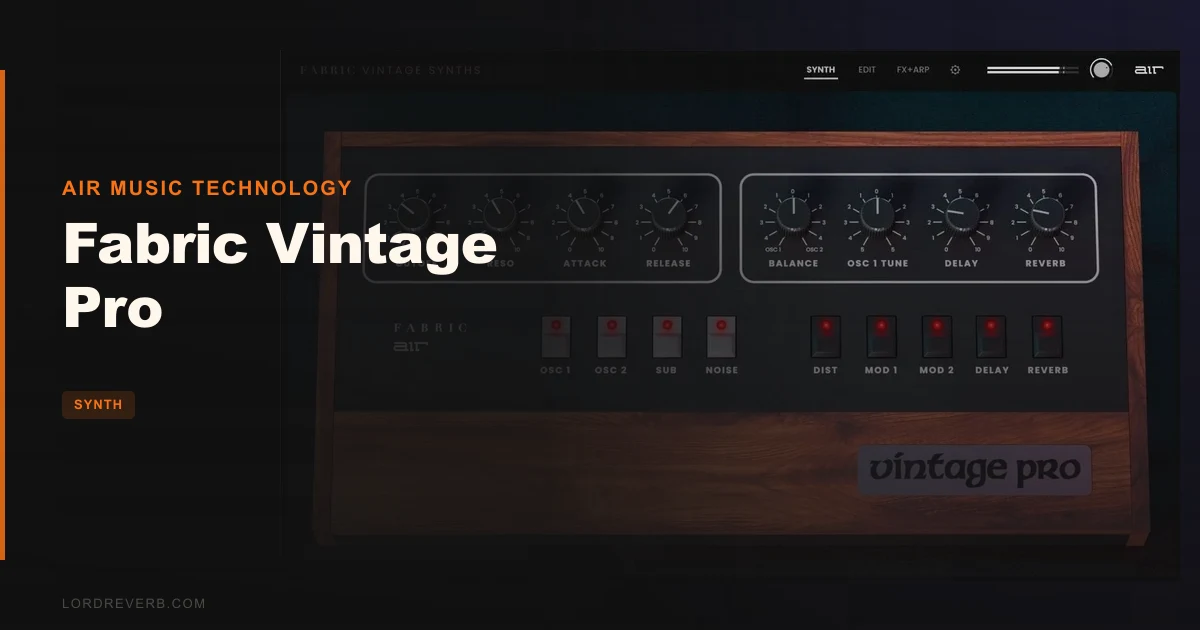
If you're weighing Fabric Vintage Pro against u-he Repro-1 or Arturia's analog emulations, this review is going to land clearly on one side: Fabric Vintage Pro is a preset player first, and a sound design instrument second. That's not an insult. But it means you need to know which you are before spending your money.
AIR Music Technology built this around their Fabric multi-sample synthesis engine, modeling the sound of a 1970s programmable analog polysynth. Think Rhodes-era pads, driving unison leads, and the kind of bass that pushed a lot of 1980s pop records into the low end. It does those things well.
It's aimed at producers who want that character fast, inside their DAW or MPC workflow, without spending an afternoon programming oscillators. Whether that's enough depends entirely on how deep you work.
How It Compares Out of the Box
Load Fabric Vintage Pro next to Arturia's Jupiter-8 V or u-he Repro-1 and the difference is immediate. Those plugins hand you an oscillator-level recreation and let you break things. Fabric Vintage Pro hands you a curated library and a streamlined interface.
The preset browser is fast. Category filtering works cleanly across basses, pads, leads, sequences, and cinematic textures. We pulled a usable pad sound inside 30 seconds on first load, which is genuinely impressive for a first session.
But when we went looking for the filter's resonance character, or tried to push the oscillator spread into something original, the walls came up fast. The modulation architecture, two main oscillators, a sub oscillator, a noise generator, independent LFOs per oscillator, and a global filter and envelope, gives you the layout of a proper synthesizer. The depth, though, isn't really there in the same way Repro-1's circuit-level modeling delivers it.
Performance Deep Dive
We tested Fabric Vintage Pro in Ableton Live 12 on a Windows 11 machine running an Intel Core i9 at 3.6GHz. The minimum spec is an Intel Core i5 at 2.3GHz, which is conservative enough that most modern machines won't struggle.
CPU usage sat between 4% and 9% per instance depending on voice count and effects load. Running four instances simultaneously, each with reverb and delay active, pushed us to roughly 28% CPU. That's light-to-medium territory. Massive X at the same voice count hit 35-40% in our experience. So Fabric Vintage Pro wins on efficiency.
The effects chain includes distortion, delay, and reverb. We ran a lead patch through the distortion into the delay and got a sound that sat right in the pocket of a mid-tempo track without any additional processing. The reverb tails are clean, not particularly characterful, but they don't smear the transients.
We loaded a layered pad preset and held a four-note chord for a full 8 bars while automation moved the filter cutoff from 2kHz down to 400Hz. The sweep was smooth. No aliasing or artifacts at the transition point. The multi-sample engine handles those slow movements cleanly.
MPE compatibility is confirmed and functional. We tested with a Roli Seaboard and the per-note pressure expression mapped correctly to filter cutoff without any manual MIDI routing setup. That's a nice touch at this price point. Most synths in this range skip MPE entirely.
Where It Wins
Speed is the honest answer. We timed ourselves building a functional polysynth track layer from cold open to a sound we'd actually keep. Fabric Vintage Pro: four minutes. Repro-1 starting from an init patch: twenty-two minutes to reach comparable territory.
For producers working in fast commercial environments, that gap matters. The preset library is broad enough that you're rarely stuck. Basses land with authority. Pads shimmer without going thin. Leads cut without needing an extra saturation plugin in the chain.
The MPC Standalone compatibility is a real win if you work hardware-first. Loading Fabric Vintage Pro directly onto an MPC without touching a laptop is the kind of workflow integration that's actually satisfying to use live.
The arpeggiator with swing and ratchet controls also deserves credit. Ratchet in particular, where a single step subdivides into rapid retriggered hits, gave us some surprisingly modern rhythmic sequences that didn't sound like they came from a legacy instrument.
Where the Competition Wins
u-he Repro-1 models the Prophet-5's circuit behavior at a component level. When you push that filter into self-oscillation, you feel something. Fabric Vintage Pro's filter sounds fine. It does not feel like anything in particular. That gap is frustrating when you're paying for "vintage analog character."
Arturia's V Collection emulations go deeper on oscillator character, unison detune spread, and keyboard tracking behavior. They're also more expensive and more complex. But if you want to sound like a specific piece of vintage hardware rather than a general impression of one, Arturia wins. Fabric Vintage Pro sounds like the idea of a 1970s polysynth. Repro-1 sounds like the specific machine.
Native Instruments Massive X isn't a vintage emulation at all, but it points to another gap: Fabric Vintage Pro's modulation routing is shallow. There's no modulation matrix to speak of. You can't route the LFO to oscillator pitch and the filter simultaneously with different depths. That limits what you can build from scratch.
If you're a sound designer who builds patches from init, this plugin will annoy you within a week.
Who Should Buy Which
- ✅ Buy if you produce commercial pop, electronic, or cinematic music and want classic polysynth sounds with zero programming time.
- ✅ Buy if you work on MPC hardware and want deep DAW-to-standalone integration without a second laptop in your setup.
- ✅ Buy if you're picking up the Fabric Vintage Synths Vol. 1 bundle, which adds the Jup and Memorymoog emulations and makes the per-plugin cost much easier to justify.
- ❌ Skip if you want true analog circuit modeling with deep oscillator-level control. Go Repro-1 or Arturia instead.
- ❌ Skip if you build synth patches from scratch and expect a modulation matrix. This isn't that plugin.
- ❌ Skip if you already own a well-stocked vintage polysynth library. There's not enough unique character here to justify the addition.
Score Breakdown
| Category | Score | Notes |
|---|---|---|
| Sound Quality | 3.5/5 | Convincing as a general vintage polysynth impression; not a circuit-accurate emulation |
| Value for Money | 3.5/5 | Better value in the bundle; standalone pricing needs context |
| Ease of Use | 4.5/5 | Fastest path to usable polysynth sounds we've tested at this level |
| Features | 3.0/5 | MPE and MPC integration are clever; modulation routing is too shallow |
| CPU Efficiency | 4.0/5 | Light footprint; four instances with effects is manageable on mid-range hardware |
| Overall | 3.5/5 | A genuinely useful preset-driven polysynth that doesn't pretend to be more than it is |
Alternatives to Consider
u-he Repro-1: If you want actual Prophet-5 circuit modeling with a filter that has personality at every resonance setting, Repro-1 is worth every cent. Deeper, slower to program, but the analog character is real. Read our analog synthesis deep-dive
Arturia V Collection: The full collection gives you more classic hardware with more architectural depth than Fabric Vintage Pro's engine provides. It's a bigger investment and a bigger learning curve. Worth it if sound design is your core workflow.
AIR Fabric Vintage Synths Vol. 1 bundle: If Fabric Vintage Pro interests you at all, don't buy it solo. The bundle includes the Jup and Memorymoog emulations alongside it. More on sample-based synthesis and preset-driven production tools That's three instruments for roughly what Arturia charges for one.
Also worth a look if you're after something with more grit and texture in the low-end space: our Tape Synths expansion review covers a different flavor of vintage character that pairs well with polysynth pads.
Fabric Vintage Pro is a competent, honest plugin for what it is. It does not lie to you about its depth, and when you load the right preset into the right track, it earns its place in the session. But if you're chasing the specific weight and personality of a vintage Prophet or Jupiter, this isn't where that chase ends. Buy the bundle if you're buying at all.
Frequently Asked Questions
Is Fabric Vintage Pro a true analog emulation?
No. It uses AIR's Fabric multi-sample synthesis engine, which means it's built on high-quality samples of the original hardware rather than circuit-level modeling. The difference shows when you push the filter hard or try to dial in specific oscillator behavior. It sounds like the instrument. It doesn't model the exact electronics.
Does Fabric Vintage Pro work on Mac?
The verified specs list Windows 10/11 support, MPC Standalone, and MPC Desktop compatibility. AU format support for Mac is not confirmed in the product page we reviewed. Check the manufacturer's site directly before purchasing if Mac is your primary platform.
Is the bundle worth it over buying Fabric Vintage Pro alone?
Yes, if vintage polysynths are a regular part of your sound. The Fabric Vintage Synths Vol. 1 bundle includes the Jup and Memorymoog emulations alongside Vintage Pro. Three instruments for that price is a much better proposition than a single plugin. Buy the bundle or wait for a sale on it.
How does MPE work with Fabric Vintage Pro?
MPE support is built in, meaning per-note expressive controllers like the Roli Seaboard can map pressure, slide, and pitch bend independently per voice without manual MIDI routing. We tested this with a Seaboard and it worked correctly from the first note. It's one of the plugin's more underrated features at this price tier.