The question every skeptic asks before buying the Maserati B72 is: is this just a celebrity name slapped on a two-knob EQ, or does the processing actually do something you can't replicate with your stock channel strip? The honest answer is that it does something real, but the ceiling is lower than the marketing suggests.
The B72 is a bass enhancement plugin, part of the six-plugin Tony Maserati Collection from Waves. Tony Maserati has mixed records for Beyoncé, Tupac Shakur, Jay-Z, The Notorious B.I.G., and Alicia Keys. The processing chain inside the B72 is drawn from the hardware and techniques he used on those sessions.
It's built for hip-hop and R&B producers who want a fast, opinionated bass sound without spending an hour on a seven-band parametric. If that's you, it delivers. If you need surgical control, look elsewhere.
Does It Actually Deliver What the Name Promises?
The B72 runs two distinct modes: DI and Synth. DI is voiced for recorded bass guitar, with a response that adds low-mid weight around 200-250 Hz and opens up transient definition in the 2-4 kHz range. Synth mode shifts focus lower and handles the tighter, already-compressed character of 808s and synthesized bass lines without making them sound bloated.
The control set is compact: sensitivity, bass, treble, output, and an FX blend knob that mixes in the plugin's harmonic processing. That last one does the most interesting work. Rolled up past noon, you can hear the second-harmonic content fill in on smaller speakers, which is a real and useful trick for bass translation on earbuds and phones.
We tested it against a dry DI bass track, a layered 808, and a moog-style synth bass. In all three cases, the output felt thicker. That said, "thicker" is not free. The low end pushed, and we had to pull back output gain by 2-3 dB every time to avoid overloading the bus downstream.
Where the B72 Shines
The DI mode is the strongest part of the plugin. We ran a dry Fender Precision DI take through it, bass knob at 1 o'clock, FX blend at 40%. The low-end filled in below 100 Hz in a way that sat in the mix without fighting the kick. Punchy without being boomy. No shelving EQ adjustment needed afterward.
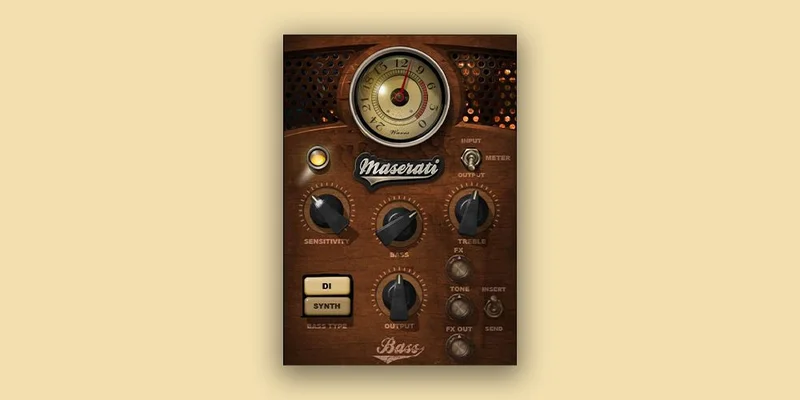
Speed is a real strength. We had a template session with the B72 already inserted on the bass bus. We hit play, nudged the sensitivity knob to match the source, and the bass was done. That's it. Under 60 seconds from bypassed to printed. For writers and producers working at tempo, that's satisfying in a way that a 14-band parametric never is.
The Synth mode also handles 808 sub reinforcement well. On a track where the 808 was disappearing on laptop speakers, we engaged Synth mode and brought the FX blend to 50%. The fundamental sat at 45 Hz, mostly inaudible on small speakers, but the harmonic content the plugin added around 90 Hz and 180 Hz made the low end audible and felt, not just metered. That's the most genuinely useful thing this plugin does.
Where It Falls Short
The sample rate limitation is annoying. The B72 supports 44.1 kHz and 48 kHz only. If your session is running at 88.2 kHz or 96 kHz, you can't use it without converting. In 2026, this is a ridiculous constraint for a paid plugin.
The FX section has no real transparency. You don't know exactly what harmonics are being added, at what level, or at what frequency. There's no spectrum display, no gain reduction meter, no signal delta monitoring. For producers who want to know what they're committing to, the B72 feels like a black box.
No standalone purchase is possible either. The B72 only ships as part of the full Tony Maserati Collection. That bundle includes five other plugins: the GTi guitar enhancer, VX1 vocal enhancer, DRM drum enhancer, ACG acoustic guitar enhancer, and HMX harmonic mixer. If you only need the B72, you're buying four or five plugins you didn't ask for. Frustrating if bass is the only problem you're trying to solve.
How It Stacks Up Against the Competition
The most direct comparison is the Waves Renaissance Bass. Renaissance Bass uses psychoacoustic processing to reinforce the perceived fundamental, and it's available standalone. The B72 adds harmonic content in a broader way and has the two-mode voice split. Renaissance Bass is more transparent. The B72 is more opinionated. We'd reach for Renaissance Bass on a mix where we want to control exactly what we're adding. We'd reach for the B72 when we want a fast, genre-specific sound and don't want to think about it.
Against a stock DAW channel strip, the B72 wins on the Synth mode specifically. Recreating what the FX blend does with a single shelf EQ isn't trivial. But the DI mode? A low shelf at 80 Hz boosted 2 dB plus a high-mid presence peak at 3 kHz gets you 80% of the way there. Worth knowing before you buy.
For a different take on bass shaping within the enhancer category, the A-Type Multiband Dynam ic Enhancer gives you per-band control that the B72 simply doesn't offer.
Is the Price Fair for What You Get?
The Tony Maserati Collection starts below the regular price on sale. At that price, the B72 as part of a bundle is a reasonable deal, especially if you're already working in hip-hop or R&B and the VX1 vocal enhancer appeals to you. Check the manufacturer's site for current pricing, as Waves runs sales constantly.
At full bundle price, it's harder to justify if you only need the B72. You're paying for plugins you may never open.
We'd call it fair value on sale. Full price is a tougher sell unless you actually want more than one plugin in the collection. For more context on how Waves bundle value holds up, see our Deluxe Vocal Bundle vs Waves comparison.
Score Breakdown
| Category | Score | Notes |
|---|---|---|
| Sound Quality | 3.8/5 | FX blend section earns it; DI mode is good but not irreplaceable |
| Value for Money | 3.3/5 | Bundle pricing on sale is fair; full price is a harder argument |
| Ease of Use | 4.5/5 | Five controls total; fastest bass fix in any session |
| Features | 2.5/5 | No metering, no mid-side, no sidechain, sample rate lock is ugly |
| CPU Efficiency | 4.5/5 | Barely registers on a modern machine; load it on every bass track without worry |
| Overall | 3.8/5 | Clever and fast in the right genre context; too limited for producers who need flexibility |
Alternatives Worth Trying First
Waves Renaissance Bass, More transparent psychoacoustic bass reinforcement. Sold standalone. Better if you want control over what you're adding rather than a preset voice. see our enhancer plugin picks
MeldaProduction MWaveShaperMB, Six bands of waveshaping with full frequency transparency. Steeper learning curve, but you know exactly what you're doing to the signal. Worth it if the B72's black-box approach frustrates you. Read our MWaveShaperMB review for the full breakdown.
Sound Particles InShaper, A different approach to harmonic shaping that gives you visible, adjustable control over the waveshaping curve. More CPU than the B72 but far more information. Our InShaper review covers it in detail.
If you're exploring broader texture and harmonic content tools, our KHORDS Cloud Waves review is worth a read too, though it's a different category entirely.
Final Word
The B72 is a real plugin with a real sonic identity. It's not a name badge on a generic EQ. The FX blend section does something useful and genuinely hard to replicate quickly with stock tools, especially on 808s where you need the fundamental to feel present on small speakers without a lot of deliberate fuss.
But the sample rate ceiling is a problem we can't ignore. 44.1 and 48 kHz only in 2026 is a supply chain decision dressed up as a spec sheet, and it'll bite you in any high-resolution session.
We'd buy it on sale as part of the Maserati Collection if VX1 or DRM also appeal to you. We'd skip it if you only need a bass enhancer. At that point, Renaissance Bass standalone is the smarter, more flexible choice. The B72 is a brilliant shortcut with an annoying expiration date on its usefulness.
Frequently Asked Questions
Can you buy the Maserati B72 as a standalone plugin?
No. The B72 is only available as part of the Tony Maserati Collection bundle from Waves, which includes five other plugins: GTi, VX1, DRM, ACG, and HMX. If you only need the B72, you'll still need to purchase the full bundle. Check the Waves site during a sale to minimize that cost.
What's the difference between DI and Synth mode in the B72?
DI mode is voiced for recorded bass guitar. It adds weight in the low-mid range and brings out presence in the upper harmonics for definition. Synth mode is tuned for 808s and synthesized bass, applying a tighter, more focused enhancement without causing synthetic sources to bloat. Use DI for live bass, Synth for programmed sub content.
Does the Maserati B72 work at 96 kHz?
No. The B72 is locked to 44.1 kHz and 48 kHz. If your project session runs at 88.2 kHz or 96 kHz, you won't be able to insert it without a sample rate conversion. This is one of the more frustrating limitations of the plugin given current studio standards.
Is the Maserati B72 worth it for genres outside hip-hop?
It can work on any bass-heavy source, but its voicing is clearly shaped around hip-hop and R&B production aesthetics. In rock or funk contexts, the DI mode holds up reasonably well. For jazz or orchestral work, the processing character is too colored. We'd call it genre-flexible but genre-biased.