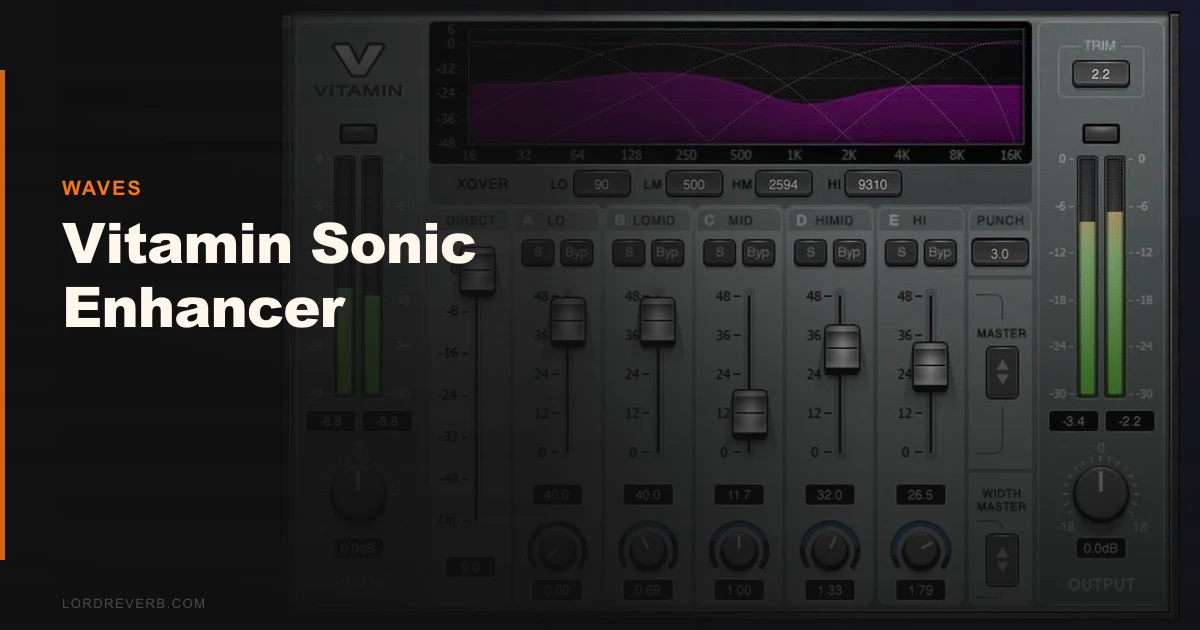
We were polishing a midrange-heavy vocal stack at around 2 a.m. when we slapped Vitamin on the bus to see if it could bail us out. It did, briefly. The air opened up. The low mids got tighter. Then we nudged the HIMID fader three clicks past noon and the sibilance turned to glass. That moment told us everything we needed to know about this plugin: it’s helpful until it isn’t, and the line between “polished” and “crunchy” is thinner than Waves’ marketing suggests.
Vitamin Sonic Enhancer is a multiband processing tool from Waves that combines EQ, compression, and saturation across five contiguous frequency bands. It’s built for speed. It’s not built for precision. If you’re a professional mix engineer with 20 minutes and a working knowledge of parallel chains, you probably don’t need it. If you’re a producer finishing tracks at home who wants a quick lift without opening six plugins, it’s a different conversation.
What It Is (and What It's Not)
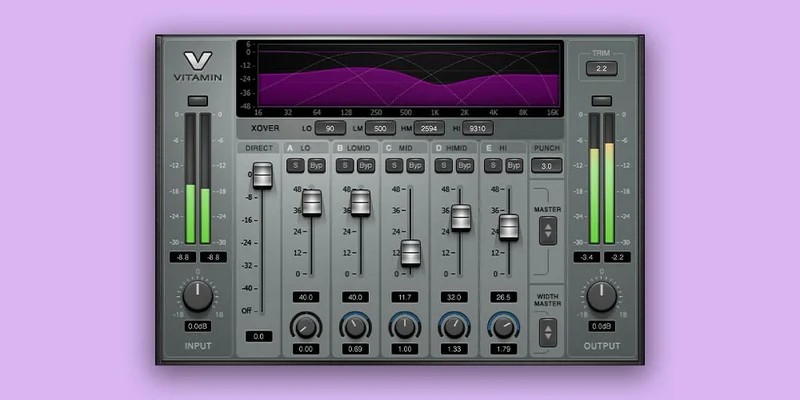
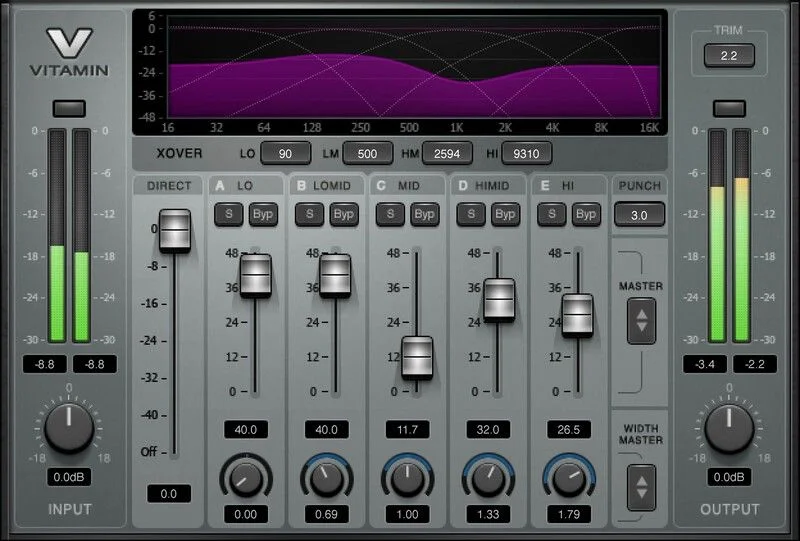
Vitamin runs five bands: LO, LOMID, MID, HIMID, and HI. Each band applies a combined process: saturation, EQ shaping, and compression, all in one fader move. Under the hood, the saturation engine generates 3rd harmonic distortion. That’s what gives you the “loudness without volume” sensation at low-to-moderate settings.
What it’s not: a transparent mastering tool. It’s not a replacement for a properly dialed multiband compressor. It’s not going to save a badly tracked vocal. And it’s not a plugin we’d reach for on a mix we care about deeply.
It processes at zero latency, which makes it usable for live sound on the SoundGrid version ($149 at intro, check Waves for current pricing). The Native version runs AAX, VST, AU across Mac and Windows. iLok or Waves License Center required. That last part matters more than people discuss.
Living With It
Setup took four minutes. Literally. Open, insert, done. That’s the honest appeal of Vitamin.
We ran it on a two-week session across four different source types: a drum bus, a vocal chain, a bass group, and a synth pad. The results were inconsistent in a way that felt instructive.
On drums, we pushed the LO band to around 60% and pulled the LOMID down a touch. The kick got more presence. Satisfying, and fast. We had the same result in about eight minutes that would’ve taken 20 minutes building a parallel saturation chain manually.
On the vocal chain, it worked below 50% on every band. Above that, especially on HIMID, the 3rd harmonic distortion compounded with any existing brightness and we started hearing artifacts. Not subtle ones.
The MID band compression behavior is the one we found most frustrating. There’s no attack or release control. Waves bakes those decisions in. On sustained synth pads, the compression sucked the life out of the sustain phase in a way we couldn’t fix because we had zero control over the time constants. That’s a genuine trade-off, not a bug. But it’s annoying.
We also hit the iLok friction. On a session away from our main machine, we had to re-authorize. Not catastrophic, but the kind of speed bump that contradicts the “it’s quick” pitch.
The Trade-Offs
Here’s the honest version. Vitamin saves time. We mean real time: 15 to 20 minutes per mix if you’d otherwise be building parallel EQ and saturation chains by hand. At $39.99 on sale (which it almost always is), that math works for hobbyists and home studio producers.
The cost of that speed is control. Every band is opinionated. The compression is invisible and non-adjustable. The saturation clips at 3rd harmonic by design, which means you can’t swap in a different saturation character. You either like what it does or you work around it.
Harshness is the real ceiling. We tested it hard, and above moderate fader positions on any band above 1kHz, the distortion compounds and the result gets brittle. Professionals who understand parallel processing will hit that ceiling inside the first session and want to step around Vitamin entirely.
For a beginner who doesn’t know what a parallel chain is? Vitamin gives them 80% of the result in 10% of the time. That’s a legitimate value proposition, even if it’s not the one we’d choose.
Against the Field
The Universal Audio A-Type Multiband Dynamic Enhancer costs more and requires UA hardware or subscription, but it gives you actual control over compression behavior per band. Better results. Higher bar to entry.
For multiband waveshaping with more surgical control, MeldaProduction’s MWaveShaperMB offers six bands and full shaping curves. It’s CPU-heavier and has a steeper learning curve. Vitamin w ins on speed. Loses on depth.
Sugar by Process Audio (recently emerged as a competitor in this space) runs a similar concept with a cleaner high-frequency character and a more transparent compression signature. Sugar sounds less harsh when pushed. We’d choose it over Vitamin at equivalent price points if you can find it.
If vocal polish is your main use case, the W.A. Production Deluxe Vocal Bundle covers more ground for similar money with tools that offer actual parameter control.
The Real Verdict
We’d buy Vitamin at $39.99. We wouldn’t buy it at full retail price.
It’s a beginner’s shortcut with a real ceiling. It gets you most of the way to a polished sound quickly, which has genuine value when you’re learning and time matters more than precision.
But if you’re past the beginner stage and you know what a parallel chain is, you’ll outgrow it inside a month. The lack of compression controls, the harsh high-frequency saturation character, and the baked-in decision-making will frustrate you.
Buy it on sale for home production. Skip it if you’re working professionally.
Score Breakdown
| Category | Score | Notes |
|---|---|---|
| Sound Quality | 3.0/5 | Works well at moderate settings; harsh above mid-fader on high bands |
| Value for Money | 4.0/5 | At sale price, hard to argue, at full retail, hard to justify |
| Ease of Use | 4.5/5 | Genuinely the simplest multiband enhancer we've used |
| Features | 2.5/5 | Five bands with no time-constant control limits professional use severely |
| CPU Efficiency | 4.0/5 | Light footprint; zero-latency mode doesn't spike the meter |
| Overall | 3.4/5 | A fast tool with a real ceiling, buy on sale, skip at full price |
Alternatives to Consider
If the harshness ceiling is a dealbreaker, look at these before committing.
The Universal Audio A-Type Multiband Dynamic Enhancer is the professional step up. More control, better high-frequency behavior, higher cost. Worth it if you’re past beginner stage.
The MeldaProduction MWaveShaperMB is what we’d use for precise multiband saturation shaping. Six bands, full curve editing, CPU-heavier but far more versatile.
For anything vocal-specific, the W.A. Production Deluxe Vocal Bundle covers more territory and gives you actual control. Vitamin as a vocal tool is a workaround. These are purpose-built.
And if you’re exploring what waveshaping plugins can do beyond basic enhancement, Sound Particles’ InShaper offers a completely different approach to harmonic shaping worth understanding.
Vitamin is a fine first enhancer plugin. It’s a frustrating one to be stuck with later.
Frequently Asked Questions
Does Vitamin Sonic Enhancer require iLok?
Not a physical iLok dongle, but it does require the Waves License Center for activation. You can run it on a machine, a USB drive via Waves' portable license option, or authorize it online. For studio-only use this is mostly painless, but if you're running live rigs across multiple machines, re-authorization can slow you down. It's one of those friction points nobody talks about enough.
Is Vitamin Sonic Enhancer worth buying at full retail price?
No. We wouldn't buy it at full retail. Vitamin goes on sale constantly, and the functionality doesn't justify full retail when comparable or better tools exist at lower price points. Set a Waves sale alert and wait. You'll never pay full price if you're patient.
What's the difference between Vitamin Native and SoundGrid?
Native runs AAX, VST, and AU for standard DAW use. SoundGrid is built for Waves' SoundGrid network, designed for live sound applications and multi-operator setups. The zero-latency processing makes the SoundGrid version genuinely useful for front-of-house applications. For studio-only work, Native is all you need.
Does Vitamin Sonic Enhancer work on drums and bass, or is it mainly for vocals?
We tested it on both. On a drum bus with conservative LO band settings (around 40-50% fader), it adds presence without killing the transient punch. On bass, the LOMID band can tighten up mud reasonably well. The harshness issue we flagged is mostly a problem above 1kHz, so low-frequency source material actually gives Vitamin its best results. Just keep the MID and HIMID bands restrained.