Spring reverb plugins have a honesty problem. Most of them paste an impulse response of a real tank onto your signal, call it "vintage," and charge a premium for the privilege. The result is a static snapshot of a spring that lived and breathed forty years ago, with none of the wobble, the tension, the way the thing interacts with hot input levels. u-he's Twangström exists because that approach leaves a gap you can feel the moment you play a chord through it.
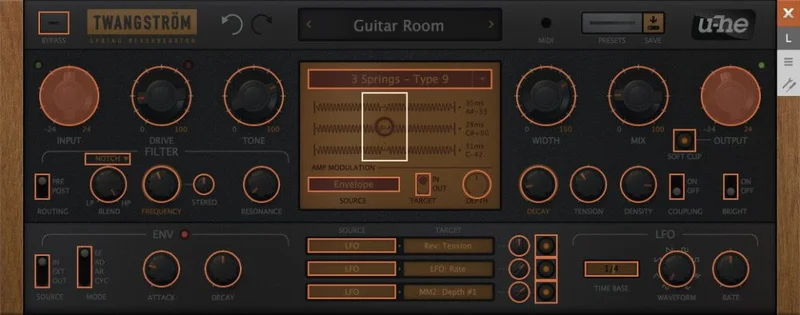
Twangström is a spring reverb plugin with physical modeling at its core, a drive stage, tone EQ, modulation section, and a mid-side Width control. It runs VST2, VST3, AU, and AAX. It costs EUR 69. It's built for producers and engineers who want spring character that moves, not spring character that sits still.
The Gap Most Spring Plugins Leave Open
Here's the frustration. You load an IR-based spring reverb on a Telecaster DI track. It sounds fine at low levels. Then the guitarist hits harder, the input clips slightly, and the reverb doesn't respond at all. A real spring tank would sag, compress, and get weirder. The IR version just gets louder.
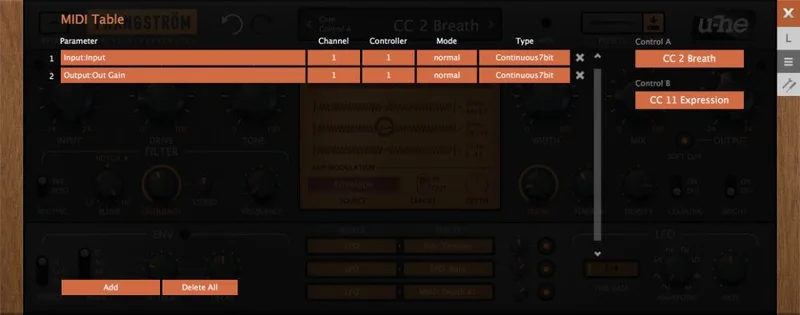
Physical modeling solves this because it simulates the mechanics, not just the fingerprint. Twangström models three specific tanks: the Type 4 (Fender-style, shorter and brighter), the Type 8 (Marshall-style, longer and darker), and the Type 9 (a variant with its own tension and decay character). Each one responds differently to input gain. Hit the drive stage harder on the Type 8 and the tail actually changes shape.
This is what most reverb plugins don't address. Static reverbs don't interact with dynamics. Twangström does.
How It Performs in Practice
We spent two weeks running Twangström across guitar DIs, Rhodes patches, synth pads, and a drum bus. The results were not equal across all of them.
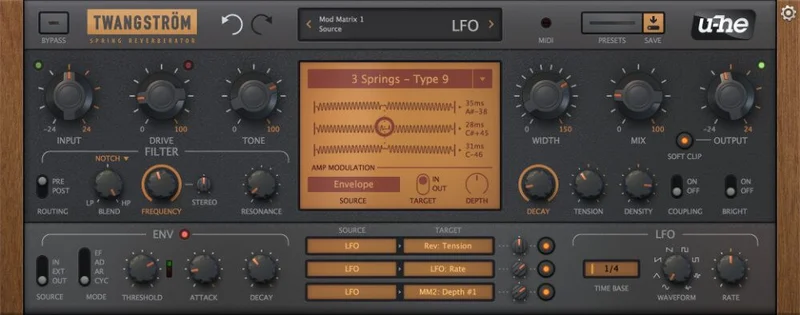
On a Strat DI, we loaded the Type 4 tank, set Input Gain to around 65%, engaged the drive stage at 40%, and pulled the Tone EQ down slightly above 3kHz. The spring wobble on chord swells was satisfying in a way that surprised us. The tail had actual texture, not a convolution blur.
The Shake parameter is where this plugin earns its price. Set between 20 and 40%, it replicates the physical rattle of a spring being disturbed by low-end transients. We hit a low E power chord with Shake at 30% and the reverb physically lurched for a half-second before stabilising. We've tested a lot of spring emulations. None of them do this as convincingly.
On a Rhodes patch, the Type 9 tank with slow LFO modulation (Twangström offers eight waveforms, including sine, triangle, and random) added subtle pitch movement to the tail that worked like a slow chorus underneath the reverb. Width at around 60% spread it without making it sound artificial in mono.
On a drum bus, it was less impressive. The transient attack of the snare caused the spring model to behave erratically, and unlike on guitar material, that felt like a problem rather than a feature. We tried cutting the Input Gain and rolling back Shake. It improved, but we'd rather reach for a plate here. This isn't the tool for drums.
CPU usage sat at medium. In a 64-track session on an M2 Mac running Logic Pro, a single instance used roughly 2-3% CPU at 44.1kHz. Annoying but manageable if you're not stacking six of them.
What It Gets Right and Where It Falls Short
The three-tank system is cleverly implemented. The Type 4 cuts through on single-note guitar lines. The Type 8 adds body to low-mid-heavy sources. The Type 9 sits somewhere between them and works brilliantly on keys.
The drive stage isn't an afterthought. It changes the harmonic content of the reverb tail itself, adding odd-order saturation that makes the decay feel alive. Paired with the Tone EQ (which functions as a tilt filter across the reverb signal), you can dial from clean spring to ragged surf-garage without touching a second plugin.
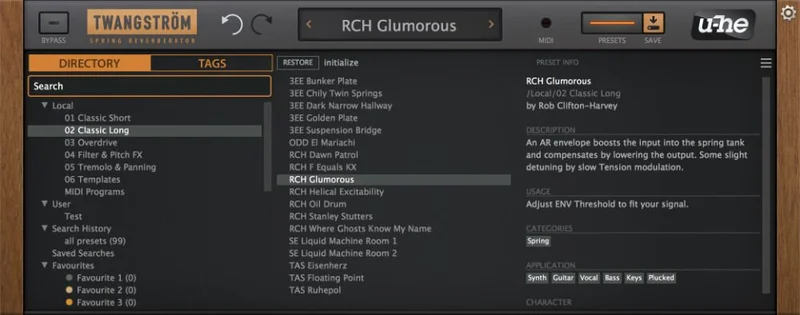
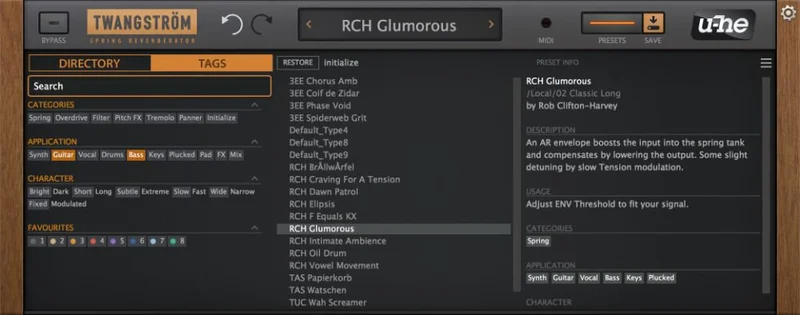
The 76 factory presets are genuinely useful. NKS compatibility means Komplete Kontrol users get parameter mapping straight out of the box. Version 1.0.2 is stable. We didn't see a single crash across two weeks.
The frustrating part is the modulation section's lack of visual feedback. You're adjusting LFO rate and depth by ear with no waveform display or rate readout in Hz or BPM. For sync-to-tempo applications, this matters. You're guessing instead of dialling.
The four envelope modes (which shape how the reverb responds to input transients) also lack labelling that explains what each one does. Trial and error works, but clearer documentation would save twenty minutes per session. This is annoying on a plugin that otherwise feels well-designed.
Is EUR 69 the Right Price?
For a physical modeling spring reverb with a built-in character chain, EUR 69 is defensible. It's cheaper than many IR-based competitors that do less. The Apogee Clearmountain's Spaces runs at a much higher price for a very different proposition, so that's not a fair fight.
But within spring-specific plugins, EUR 69 puts Twangström at a price where you’re paying for genuine engineering, not just a pretty UI.
We'd still love to see a sale price around EUR 49. At EUR 69 it's a considered purchase, not an impulse buy. Worth it for the right producer. A stretch for someone who only needs spring reverb occasionally.
Who Should Buy This (and Who Shouldn't)
- ✅ Buy if you record or produce guitar-heavy music and want reverb that responds to playing dynamics
- ✅ Buy if you work with vintage keys, Rhodes, or synth pads and want spring character with built-in modulation and drive
- ✅ Buy if you're building a dub or lo-fi signal chain and need a spring that can sound broken on command
- ❌ Skip if drums are your primary use case. A plate or hall plugin will serve you better.
- ❌ Skip if you need tempo-synced modulation with visual feedback. The lack of BPM readout will frustrate you.
- ❌ Skip if you already own a full-featured reverb suite with a spring tank included. Check what you have first.
Score Breakdown
| Category | Score | Notes |
|---|---|---|
| Sound Quality | 4.5/5 | Three distinct tanks with genuine dynamic response. Best spring modeling we've tested at this price. |
| Value for Money | 3.5/5 | EUR 69 is fair for what it does, but a sale would make this an easy recommendation for everyone. |
| Ease of Use | 3.5/5 | Intuitive layout hurt by undocumented envelope modes and no modulation rate display. |
| Features | 4.0/5 | Drive stage, Width, Shake, four envelope modes, eight LFO waveforms, 76 presets, NKS. Solid set. |
| CPU Efficiency | 3.5/5 | Medium usage. Fine for one or two instances. Think before stacking. |
| Overall | 4.2/5 | Best physical-modeled spring reverb at this price, with caveats for drum producers and modulation-heavy workflows. |
Alternatives to Consider
AudioThing Springs is the most direct competitor. It's IR-based rather than physically modeled, which means less dynamic interaction but more predictable behaviour. Works better on drums. If you need spring reverb that doesn't react to input level, Springs may suit you more. Check the reverb plugins guide for a broader comparison of reverb types.
u-he Presswerk (a different u-he tool) shows the same design philosophy of extracting vintage processing into focused standalone plugins. If Twangström's approach appeals, look at the rest of u-he's plugin lineup via the ACE reviews to understand how these tools were designed to sit together.
Valhalla Vintage Verb covers more ground in terms of reverb types but doesn't model spring physics. If you want one reverb plugin that handles everything, Valhalla is likely the wiser choice. If you want spring character done with surgical specificity, Twangström wins that argument.
The honest closing recommendation: if you make music where a spring reverb would have been used on the original recording, buy Twangström. Guitar, keys, vintage synths, dub bass, surf, lo-fi. It's the right tool, and at EUR 69 you're not overpaying for it.
If you're trying to use it everywhere, you'll hit its limits fast. Spring reverb is a character choice, not a general-purpose tool. Twangström knows exactly what it is. You should too before you buy it.
Frequently Asked Questions
Does Twangström work in Pro Tools?
Yes. Twangström supports AAX format from Pro Tools 10.3.7 onwards. Both 32-bit and 64-bit sessions are covered. We'd recommend running it at 64-bit for stability.
What's the difference between the three spring tank types?
The Type 4 models a Fender-style tank: shorter decay, brighter character, sits well on guitar and clean keys. The Type 8 models a Marshall-style tank with longer decay and more low-mid weight. The Type 9 is a third variant with its own tension character, sitting roughly between the other two and working well on synth pads. Each responds differently to the Input Gain and Drive controls.
Can I use Twangström on drums?
You can, but we wouldn't make it your first choice. The physical spring model reacts unpredictably to sharp transients like snare hits, and the Shake parameter can turn chaotic at higher settings with percussive material. For drums, a plate emulation gives you more control. Twangström is better suited to sustaining sources.
Is there a free trial for Twangström?
u-he typically offers demo versions of their plugins with periodic audio muting. Check the u-he website directly for current trial availability, as demo policies can update between software versions. The trial is worth downloading before you commit EUR 69 to a single reverb character.