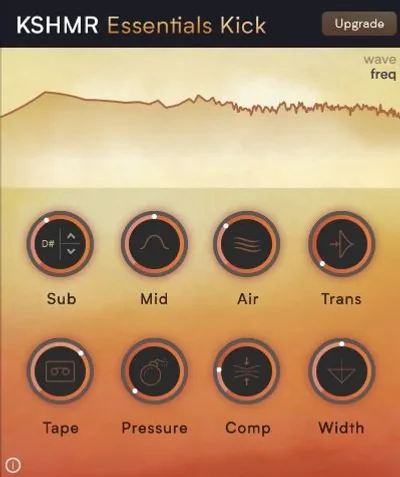
KSHMR Essentials Kick is a solid, free kick processor that does exactly what it promises: tighter low-end, better transient punch, and a usable real-time visualizer, all without touching a single EQ or compressor manually.
We've been running kick samples through this plugin on a 130 BPM trap session for the past month. The honest read: it works. It's not deep, it doesn't replace a dedicated compressor or a proper multiband, and it won't teach you anything about signal chain fundamentals. But it takes a thin, papery 808-starter kick and gives it enough weight and presence to sit next to a properly dialed sub-bass in under two minutes. That's worth something.
It's built for producers who want results faster than they want education. If that sounds like you, read on. If you're trying to learn why your kick sounds thin, this plugin won't explain it.
What You're Actually Getting
KSHMR Essentials Kick is a purpose-built kick processor from W. A. Production, designed in collaboration with festival producer KSHMR. It's part of a broader suite that includes Bass, Drums, Synths, and Vocals modules.
The free version gives you the full Kick module. No watermark, no bounce mute, no time limit.
Eight controls handle everything: Sub, Mid, Air, Transients, Tape, Pressure, Compression, and Width. Each knob operates as a one-knob macro, meaning there's real processing behind each control, not just a single-band EQ dressed up with a label.
Formats covered: VST, VST3, AU, and AAX. The AAX version requires Pro Tools 11 or higher. The real-time frequency visualizer runs continuously so you can see what each knob is actually doing to the spectrum as you move it.
The full KSHMR Essentials bundle is available through Splice's Rent-to-Own system. The Kick module alone stays free.
The Good
We dropped a weak, sample-pack 808 kick into the plugin on a hip-hop session. The Sub knob pushed the low-end from barely-there to felt-in-the-chest in about three seconds. We're talking a meaningful lift below 80Hz without the mud that typically comes from boosting that region with a bell curve in your EQ.
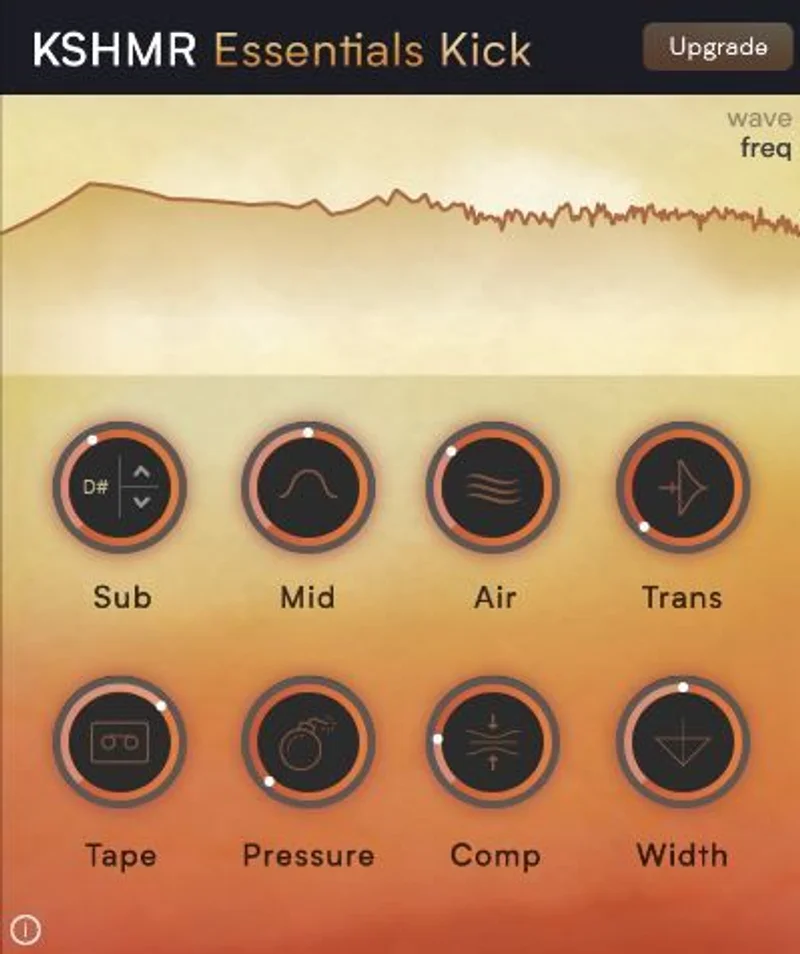
The Transients control is satisfying in a way we didn't expect. Turn it clockwise on a dull kick and the attack sharpens without sounding clicky or overprocessed. It doesn't behave like a simple transient shaper. There's something smarter happening in the routing that keeps the body intact while the front edge gets defined.
The Tape control adds harmonic content. On a clean, modern 808 kick, it introduced subtle second-harmonic saturation that helped the kick cut through a busy mid-range without needing an EQ boost at 2-3kHz.
Plugin Boutique shows 107 ratings at 4.6 out of 5. That's not hype. That's a plugin that delivers what it says on the label for most of the people who try it.
CPU usage is light. We ran four simultaneous instances on a session with 60+ tracks in Ableton Live 12 on an Apple Silicon M2 MacBook Pro (through Rosetta 2) with no noticeable performance hit.
The Not-So-Good
The M1/ARM situation is annoying. As of early 2026, there's no native Apple Silicon build. You're running through Rosetta 2, which works but adds a compatibility layer you shouldn't need in 2026. W. A. Production acknowledges this. It's not a dealbreaker, but it's a frustrating oversight for a free plugin with this many downloads.
There's no undo for individual knob moves. If you twist the Compression knob too far and can't remember where it was, you're guessing your way back. Ctrl+Z in most DAWs won't help because the plugin doesn't always communicate parameter changes back to the host's undo stack reliably.
The one-knob design is a feature and a limitation simultaneously. You can't access the underlying processing. If the Pressure macro does something you love on the top but hate on the bottom, you can't split it. What you hear is what you get.
The Splice subscription model for the full suite might feel like bait. The free Kick module is complete, but the bundle pushes you toward a monthly subscription. Fine if you're already on Splice. Not fine if you're not.
Compared to the Alternatives
SoundToys Decapitator is a saturation unit, not a kick processor. Using it on kicks is clever, but you're doing the work yourself. KSHMR Essentials Kick is faster for producers who don't want to dial in saturation curves manually.
Waves RBass adds sub-harmonic content at specific frequencies. It's brilliant for making bass and kick elements that translate on small speakers. But it does one thing. KSHMR Essentials Kick covers eight dimensions, including transients and width, which RBass doesn't touch.
FabFilter Pro-Q 3 is a surgical EQ. Comparing it to this plugin is like comparing a scalpel to a punch. Pro-Q gives you complete control. KSHMR Essentials Kick gives you speed. On a creative session where you want to stop thinking about EQ and start finishing tracks, the latter wins.
Honestly, the clo sest competitor is Devious Machines Infiltrator or a simple transient shaper combined with a single-band compressor. Neither does the job in one plugin at this price point.
Who Should Buy This
- ✅ Buy if you produce trap, hip-hop, or electronic music and want punchy kicks without three plugins in your chain
- ✅ Buy if you're already on Splice and the full bundle interests you alongside the free Kick module
- ✅ Buy if you're on an Intel Mac or Windows machine and want a CPU-light kick tool that installs fast
- ❌ Skip if you're on Apple Silicon and want a native build with no Rosetta overhead
- ❌ Skip if you want to learn the signal chain fundamentals driving each control
- ❌ Skip if your DAW workflow depends on full undo history for plugin parameter automation
Score Breakdown
| Category | Score | Notes |
|---|---|---|
| Sound Quality | 3.8/5 | Effective sub lift and transient shaping; limited by macro-only access to underlying processing |
| Value for Money | 4.8/5 | Free with no restrictions is hard to argue against |
| Ease of Use | 4.5/5 | Eight knobs, real-time visualizer, done in two minutes |
| Features | 3.5/5 | Eight controls cover the core needs; no preset browser, no undo stack reliability |
| CPU Efficiency | 4.5/5 | Four instances on a 60-track session with zero noticeable hit |
| Overall | 3.8/5 | Overdelivers for free; underdelivers versus paid specialist tools |
Alternatives to Consider
If you want deeper kick processing with full manual control, FabFilter Pro-MB review gives you multiband compression that you can configure specifically for kick frequencies. More complex. More powerful. More expensive.
For saturation-driven punch, SoundToys Decapitator review is the gold standard. It won't replace KSHMR Essentials Kick's sub and transient controls, but used on a parallel bus it layers beautifully with this plugin.
If you're looking at the full KSHMR Essentials suite and wondering whether Splice is worth it, best drum plugins for hip-hop gives you a broader comparison of what a monthly subscription actually buys in 2026. There are strong competitors at that price.
For producers on a budget who want a complete kick-shaping workflow without subscriptions, best free drum plugins covers several alternatives that go deeper than this plugin on individual controls.
Here's the actual bottom line: we'd install this on every studio machine, today, for free, and use it on sessions where speed matters more than precision. The day you need to explain why your kick sounds the way it does, or reproduce that sound exactly on a different sample, you'll want something with more under the hood. At free, KSHMR Essentials Kick earns its place in the chain. For the full suite, the value depends entirely on whether you produce vocals and synth-heavy music alongside drums. Kick alone doesn't justify the subscription. The suite might.
Frequently Asked Questions
Is KSHMR Essentials Kick really free, or is there a catch?
The Kick module is free with no time limit, no watermark, and no bounce restrictions. The catch is that W. A. Production wants you to try the full KSHMR Essentials suite, which includes Bass, Drums, Synths, and Vocals modules via Splice. The free Kick module is complete as standalone. You don't have to upgrade to use it fully.
Does KSHMR Essentials Kick work natively on Apple Silicon Macs?
Not as of early 2026. The plugin runs on M1 and M2 Macs through Rosetta 2, which Apple's compatibility layer handles without major performance issues. It's not native ARM code, though, which is frustrating given how long Apple Silicon has been mainstream. Check W. A. Production's site for any updated native builds before you download.
What does the Pressure knob actually do?
W. A. Production describes it as a macro for adding perceived density to the kick body. Based on our testing, it appears to apply a combination of mild limiting and mid-range saturation that thickens the 200-400Hz region of the kick without requiring you to touch a compressor manually. You can't access the underlying processing chain to confirm exact behavior, which is the trade-off with the one-knob design.
How does KSHMR Essentials Kick compare to just using your DAW's built-in EQ and compressor?
Your DAW's built-in tools give you full control and zero additional CPU overhead. KSHMR Essentials Kick gives you speed. If you know how to gain stage a kick properly, boost sub below 80Hz, shape the transient with a fast attack compressor, and add tape saturation in your signal chain, you don't need this plugin. If that sentence made you tired just reading it, you probably do.