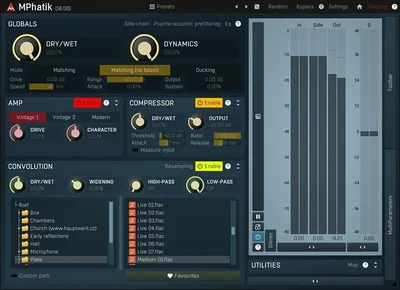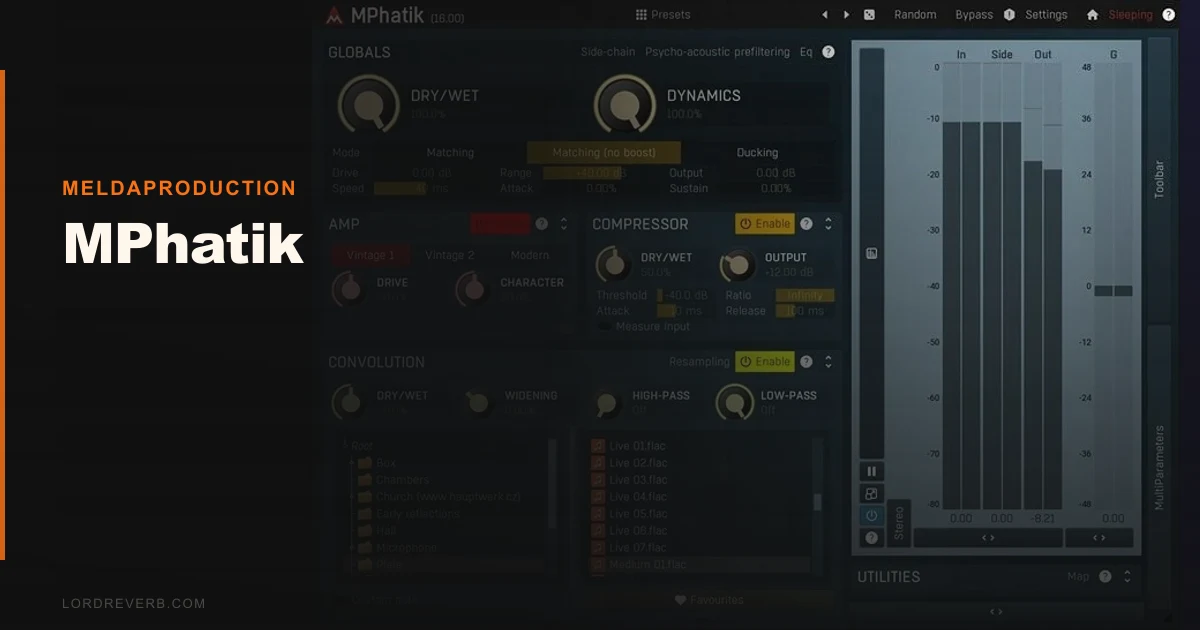
We loaded a drum bus that had been crushed through three stages of analog-modelled saturation and a parallel compression chain, and it sounded exactly the way you’d fear: loud, hyped, and flat as a parking lot. The transients were technically there. The life wasn’t. We dropped MPhatik across the bus, hit the dynamics restoration section, and within about four minutes of dialling in the input-to-output envelope analysis, the kick had its crack back. Not a new transient stapled on top. The original shape, restored. That’s the pitch, and it mostly delivers.
MPhatik is for producers who’ve been force-choosing between saturation and feel. If that’s not your problem, keep scrolling.
What MPhatik Actually Does (And What It Doesn't)
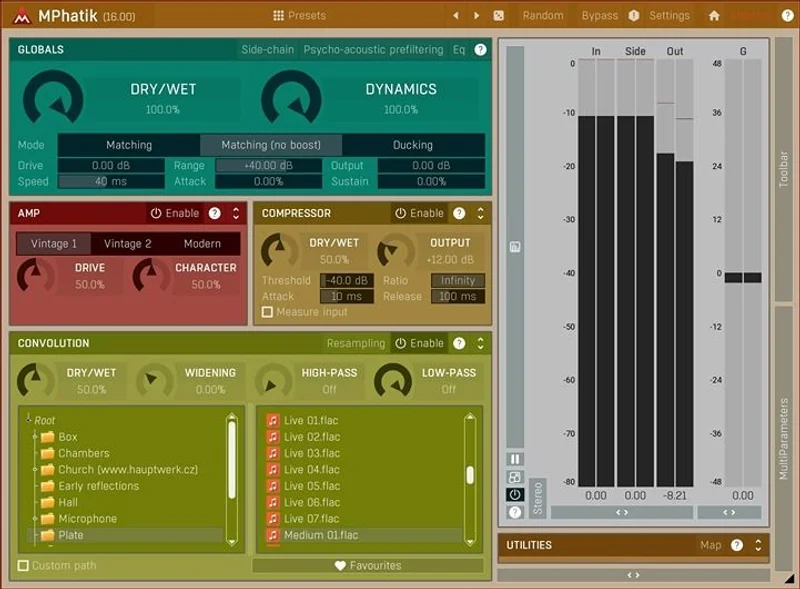
MPhatik is MeldaProduction’s answer to one of the most frustrating contradictions in modern mixing: the more character you add through saturation, compression, and convolution processing, the more you flatten the dynamics that made the source interesting in the first place.
The plugin works by analysing the input and output envelopes of a signal and using that difference to rebuild dynamics that processing has erased. It’s not a transient shaper bolting on attack. It’s closer to a restoration tool that references what the signal was, then corrects for what the processing took away.
What it’s not: a quick-fix saturator you set and forget. It’s also not a great choice for simple warmth on a single instrument track. The complexity here serves complex problems. Drop it on a single acoustic guitar with gentle EQ and you’ll wonder what you paid for.
Living With It: A Honest Week of Testing
Setup is standard MeldaProduction. VST3, AU, and AAX all installed cleanly. macOS 10.14 Mojave minimum, Windows 10 or 11, both 64-bit. Activation runs through their MeldaProduction Application Manager, which we’ve used across a dozen of their plugins without a single issue.
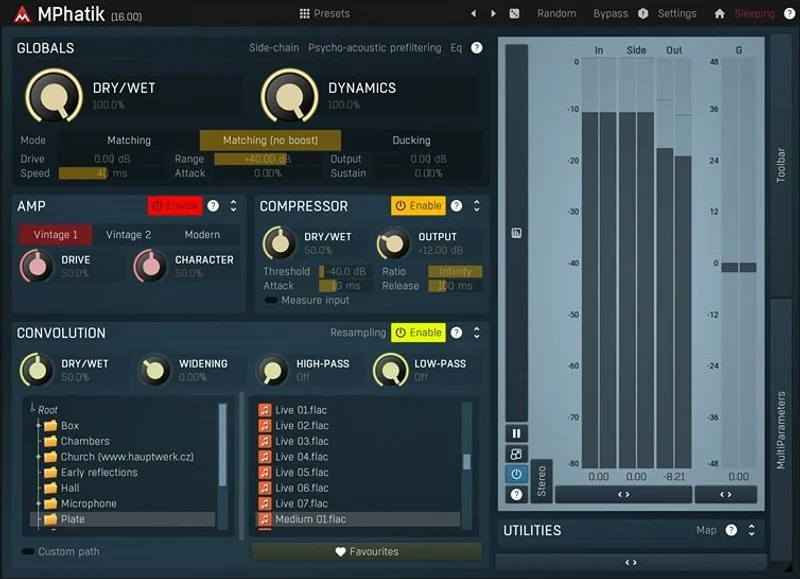
The interface is where things get real. MeldaProduction builds for power users, and MPhatik is no exception. The modulation section alone, four fully-featured modulators that each switch between LFO, level follower, ADSR envelope, randomizer, or pitch detector, took us the better part of a session to even map mentally. Once it clicked, the creative possibilities got genuinely exciting.
We assigned a level follower modulator to the saturation drive parameter on a bass synth. As the bass pushed harder at the top of a phrase, the saturation responded dynamically. The result sat in the mix with a kind of intelligent responsiveness that static settings can’t touch.
The convolution reverb IR browser did frustrate us. Early versions had a navigation bug where scrolling through impulse responses could skip or freeze. We hit it twice. Not a dealbreaker, but annoying enough to mention.
On CPU: run the dynamics restoration alongside convolution and two active modulators, and you’ll watch your meter climb. On a modern machine it’s manageable. On an older system or a dense session, watch your buffer settings.
The Trade-Offs Worth Talking About
The core technology is brilliant. Analysing envelope difference to restore dynamics is a smarter approach than anything a traditional multiband transient shaper does. But smart tools need calibration time. You’re not tweaking one knob. You’re teaching the plugin what the original dynamics were supposed to feel like, then letting it reference that model against the processed result.
That relationship between input analysis and restoration sensitivity is where most people will spend their time. Set the detection too aggressive and you introduce pumping artifacts. Too subtle, and you might as well not have used it.
The modulation depth is a strength that also raises the learning curve. Four modulators, each with five different operational modes, means you’re looking at a system closer to a modular environment than a standard multi-effect. That’s satisfying when it clicks. It’s overwhelming when you’re on a deadline.
The multi-channel support, mid/side, stereo, and surround up to 8 channels, is a legitimate differentiator. Most mixing engineers working in immersive formats have almost nothing at this price point that can handle that signal chain. That alone makes MPhatik a serious option for post-production work.
Against the Field
For dynamics control on a drum bus, FabFilter Pro-MB review is the more surgical option. Faster to dial in, cleaner workflow, and the dynamic EQ approach is more transparent on material that doesn’t need restoration, just control.
For saturation with character, best saturation plugins covers the competitive landscape well, but nothing there combines saturation with active envelope restoration the way MPhatik does.
iZotope’s Neutron comes up in the same conversation because of its transient shaping and multi-band compression. Neutron wins on workflow speed and the AI-assisted s
tarting points. MPhatik wins on depth, modulatability, and the convolution layer.
For pure transient design on drums, Transient Master alternatives will point you toward faster, lighter options if envelope restoration isn’t your specific problem.
If your problem is specifically “I saturated this and killed the feel,” MPhatik has no real direct competitor at this price.
The Real Verdict
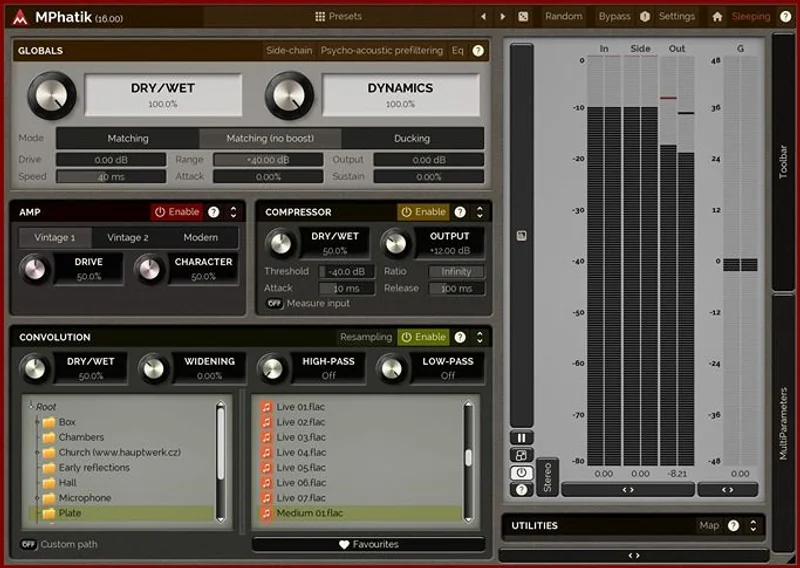
MPhatik earns its price if dynamics restoration is your actual problem. We’d buy it for a session that lives in heavy saturation territory: drums, bass, aggressive synths, dense parallel compression chains.
We’d skip it if you’re looking for a one-stop character plugin. The learning curve is real. The CPU cost is real. The IR browser bug was real, even if patchable.
It’s wrong for anyone who needs a quick creative effect to layer across a mix. It’s right for the engineer who’s stared at a flattened drum bus and thought: “there has to be a smarter fix than re-tracking.”
There is. It’s this.
Score Breakdown
| Category | Score | Notes |
|---|---|---|
| Sound Quality | 4.5/5 | Envelope restoration technology sounds natural, not surgical or bolted-on |
| Value for Money | 4.0/5 | The price is fair for this feature depth, and introductory pricing makes it a strong buy. |
| Ease of Use | 3.0/5 | Steep curve; modulation system alone requires dedicated learning time |
| Features | 4.5/5 | Four multi-mode modulators, convolution reverb, amp sim, surround support: hard to beat |
| CPU Efficiency | 3.5/5 | Acceptable on modern machines; heavy when convolution and modulators stack up |
| Overall | 4.1/5 | Unique technology, real learning investment, correct tool for a specific and common problem |
Alternatives to Consider
FabFilter Pro-MB, FabFilter Pro-MB review The cleaner, faster option for multiband dynamics work. No restoration engine, but the workflow is a fraction of MPhatik’s complexity. Better for mixing engineers who want precision without a steep setup.
iZotope Neutron, iZotope Neutron review Covers transient shaping, multiband compression, and AI-assisted starting points in one plugin. Wins on speed and accessibility. Loses on modulation depth and surround support.
Klanghelm MJUC, best compressor plugins Worth considering if what you love about MPhatik is the idea of character-preserving dynamics control. MJUC is lighter, simpler, and excellent on single channels where over-compression is the problem, not saturation-induced envelope loss.
The drum bus that started flat as a parking lot ended the session punching above its own weight. That’s not a small thing. In a mix where everything is fighting for space, restoring the original dynamic shape of a crushed performance is the difference between a kit that sounds played and one that sounds processed.
At $109, MPhatik is worth it for engineers who live in that problem. If you’re still deciding, grab the free trial. Thirty minutes on a heavy drum bus will tell you everything.
Frequently Asked Questions
What makes MPhatik different from a standard transient shaper?
A standard transient shaper adds or removes attack and release based on fixed parameters you set manually. MPhatik analyses the difference between the input and output envelopes of your signal, then uses that difference to restore dynamics that processing has actually removed. It's referencing what the sound was, not just sculpting what it is now. That's a meaningfully different approach, and it sounds different in practice.
Is MPhatik only useful on drums?
No, though drums are where the benefits are most obvious. The dynamics restoration engine works on any heavily processed source: saturated bass, a compressed guitar bus, dense synth layers. The four modulators open creative territory well beyond drums, including auto-wah-style effects, pitch-responsive processing, and rhythmic modulation on pads or leads.
Can MPhatik handle immersive or surround audio formats?
Yes. MPhatik supports mid/side, stereo, and up to 8-channel surround processing from a single instance. That makes it one of the more capable options in this price range for post-production engineers working in immersive formats who need dynamics restoration across wide or spatial signals.
Does MeldaProduction offer a free trial of MPhatik before buying?
Yes. MeldaProduction offers a free trial through their Application Manager. The trial is fully functional, which means you can test the dynamics restoration, convolution reverb, and modulation system on your own sessions before committing. We'd strongly recommend doing that, specifically on a drum bus or a heavily saturated signal, before purchasing.