The Waterfall Rotary Speaker is the most convincing Leslie 147 plugin we’d point a guitarist or vocalist toward, and at $99 it’s worth buying if you actually want that sound on records. It’s for producers who’d rather dial in a real rotary cabinet than fake it with chorus. Keyboard players who need zero-latency live response should look elsewhere.
We love how it behaves when you stop treating it as a modulation effect and start treating it as an amp in a room. The mic placement and the tube power amp are doing the heavy lifting here.
It isn’t perfect. We’ll get to the phasing, the shy low end and the knob juggling.
What You're Actually Getting
It’s a Universal Audio emulation of one cabinet: the Leslie 147. Not the whole Leslie family. One model, done deep.
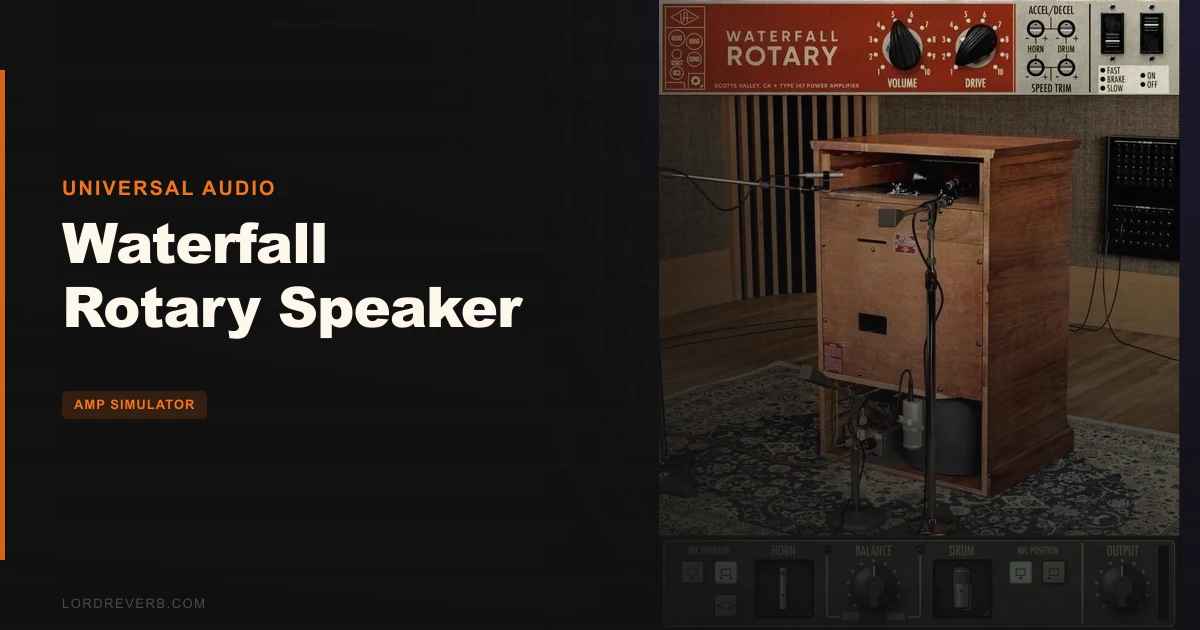
You get three-dimensional movement, the full tonal range of the Type 147, and a model of its tube power amp. The sound is captured through vintage microphone setups, so the cabinet is modelled as heard in a room, not just as a spinning-speaker algorithm.
It runs as AAX, AU and VST3 on Mac and PC, with any soundcard. The UAD Native version needs no UA hardware. Drop it on an insert or an aux channel.
Presets are aimed at vocals, guitar, bass, keyboards and drums, so you have a starting point on whatever you throw at it.
The Good
The realism is the headline. Owners compare it against other Leslie plugins and keep landing on the same word: convincing. The professional miking is a big part of that.
Then there’s the tube power amp. Push it and you get saturation with rich overtones and harmonics. UA claims other rotary emulations lack that, and the owner reports line up with the claim.
It swings wide. Reviewers describe it sounding sweet and lovely at gentle settings, then dirty and grimy when you lean in. That’s range you can use in one session.
Guitarists rave about it on Les Paul instruments. One report says it absolutely nailed the vibe.
And the details. The relay click and belt slip modelling sounds like a gimmick until you hear it. Owners single those mechanical noises out as the touches that sell the illusion.
The Not-So-Good
Let’s be blunt. The stereo mic pair can cause phasing. If your sound suddenly thins out when you fold to mono, that’s the first place to look. Annoying.
The bass is shy by default. You’ll have to push it to get low end that sits properly in a mix, and that’s frustrating on a bass or organ part.
Clean is harder than it should be. One user reports the input must stay quite low for a totally clean, unsaturated sound, even with drive at 1. The gain staging across several knobs is the part organ players call workflow friction.
There’s also latency. Real-time organ performers say it hurts responsiveness. And there’s no hardware-accelerated version for UAD accelerators or Apollo interfaces, just the native build.
Compared to the Alternatives
IK Multimedia’s B-3x gets you roughly 80-90% of the character, but its drive is less smooth. If your budget is tight, that’s a fair trade. If you’re chasing the grit, it isn’t.
AcousticSamples B5 and IK’s B3 emulation are comparable Leslie options with a different sonic character. They’re worth a listen before you commit, because “different” can mean “better for your organ part.”
NEO Instruments Ventilator comes up as the weaker choice next to this one. We wouldn’t spend money there when the Waterfall is on the table.
The pattern: the alternatives get close, but owners reach for the Waterfall when they want the cabinet to feel real.
Who Should Buy This
✅ Buy if you want a Leslie 147 on guitars, vocals or keys and care about the miked-in-a-room feel. ✅ Buy if you like pushing saturation and hearing the overtones bloom. ✅ Buy if you want a Mac or PC plugin with no UA hardware required.
❌ Skip if you need a clean, low-latency live organ rig. ❌ Skip if you want other Leslie models, since it only does the 147. ❌ Skip if you want UAD or Apollo DSP acceleration.
Specs & Technical Details
| Spec | Detail |
|---|---|
| Developer | Universal Audio |
| Price | $99 |
| Plugin Format | VST3 / AU / AAX |
| OS Support | Mac / Windows |
| Activation | N/A |
| CPU Usage | N/A |
| Trial Available | N/A |
| Version Reviewed | N/A |
Score Breakdown
| Category | Score | Notes |
|---|---|---|
| Sound Quality | 4.4/5 | Convincing 147 movement, tube saturation and mic realism |
| Value for Money | 4.3/5 | Strong for the sound, but only one cabinet model |
| Ease of Use | 3.8/5 | Multi-knob gain staging and a shy bass register |
| Features | 4.3/5 | Mic setups, mechanical noise modelling, instrument presets |
| CPU Efficiency | N/A | Not enough data to score honestly |
| Overall | 4.4/5 | Excellent 147 sound held back by phasing, low end and latency quirks |
Alternatives to Consider
IK Multimedia B-3x
Gets you 80-90% of the character with a less smooth drive. Pick it if you want a cheaper way into the sound and can live with a rougher edge.AcousticSamples B5
A comparable Leslie option with a different sonic character. Audition it if the Waterfall's voicing doesn't suit your organ parts.Another comparable option worth hearing against the Waterfall before you decide.
The Verdict
Buy it at $99 if the Leslie 147 is the sound in your head. The miking and tube amp give you a cabinet that feels real, and the grit is genuinely satisfying.
It’s the wrong tool for live organists chasing instant response, and for anyone who wants a full range of Leslie models. For guitars, vocals and studio keys, it earns its slot.
Keep the input low, nudge the bass up, check it in mono, and the cabinet will pay you back.
Related reviews: AmpKnob Trivium Rhythm
Frequently Asked Questions
Do I need UA hardware to run the Waterfall Rotary Speaker?
No. The UAD Native version runs on Mac or PC without any UA hardware, and it works with any soundcard. It comes in AAX, AU and VST3 formats. There's no hardware-accelerated version for UAD accelerators or Apollo interfaces.
Does it only emulate one Leslie model?
Yes. It models the Leslie 147 and nothing else. If you need other Leslie cabinet variants, this plugin won't cover them.
Why does my sound thin out or go phasey?
Owners report phasing issues with the stereo mic pair configuration. Check your mix in mono and adjust the mic setup until the sound holds together. If your low end feels weak, remember the bass register is restrained by default and needs a push.