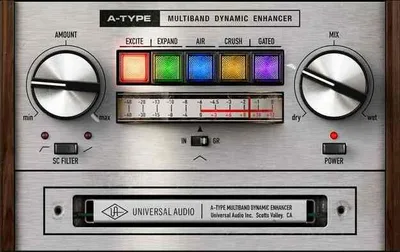
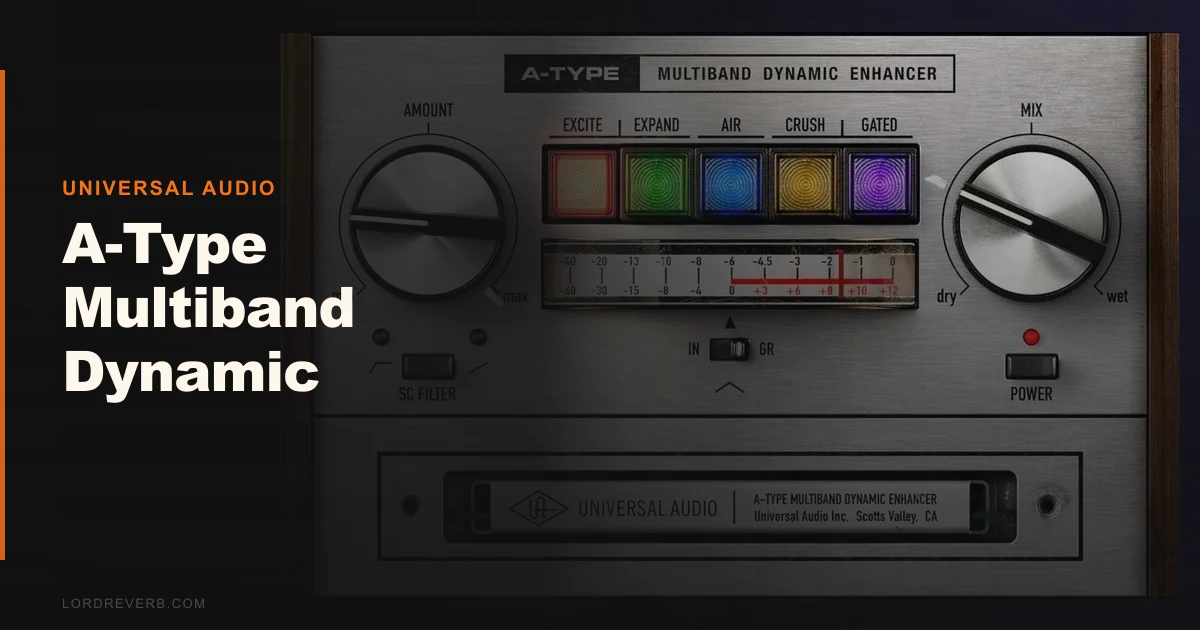
You've got a vocal that sits perfectly in isolation and completely disappears the moment the full mix hits. You pull up a compressor and it gets duller. You reach for an EQ and it gets brittle. What you actually need is something that moves with the signal, tightens specific frequency bands dynamically, and adds just enough edge to push through without weighing anything down. That specific problem is what the Universal Audio A-Type Multiband Dynamic Enhancer was built to solve.
This plugin models the Dolby A-Type noise reduction system, originally designed in 1965 and used on records by Queen, Fleetwood Mac, Stevie Wonder, and The Cars. Those engineers weren't using it as intended. They were exploiting its compander behavior as a texture tool. UA has taken that happy accident seriously and turned it into a full plugin with five operating modes, a Circuit Mods panel, and sidechain filtering options the original unit never had.
It's built for producers, mixing engineers, and studio obsessives who want a very specific kind of multiband dynamic color. If that's you, keep reading.
The Problem It Was Built to Solve
Standard multiband compressors flatten things. That's their job. You squeeze the 200-400Hz buildup on a bus, you tame the 3-5kHz harshness, and the mix gets more controlled. But it also loses something. The breath between notes. The crack of a consonant. The air sitting just above 10kHz.
The original Dolby A hardware didn't compress. It companded. Four frequency bands, a compressor and expander working in tandem, designed to reduce tape noise by encoding before and decoding after recording. When engineers used only the encode or decode stage in isolation, they got a strange, additive texture. Things got clearer without getting thinner. Fuller without getting muddy.
That's the gap the A-Type plugin targets. It's not a compressor. It's not an EQ. It sits somewhere between both, and that in-between space is exactly where vocals either find their place in a mix or get lost in it.
How It Actually Performs
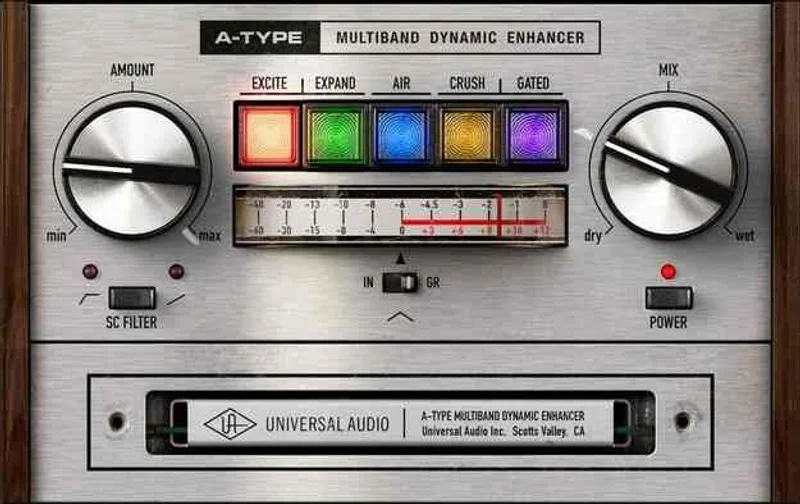
We ran the A-Type on a dry lead vocal first. Set the mode to EXCITE, AMOUNT at about 40%, MIX at 70%. Within about thirty seconds, something satisfying happened: the 3-5kHz presence range sharpened without any EQ node getting boosted. It felt like the signal had tightened its own belt. Consonants pushed forward. The 200Hz weight didn't pile up. We checked the spectrum analyzer and the broad curve had genuinely shifted without a static EQ change in sight.
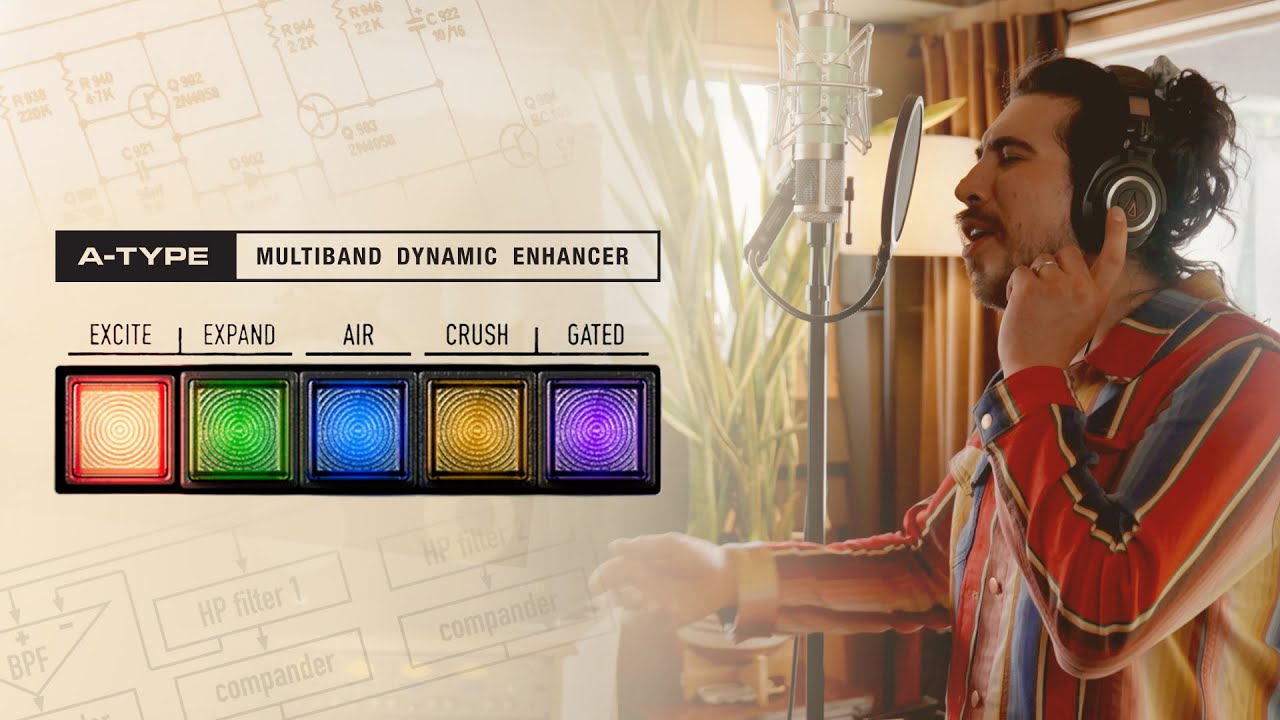
The five modes do meaningfully different things. EXCITE is the most gentle. Think of it as a presence enhancer that adds about 2-3dB of perceived clarity in the upper midrange without brittle artifacts. AIR lives above 8kHz and genuinely works on acoustic instruments. EXPAND widens the dynamic range rather than compressing it. CRUSH is where things get aggressive, a heavy compansion curve that introduces audible saturation and works brilliantly on drum room buses. GATED is the most extreme, and it's either perfect or disastrous depending on what you put through it.
The Circuit Mods panel is where this plugin separates from any other vintage tape emulation in the market. You get access to multiband gain controls, crossover frequency adjustments, Ratio, Knee, and Attack parameters, plus three sidechain filter options: flat, a 12dB/octave 150Hz highpass, and a Tilt filter with a linear 3dB/octave boost. The highpass sidechain is brilliant on vocals. It stops the low end from triggering the compansion and lets the upper mids and top end do the work cleanly.
We tested against the stock Neve 1073 emulation running parallel EQ and a Fairchild 670 on the same vocal chain. The A-Type got closer to where we wanted in fewer moves. That's not always the case. On a full drum bus, the 1073 into a bus compressor still beats it for sheer punch. But for nuanced vocal texture? The A-Type is the better tool.
CPU load sits at medium. Running three instances on a mid-2023 Apple Silicon machine didn't cause any issues. Running eight on an older Intel system got uncomfortable. We'd call it reasonable, not light.
Strengths and Weaknesses
The modeling quality here is genuinely impressive. UA claims this is the only end-to-end A-Type emulation available, and we have no reason to argue. The compansion curves feel right. The rare cartridge mods that UA built into the Circuit Mods panel add functionality that's actually useful rather than decorative.
EXCITE and AIR are the modes we'd use every session. CRUSH and GATED we'd reach for specifically. EXPAND is clever but takes patience to dial in without things sounding over-processed.
The frustrating part is the learning curve. If you don't already know what a Dolby A compander does, the plugin gives you very little help. There's no visual feedback showing what the multiband curves are doing. You're working by ear, which is fine in principle, but annoying when you're staring at five mode buttons trying to understand why the GATED mode is making your snare sound like it's in a trash can.
The Circuit Mods panel can be a trap. We pushed the crossover points too far on a vocal bus and introduced phasing artifacts that took fifteen minutes to identify. The controls are powerful. They're also easy to break with.
Value for the Price
At $149, this isn't an impulse buy. Check Universal Audio's site for current pricing, as they run sales regularly and the native version has appeared discounted on UA bundles.
We think the price is mostly justified if you're mixing vocals professionally or you work in genres where that specific compansion texture is a sound goal. For producers who want a general-purpose enhancer, it's too expensive and too nar row. The best vocal plugins for mixing roundup has options that cover more ground for less money.
If you already own a UAD interface and use it for tracking, the latency-free operation is a real selling point. That alone makes it worth considering seriously for vocals recorded hot in a session.
Who Should (and Shouldn't) Buy This
✅ Buy if you mix vocals professionally and want multiband dynamic shaping that doesn't sound like compression.
✅ Buy if you own UAD hardware and want to run it latency-free during tracking.
✅ Buy if you're chasing that specific 70s-80s studio texture and you've already tried EQ and compression.
❌ Skip if you're looking for a general-purpose mastering enhancer with broad applications.
❌ Skip if you're new to dynamics processing and don't have a solid foundation in compression concepts yet.
❌ Skip if your budget is tight. There are free enhancer plugins worth using that'll get you 60% of the way there.
Score Breakdown
| Category | Score | Notes |
|---|---|---|
| Sound Quality | 4.5/5 | Compansion modeling is accurate and the texture is genuinely unique |
| Value for Money | 3.5/5 | The price is fair for professionals but hard to justify for casual use |
| Ease of Use | 3.0/5 | Five modes are approachable; Circuit Mods requires real patience and knowledge |
| Features | 4.0/5 | Sidechain filtering and Circuit Mods go well beyond the original hardware |
| CPU Efficiency | 3.5/5 | Medium load; fine on modern machines, watch it on older Intel systems |
| Overall | 4.1/5 | Brilliant in its lane, but the lane is narrow and costs a good amount to enter |
Alternatives Worth Knowing About
If the A-Type feels too narrow for what you need, three alternatives are worth your time.
Waves Vitamin Sonic Enhancer covers similar territory at a lower price. It's a multiband harmonic enhancer with five bands you can adjust independently. Less historically accurate, more immediately useful for beginners. Waves Vitamin review
Sonnox Oxford SuprEsser DS approaches the dynamic frequency shaping problem from a different angle, as a dynamic EQ and de-esser with surgical control. It's more clinical than the A-Type but gives you visual feedback that beginners and intermediate engineers will love. best dynamic EQ plugins
iZotope Nectar 4 is the broader solution for vocal processing. It combines multiband dynamics, harmonic excitation, and intelligent pitch correction in one plugin. More expensive, more capable, and covers far more of the vocal production workflow. iZotope Nectar 4 review
Our Final Take
The A-Type Multiband Dynamic Enhancer does something most plugins don't: it models a piece of hardware that was being misused as an artistic feature, then it does that misuse correctly. That's a love letter to a very specific era of recording, and it sounds brilliant when you're making music that lives in that space.
We'd buy it for vocals. We'd use EXCITE and AIR the most. We'd leave GATED for moments where we specifically want things to go wrong in a controlled way.
It's not for everyone. If you're after a general-purpose enhancement tool, skip it and look at the best audio enhancer plugins for mixing list instead. But if you've ever heard a 1977 Fleetwood Mac vocal sit perfectly in a dense arrangement and wondered what was doing that, the A-Type is as close as you'll get to the answer.
Some tools sound like history. This one sounds like the engineers who broke the rules with it.
Frequently Asked Questions
What does the A-Type Multiband Dynamic Enhancer actually do to a signal?
It applies a four-band compansion curve modeled on the Dolby A noise reduction hardware from 1965. Instead of compressing the full signal, it processes four separate frequency regions with a combination of compression and expansion. The result is a dynamic tonal shift rather than a static EQ boost, which is why it can add presence and clarity without the brittle artifacts a standard EQ sometimes introduces.
Is the A-Type plugin only available on UAD hardware?
No. It was originally a UAD/Apollo exclusive but is now available as a native plugin for Mac and Windows. The native version runs on standard CPU rather than DSP hardware. UAD hardware still offers the latency-free tracking benefit, but you don't need an Apollo interface to buy and run the plugin.
What's the difference between the five modes?
EXCITE adds upper-midrange presence and clarity. AIR targets frequencies above 8kHz and works well on acoustic instruments and breathy vocals. EXPAND increases dynamic range rather than compressing it. CRUSH applies a heavy compansion curve with audible saturation, best on drums and room buses. GATED is the most extreme mode, introducing hard dynamic shaping that works in specific aggressive contexts and sounds broken everywhere else. Start with EXCITE if you're new to the plugin.
How does the Circuit Mods panel differ from what the original hardware could do?
The original Dolby A hardware had no user-accessible controls for its internal crossover points, ratios, knee, or attack. Circuit Mods opens all of those parameters up, plus adds sidechain filtering options including a 12dB/octave 150Hz highpass and a linear 3dB/octave Tilt filter. These weren't present in the hardware at all. They're additions that UA built into the plugin to extend what the circuit can do, making it more flexible for mixing than the original unit ever was.