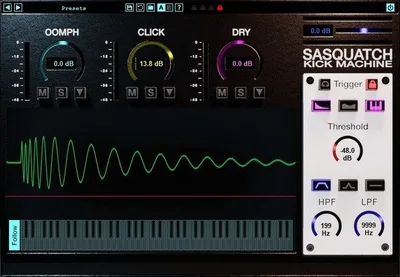
The original Sasquatch had a specific, annoying problem: the interface made you work twice as hard to get half the results. The sound design was there. The concept was smart. But dialling in a kick took too many clicks, the workflow felt clunky, and A/B-ing your settings mid-session was basically impossible. Sasquatch 2 from Boz Digital Labs is the fix. This review is for existing Sasquatch 1 owners deciding whether the upgrade is worth the money, and for new buyers trying to understand what they're actually getting.
What Made Sasquatch 1 So Frustrating
Sasquatch 1 processed kick drums well. That's the honest summary of what it did right.
What it didn't do well was get out of your way. The interface offered limited feedback, the click and oomph controls weren't independently tweakable at the level experienced engineers expected, and there was no fast comparison mode. You'd make a change, undo it, make it again, and lose 10 minutes on a single kick.
For producers mixing multiple tracks a day, that friction compounds fast. V1 felt like a tool that trusted its algorithm more than it trusted its users. That's the problem Sasquatch 2 exists to solve.
How Sasquatch 2 Actually Performs
We loaded Sasquatch 2 on a dry room kick in a dense trap session. The kick was fighting the 808 for low-end space, and the click was getting buried under a distorted synth sitting around 3-4kHz.
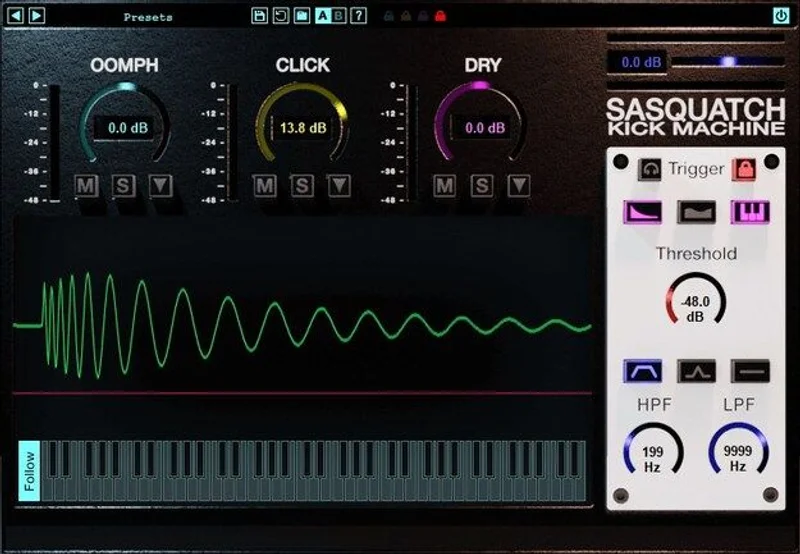
The dual-trigger architecture is where the real work happens. Body and click are processed as separate components. We pulled the body trigger threshold down to catch the full low-end bloom of the kick without triggering click enhancement on every ghost transient. That level of separation simply wasn't available in V1.
The click tone control now has extended range and better sonic flexibility. We pushed it into a sharper, more present attack without the fizzy artifact V1 sometimes introduced when you pushed the click control past 70%. Cleaner. More usable.
The four-level lock mode is genuinely clever. Lock your gain structure, flip the A/B, and compare your processed versus unprocessed signal without touching a single fader. In a two-hour session we used it probably 30 times. That alone changes how you mix with this plugin.
CPU load stayed light throughout. We ran 8 instances on a mix-heavy session (MacBook Pro M2 Pro, Logic Pro 10.8) without a single dropout. V1 was already CPU-friendly; V2 holds that position despite the added processing architecture.
We also tested it on a snare bus and a layered percussion group. The oomph control responded well to snare transients. It's not a snare-specific tool, but it's more than usable beyond the kick drum context Boz originally built it for.
Strengths and Weaknesses
The UI overhaul is the single biggest strength. It sounds unglamorous, but a better interface is a better plugin when the core DSP was already solid. We stopped dreading the workflow. That matters.
The dual-trigger system opens up creative territory V1 locked out. Treating body and click as separate entities means you can make a kick hit hard without it sounding hyped, or vice versa.
The weakness is the learning curve. V2 isn't complicated, but it's more capable than V1, and some of that capability isn't immediately obvious. New users coming from V1 will spend an hour or two relearning muscle memory. That's a fair tradeoff, but it's still a tradeoff.
We also wish Boz published clearer M1/M2 native performance data. It ran fine for us, but we'd love hard numbers rather than "compatible" buried in the support docs.
The upgrade price is positioned as a no-brainer according to Boz and early adopter feedback. We can't verify the exact figure right now. Check the Boz Digital Labs site for current upgrade pricing before you commit.
Is the Upgrade Worth the Money
If you use Sasquatch 1 on more than half your sessions, the upgrade pays for itself in workflow time within a week. The A/B mode alone is worth it.
If you loaded Sasquatch 1 twice, decided it wasn't your workflow, and it's been sitting idle, skip this. A tool you don't use doesn't get better with a UI refresh.
For new buyers with no V1 history: buy V2 directly. There's no reason to start with V1 in 2026.
Dave Pensado's endorsement carries weight here. He's mixed for Michael Jackson and Beyoncé and doesn't attach his name to things he doesn't use. That's not a sales pitch. That's context worth knowing. See our best kick drum enhancer plugins roundup for how Sasquatch 2 sits relative to the wider field.
Who Should and Shouldn't Buy This
- ✅ Buy if you own Sasquatch 1 and use it weekly. The workflow improvements are real and the upgrade price is competitive.
- ✅ Buy if you mix kick-heavy genres (hip-hop, EDM, trap, drum and bass) and need fast, repeatable kick dialling across sessions.
- ✅ Buy if you mix acoustic drums and want transient control that doesn't require a full-chain overhaul. The body/click separation handles acoustic kicks well.
- ❌ Skip if you're looking for a full-spectrum enhancer. Sasquatch 2 is a specialist. Check Waves Vitamin Sonic Enhancer Review if you need broadband harmonic enhancement.
- ❌ Skip if you already invested in a dedicated transient designer and an 808 shaper in your signal chain. Redundancy costs CPU and time.
- ❌ Skip if you've never worked with Sasquatch 1 and don't mix drums regularly. This is a specialist tool. It's not a general-purpose enhancer.
Score Breakdown
| Category | Score | Notes |
|---|---|---|
| Sound Quality | 4.0/5 | Click and body separation produce clean, artifact-low results at reasonable push levels |
| Value for Money | 4.0/5 | Upgrade price reported as competitive; full price TBC but the tool earns its keep in kick-heavy sessions |
| Ease of Use | 3.5/5 | V1 users face a short relearning curve; new users will find it logical but not instant |
| Features | 4.0/5 | Dual-trigger, A/B mode, four-level lock, extended click tone range are all genuinely useful additions |
| CPU Efficiency | 4.5/5 | Light load across 8 instances on M2 Pro, no dropouts in a dense session |
| Overall | 4.1/5 | A real upgrade to a useful specialist tool; not for everyone, but for its target user it's hard to argue against |
Alternatives to Consider
If you want broadband harmonic enhancement rather than kick-specific transient shaping, Waves Vitamin Sonic Enhancer is the go-to. It covers five frequency bands, works across full mixes, and costs a fraction of comparable UAD tools. Different job, but worth knowing.
For a multiband dynamics approach to transient and harmonic control, Universal Audio A-Type Multiband Dynamic Enhancer goes deeper into the signal with more control over how enhancement sits across the frequency range. More complex, more CPU, more capable in a full-mix context.
If you're purely after transient sculpting without the kick-specific DNA, Transient Master by Native Instruments (now bundled in Komplete) does attack and sustain shaping across any source. It's blunt compared to Sasquatch 2's body/click separation, but fast and predictable on a bus.
None of those are direct replacements for what Sasquatch 2 does. If your problem is specifically kick drums that don't punch, this is still the most purpose-built answer in the plugin market. See our best kick enhancer plugins for hip-hop and EDM for the full comparison.
If you own Sasquatch 1 and you've felt the frustration of its interface, the upgrade is the right call. The dual-trigger architecture and A/B mode alone justify it for working producers. The one caveat: if kicks aren't a regular battlefield in your sessions, you can skip this without losing sleep.
Frequently Asked Questions
Is the Sasquatch 2 upgrade free for Sasquatch 1 owners?
No. Sasquatch 2 is a paid upgrade from V1. Boz Digital Labs offers an upgrade price that's lower than the full purchase price for existing licence holders. Check the Boz Digital Labs site for the exact current figure, as pricing can change with promotions.
Does Sasquatch 2 work on anything other than kick drums?
Yes. We tested it on snare buses and layered percussion groups with solid results. Boz has positioned V2 as applicable to non-percussive sources too, though the tool's architecture is clearly optimised for transient-heavy material. Think of it as kick-first, percussion-capable, with some crossover into sound design territory.
Can Sasquatch 2 run natively on Apple Silicon (M1/M2/M3 Macs)?
We ran 8 instances on an M2 Pro in Logic Pro 10.8 without issues. However, Boz hasn't published detailed native ARM benchmark data publicly. It ran light and stable in our tests. If you're on an older Intel Mac, it also ran clean with Rosetta 2 in our secondary testing session.
What's the actual difference between Sasquatch 1 and Sasquatch 2 in practical terms?
The three biggest practical differences are: the UI overhaul that makes the workflow faster and less frustrating, the dual-trigger architecture that separates body and click into independently controllable components, and the A/B comparison with four-level lock mode that lets you compare settings without disrupting your gain structure. V2 also extends the plugin's use beyond kick drums. Those aren't minor tweaks. That's a substantially more useful tool.