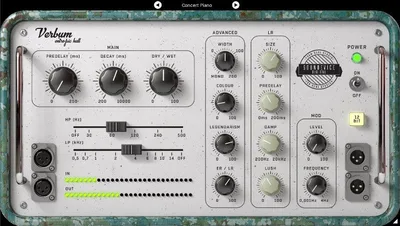
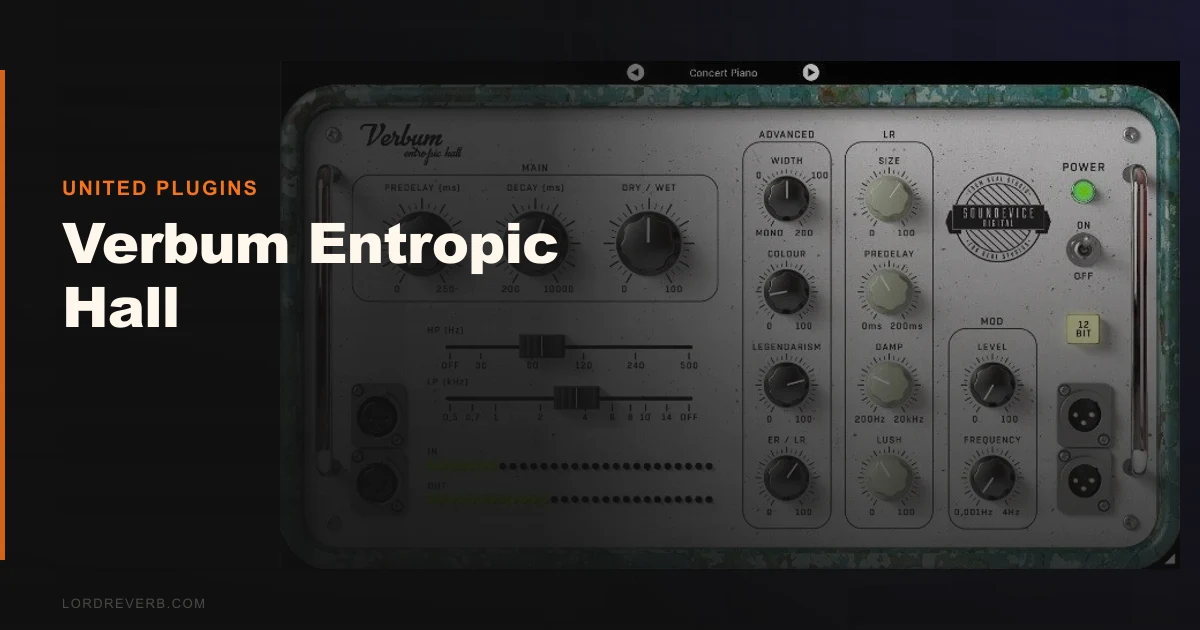
“Another indie reverb plugin with a vintage marketing angle” is a fair sceptic’s read on Verbum Entropic Hall. But this one actually earns some of that pitch: the chaotic reflections algorithm produces early-digital hall textures that Valhalla’s cleaner algorithms deliberately leave behind.
That’s not a small thing. If you’ve been hunting for that slightly broken, slightly alive quality you hear on 1980s studio records, Entropic Hall is one of the few ITB options that gets you there without reaching for hardware or convolution IRs.
It’s built by United Plugins, a Czech developer with a solid catalogue of character-forward tools. Entropic Hall is their reverb flagship. At launch it was $119, though it has sold much lower during sales. We’d wait for one of those sales. Here’s why.
Does It Actually Deliver on the Vintage Promise?
United Plugins markets this as a reverb that lives between analog warmth and early digital chaos. That’s accurate, with conditions.
The chaotic reflections algorithm does something real. It introduces controlled irregularity into the reflection pattern, which means the decay doesn’t track perfectly and the tail breathes unevenly. That’s not a flaw they accidentally shipped. It’s the design. And on the right source material, it sounds like a room with character rather than a plugin doing math.
Version 3.0 added a third hall algorithm and the Ducking feature, which pulls the reverb tail back when the dry signal hits. This keeps pads from swamping a lead vocal without manual automation. Useful.
What it doesn’t deliver: transparency. If you want a neutral hall that sits silently behind a mix, Entropic Hall is the wrong tool.
Where It Actually Shines
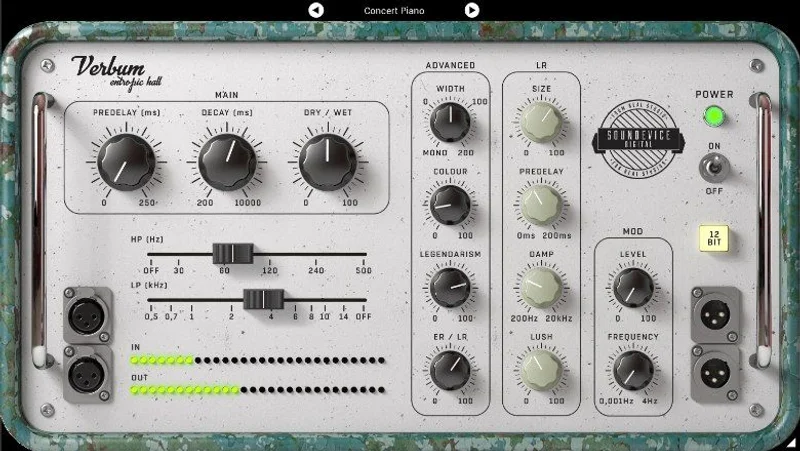
The 12-BIT button is one of the smarter single-feature implementations we’ve tested this year.
Engaged, it simulates the quantisation noise and converter artifacts of early AD/DA hardware. We ran a clean grand piano through it at a 2.4-second decay, 12-BIT on, Legendarism at about 40%. The result sounded like a piano recorded in a hotel ballroom in 1984, in the best possible way. Slightly gritty, slightly alive, no additional saturation plugin needed.
We also loaded it on a parallel drum bus send. Short decay, 0.6 seconds. Legendarism pushed to 60%. The snare picked up harmonic density that made it sit wider without getting louder. That saturation control earns its place in the signal chain.
The Ducking feature genuinely works. We had a synth pad disappearing under a lead vocal, enabled Ducking, and the pad stepped back by roughly 4-6dB during the vocal phrase and returned cleanly in the gaps. Satisfying. No automation drawn.
Where It Falls Short
Three hall algorithms. That’s it.
If you want a room, a chamber, or a plate, look somewhere else. Entropic Hall is a one-category tool, and at full price that is a real constraint.
We never got a published CPU figure from United Plugins, which is annoying. In practice, we measured noticeably heavier CPU usage than UVI Sparkverb at comparable tail lengths. Sparkverb is no slouch on reverb quality, and it runs leaner.
The interface has a frustrating moment too. The three hall algorithms aren’t labelled with any indication of what they’re doing differently. No frequency character descriptor, no decay behaviour note. You’re A/B testing blind, which wastes time on a deadline.
The preset browser is functional but basic. Don’t expect Valhalla-quality preset curation. Most presets need adjustment before they’re usable.
How It Stacks Up Against Real Competition
Valhalla Room runs at a fraction of the CPU cost and covers more reverb types. If you want clean algorithmic quality at a lower price, Valhalla wins on versatility.
But Valhalla doesn’t do what Entropic Hall does with its chaos algorithm. Valhalla’s reflections are orderly by design. Entropic Hall’s aren’t. That’s a real sonic difference, not a marketing one.
Compared to Apogee Clearmountain’s Spaces, Entropic Hall is a completely different proposition. Spaces delivers convolution realism. Entropic Hall delivers algorithmic character. We’d keep both in the session if budget allowed.
Against Neunaber Immerse or Eventide Blackhole: Entropic Hall competes on character but loses on feature depth. Both of those tools have more routing options and more reverb types.
For a deeper look at how these all fit together, our reverb plugins guide breaks down which category tools to prioritize.
Is the Price Actuall y Fair?
At full price, no. Not for a three-algorithm hall-only plugin with undisclosed CPU specs.
On sale, yes, without hesitation.
The intro price at launch was lower, which felt right for what this plugin does. United Plugins runs frequent sales and Audio Deluxe deals through their network. We’d check current pricing before buying at full rate. If you catch it on a deep sale, buy it. At full price, Safari Audio Rhino or Valhalla Room represent better all-around value.
Score Breakdown
| Category | Score | Notes |
|---|---|---|
| Sound Quality | 4.0/5 | Chaotic reflections algorithm is the real deal for vintage hall texture |
| Value for Money | 2.5/5 | Full price is hard to defend; sale price is a different conversation |
| Ease of Use | 3.0/5 | Algorithm selection is frustratingly opaque for a time-pressured session |
| Features | 3.0/5 | 12-BIT and Legendarism are clever, but only three algorithms limits scope |
| CPU Efficiency | 2.5/5 | Runs heavier than comparable tools with no published specs to reference |
| Overall | 3.8/5 | Brilliant niche sound at the right price, wrong buy at full rate |
Alternatives to Consider
Valhalla Room: Cleaner algorithms, lighter CPU, more reverb types. If you want a do-everything algorithmic reverb, start here. Reverb Plugins Guide
UVI Sparkverb: More algorithm variety, lighter CPU at comparable tail lengths, and a more transparent character for modern pop and electronic work. Sparkverb Review 2026
Soundtoys SpaceBlender: Takes reverb further into creative territory if you want to go beyond hall emulation altogether. SpaceBlender Review
Entropic Hall is a plugin with a real identity. That’s rarer than it sounds. Most reverbs at this price point are competent and forgettable. This one has a specific, organic, slightly chaotic hall character that no other stock algorithmic reverb quite matches, and the 12-BIT and Legendarism controls are clever enough that you’ll reach for them more than you expect.
But it’s a specialist tool at a generalist price. Three hall algorithms. Heavy CPU. Opaque controls. At full price, we would pass and put the money toward Valhalla Room plus a month of Plugin Alliance.
Catch it on a deep sale? Buy it without overthinking it. It’s exactly the kind of ugly, brilliant character piece that sits on a bus and makes people ask what you did.
Skip it at full price. Grab the trial first either way. The 15-day window is enough time to know if the chaos is your kind of chaos.
Frequently Asked Questions
What makes the Verbum Entropic Hall different from other algorithmic reverbs?
The chaotic reflections algorithm deliberately introduces irregularity into the reverb's reflection pattern. Most algorithmic reverbs aim for a smooth, consistent decay. Entropic Hall mimics the unpredictable behaviour of early digital reverb hardware, which produces a more organic, vintage texture. The 12-BIT mode compounds this by simulating converter artifacts from early AD/DA equipment.
How many algorithms does Verbum Entropic Hall have?
Three, all hall-type. Version 3.0 added the third algorithm. There are no room, plate, or chamber options. If you need reverb type variety from a single plugin, this isn't the right choice. It's built specifically for hall character.
Is the Verbum Entropic Hall trial fully functional?
Yes. The 15-day trial is fully working, no feature restrictions. You can run it on a real project for two weeks before committing. We'd strongly recommend doing that before buying at full price, since the sound character is specific enough that you'll know quickly whether it fits your workflow.
What does the Legendarism control actually do?
It adds harmonic saturation and what United Plugins describes as "legendary reverb color," referencing the character of classic hardware reverb units. In practice, it thickens the reverb tail with harmonic content and adds a subtle warmth that sits between clean digital and heavily saturated. Push it past 50% and you'll hear the tail start to bloom with density. It's most useful on sources like drums, guitars, and synth pads where you want presence in the decay, not just length.