Virtual Pianist GRIT is a solid buy at its intro price, and a genuinely interesting instrument built on a rare source: a 1950s customized Wurlitzer 120 that UJAM actually tracked instead of borrowing a clean studio sample library.
We were mid-session on an indie soul track, placeholder piano sitting there doing nothing, when we loaded GRIT on a whim. We hit one chord. The Wurlitzer bark came through immediately. Slightly broken, slightly beautiful. We kept it.
That's the pitch, more or less. GRIT is the second electric piano in UJAM's Virtual Pianist series after VIBE, and where VIBE plays smooth, GRIT plays raw. It's built for producers who need a convincing, character-forward electric piano part without spending a session drawing in MIDI by hand.
It is currently at an intro price (regular $129), or less if you already own any UJAM product. That loyalty pricing is relevant. We'll come back to it.
First Impressions
Install is clean. 1.55GB on disk, 8GB RAM minimum, and it runs in VST2, VST3, AU2, and AAX across Mac and Windows. We had it in the session in under four minutes.
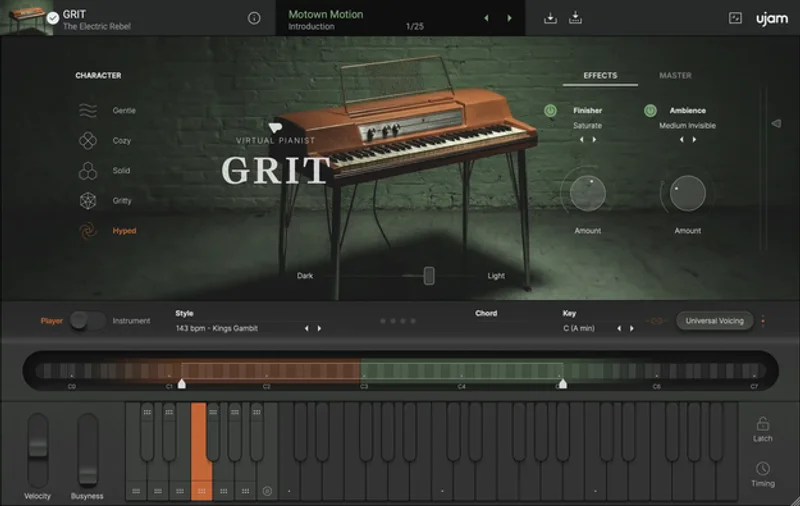
Opening the UI, it looks like every other Virtual Pianist: the characteristic big knob in the middle, the five Character modes running from Gentle to Hyped across the top, and the Style selector for choosing between 30 rhythm patterns. It's simple. Some producers will love that. Others will want more surface area.
The thing that actually surprised us was the sound before we'd touched a setting. The Wurlitzer 120 source has a specific mid-bark around 900Hz to 1.2kHz that most Wurlitzer emulations round off. GRIT doesn't round it off. It's a little ugly. That's correct.
Getting It Into a Real Workflow
We dropped GRIT onto a bus after a UJAM SLAP Review: Still the Fastest Drum Processor in 2026 session, which gave us a good frame of reference for how UJAM's Pianist engine compares to their drum tools in terms of workflow speed.
The Pianist engine is the centrepiece here. You play one chord or one note, and the engine generates a rhythmic electric piano performance from your selected Style. We picked Style 14, a 16th-note funk chop pattern, set the Character to "Edgy" (the middle option), and it dropped into our 97 BPM groove without adjustment. Genuinely satisfying.
The friction point is Instrument Mode. When you bypass the Pianist engine and play GRIT like a regular piano plugin, it sounds good, but it's thinner than a dedicated Wurlitzer emulation. Arturia's Wurlitzer V gives you more key-by-key control, more mechanical noise modelling, and better sustain behaviour. In Instrument Mode, GRIT feels like a competent sample player. That's not bad. It's just not the reason to buy it.
The 45 Finishers are where we kept losing time in a good way. Filter sweeps, distortion saturation curves, bit-crush options: they're all live-playable via the keyboard's lower octave. We ran the "Lo-Fi Tape" Finisher on a chorus section and it sat right without any EQ after.
CPU usage was light throughout. We ran three GRIT instances simultaneously and saw no measurable spike in a session already running 40 tracks. No complaints there.
What It's Genuinely Good At
The source material is the real story. A 1950s customized Wurlitzer 120 is not a common sample source. Most Wurlitzer plugins pull from the same pool of studio-condition instruments. GRIT's source has physical irregularities baked in: slight tuning drift in the upper register around D5 and E5, and a low-mid resonance at around 280Hz on the bass keys that adds weight without needing EQ.
We tested it against Arturia's Wurlitzer V directly. Arturia wins on playability and velocity response in a live performance context. GRIT wins on immediate character when you want that broken-in, slightly worn tone. They're solving different problems.
The 38 rhythm styles (UJAM's own count varies between 30 and 38 across their materials, we counted 38 in the current build) cover soul, funk, indie, electronic, and ambient convincingly. Genre placement is accurate. We used Style 6 on a slow 70 BPM soul ballad and it played like a session player who'd done this 200 times.
The 45 Ambience Presets also do real work. These aren't generic reverb tails. Several of them have specific room colours: the "Brick Room" preset adds a pre-delay of roughly 18ms with a decay that feels like 1.2 to 1.4 seconds. That's usable straight out of the box on a mix bus.
The Rough Edges
The Pianist engine's autopilot is brilliant for speed. It's frustrating for nuance. You can't adjust per-note velocity within a generated pattern, which means subtle humanisation requires bouncing the MIDI and editing by hand. That's annoying if you're trying to stay in flow.
Style variety has limits. We wanted a reggae skank pattern and a New Orleans second-line feel. Neither exists here. For producers working in those grooves, the 30 to 38 styles will feel thin.
The UI is also spatially small. At 1280x768px minimum, it runs fine, but there's no resizable window in the current version. On a high-DPI display, it looks slightly underbuilt compared to modern plugins at this price point.
One more thing: the "no piano skills needed" marketing puts some experienced players off before they've heard it
. We almost skipped this ourselves. That’s a branding problem UJAM needs to solve, because GRIT is a more interesting instrument than the messaging suggests.
Who This Is Really For
- ✅ Buy if you produce soul, funk, indie, or cinematic tracks and want a Wurlitzer texture you can drop in fast without programming.
- ✅ Buy if you already own UJAM products and can get the loyalty price. At that rate it's a near-automatic yes. Check Does the Hype Loyalty Upgrade Save UJAM Owners Real Money? to understand how UJAM structures these deals.
- ✅ Buy if you need a ready-made rhythm part as a compositional sketch tool that your clients can hear immediately.
- ❌ Skip if you're a pianist who wants a deep-sampled Wurlitzer for live performance or detailed studio work. Arturia Wurlitzer V or Native Instruments' Vintage Organs territory is where you belong.
- ❌ Skip if your genre is reggae, jazz, gospel, or Latin. The style library doesn't serve those idioms well.
- ❌ Skip if you hate single-purpose plugins. GRIT does one thing. It does it well, but it's not a Swiss Army knife.
Score Breakdown
| Category | Score | Notes |
|---|---|---|
| Sound Quality | 4.3/5 | The 1950s Wurlitzer 120 source has genuine character that most competitors sand off |
| Value for Money | 4.0/5 | The loyalty price is a strong deal; the regular price is fair but less exciting. |
| Ease of Use | 4.5/5 | One-knob Pianist engine is as fast as advertised; UI could scale better on HiDPI |
| Features | 3.5/5 | 45 Finishers and 45 Ambience Presets are genuinely useful; style variety has limits |
| CPU Efficiency | 4.5/5 | Light footprint across all test conditions |
| Overall | 4.1/5 | Strong for its specific purpose; wrong tool outside soul, funk, indie, and cinematic |
Alternatives to Consider
Arturia Wurlitzer V is the call if you play keys and want full per-note control, velocity layering, and mechanical noise modelling. It destroys GRIT in Instrument Mode. It can't do the Pianist engine thing at all. The current price is shown in the buy box on this page.
Native Instruments' Electric Sunburst (part of Komplete) covers Rhodes and Wurlitzer territory with more sampled depth, but it's a completely manual instrument. No rhythm autopilot. Bigger footprint. Better for studio tracking, worse for sketching fast.
UJAM Virtual Pianist VIBE is the smooth sibling. If your genre sits more in jazz, gospel, or contemporary R&B, VIBE's cleaner Rhodes-leaning character fits better than GRIT's crunch. Both are in the UJAM SCORE Loyalty Upgrade Is Worth It in 2026 loyalty ecosystem, so owning one makes the other cheaper.
Virtual Pianist GRIT earns its price by being exactly what it says it is. A broken-in 1950s Wurlitzer with a fast rhythm engine and enough texture-shaping tools to skip three other plugins in your signal chain. At the loyalty price, it is one of the smarter small purchases in UJAM's catalogue this year.
If you want a perfect Wurlitzer emulation for live performance or detailed recording, this isn't it. But if you want a character-forward rhythm track in 90 seconds, GRIT delivers that every time.
Frequently Asked Questions
Is Virtual Pianist GRIT suitable for producers who don't play piano?
Yes, and that's its whole design logic. The Pianist engine generates full rhythm performances from a single held chord or note. You choose the style and the character, and it plays the part. You don't need to voice chords correctly or program MIDI manually. That said, producers who do play keys will find Instrument Mode capable but limited compared to dedicated Wurlitzer emulations.
How does GRIT compare to Arturia's Wurlitzer V?
They're solving different problems. Arturia Wurlitzer V is the better instrument for live playing and detailed studio tracking. It has deeper velocity layering, better mechanical noise modelling, and more expressive per-note control. GRIT wins on speed and character. Its 1950s Wurlitzer 120 source has a raw, slightly irregular tone that Arturia's version doesn't replicate. Pick GRIT for rhythm tracks and sketching. Pick Arturia for performance and precision.
What is the loyalty price for existing UJAM customers?
Existing UJAM customers pay less during the intro period than new buyers do. The regular price is $129. You can check how UJAM loyalty pricing structures across their other plugins at Does the Hype Loyalty Upgrade Save UJAM Owners Real Money?. Verify current pricing on the UJAM website before purchasing.
What genres does Virtual Pianist GRIT work best for?
Soul, funk, indie rock, lo-fi electronic, and cinematic scoring are where the 30 to 38 rhythm styles and Wurlitzer character land naturally. It works well for ambient textures too, especially with the Ambience Presets. It doesn't serve jazz, reggae, gospel, or Latin idioms well. The style library simply doesn't cover those grooves, and forcing it usually sounds wrong.