If you can't export MIDI patterns from a drum library, you're locked into whatever phrases the developer chose, and that's exactly where UJAM Symphonic Elements DRUMS draws its line. There's no MIDI export here. What you hear is what you get, and if a phrase doesn't fit your bar structure or your tempo map bends at bar 16, you're problem-solving around the plugin rather than with it. That's the thing to know before anything else. If you need full editorial control over individual drum hits and rhythmic placement, this isn't your tool. But if you're a composer staring down a deadline and you need a cinematic drum track that sounds like it belongs in a Hans Zimmer score, at $249, this is one of the more honest value propositions in the orchestral plugin space right now.
The Catch Up Front
No MIDI export. Say it again so it sticks. You cannot drag patterns out of DRUMS and into your piano roll. The phrase-based engine is the whole design philosophy here, which means you're working with pre-arranged rhythmic content that you shape rather than build from scratch.
The mid-range drum elements are baked into the mix. There's no dedicated mid-drum control to pull them out or push them up independently. Some reviewers flag this as a real mixing headache, and we think it's a fair complaint.
Some presets also carry heavy ambience that you can't turn off at the preset level. You can work around it with the Finisher and Ambience tools, but disabling ambience that's already cooked into a preset takes extra steps.
One user report noted that drum patterns can sound identical across styles despite using different instrumentation. That's worth watching for when you're stacking multiple cues in the same project.
Plugin formats listed are VST2 and AU 2. For up-to-date info on VST3 and AAX support, UJAM's own website is the place to check. AU 2 works with Logic Pro X and newer only. Authorization requires an internet connection and a ujam.com account.
What You Get If You Clear It
At its core, DRUMS gives you 60 playing Styles and over 300 custom-designed phrases. These aren't drum loops in the traditional sense. The dedicated UJAM performance engine reads the MIDI notes you play and transforms them into fully arranged rhythmic performances. Play a chord and get a groove. Play a single note and get a hit or a roll. The developer says the engine keeps everything in time and musically on point with no programming needed.
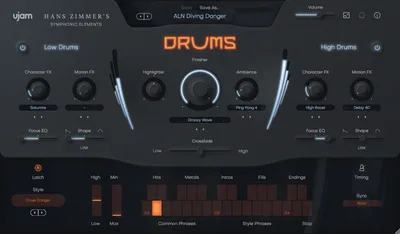
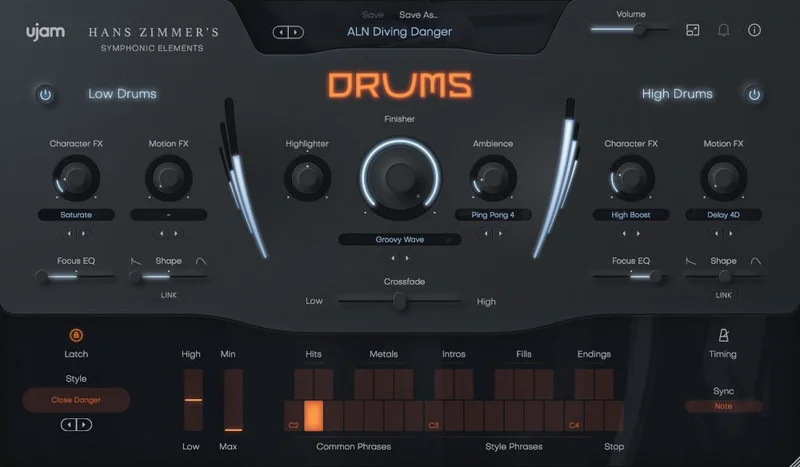
The interface splits the kit into two sections: Low Drums (bass drums, timpani) and High Drums (snares, toms). A Crossfade slider balances those two layers against each other. Each section has its own Character and Motion FX controls, so you can add texture to the lows independently from the highs.
The Sound Design section is where things get interesting for non-traditional use. Over 200 Finisher presets let you push orchestral drums into distorted impacts, shimmering textures, and abstract cinematic layers. Built-in Ambience effects add spatial depth. The whole library sits at 1.4 GB, which is lean for what's inside.
The recordings come from Hans Zimmer's Remote Control Studios. Boris Salchow arranged the content. That provenance isn't marketing fluff. Reviewers across the board report being pleasantly surprised by the variety across percussion ensembles: taikos, metals, brushes, all sitting under different styles.
Where It Shines
Speed is the honest answer. Reviewers report getting usable, epic cinematic drum tracks down fast, specifically under deadline pressure. That's the scenario this plugin was built for.
The phrase variety is wider than the style count suggests. With over 300 phrases distributed across 60 styles, you're getting an average of five distinct phrases per style. Across styles that use different underlying percussion ensembles, taikos versus metals versus brushes, the textural shift is real. Reviewers report being pleasantly surprised by how different the ensembles feel from each other.
The Low/High split with the Crossfade slider is genuinely useful. You can push the Low Drums forward on a tension cue, pull them back when you need delicacy, and use Motion FX on the High Drums to add rhythmic energy independently. This isn't the granular control of a full orchestral library, but it's more than most phrase-based tools give you.
The Finisher presets are a legitimate selling point for sound designers. 200+ presets that reshape orchestral percussion into abstract textures means DRUMS works as a source instrument for hybrid scoring, not just a straight rhythm track. Load a metallic percussion style and push the Finisher toward distorted impacts. That's a different creative direction than the box suggests.
For composers who don't have deep orchestration expertise, the intelligent engine handling arrangement complexity is the whole point. You're not programming cymbal swells by hand. You're writing the story and letting the plugin handle the drum mechanics.
Against the Field
Sonuscore's The Orchestra Complete covers a broader orchestral palette and leans more traditional if you want the whole ensemble in one place, not just the rhythm section.
Heavyocity NOVO review and FORZO are the names that come up in the same conversation. They're more expensive, they require Kontakt, and they give you significantly more granular control over individual elements. If your budget stretches and you need that level of detail, Heavyocity is where serious cinematic composers often land.
Perc X takes a similar phrase-based approach to percussion and is worth comparing if playable percussion with a simpler interface is what you're after.
Where DRUMS wins against all of them: speed of deployment, the Remote Control Studios recording pedigree at this price, and the Finisher sound design tools being built in rather than bolted on. If you're working in the box on a tight timeline and you need cinematic drums with no Kontakt dependency, $249 for what's inside here is competitive.
Who Should Buy This
- ✅ Buy if you're a media composer scoring to picture and need credible cinematic drum tracks without spending hours programming patterns from scratch.
- ✅ Buy if you work hybrid or electronic scores and want a sound design percussion source. The 200+ Finisher presets push this well past straight orchestral use.
- ✅ Buy if you're building orchestral sketches and need something that produces a full rhythmic section from a few MIDI notes, fast.
- ❌ Skip if you need MIDI export to rearrange individual hits in your DAW. This is a hard architectural limit, not a workaround.
- ❌ Skip if you're producing non-cinematic genres. The 60 styles are built for film and trailer scoring. There's no pop, jazz or hybrid EDM workflow here.
- ❌ Skip if you need independent control over mid-range drum elements in your mix. That separation isn't available, and reviewers note it as a real friction point.
Specs & Technical Details
| Developer | UJAM |
| Price | $249 |
| Plugin Format | VST2, AU 2 (VST3 / AAX: check UJAM website) |
| OS Support | Windows 7 or later (64-bit) / macOS 10.14 to 14 (64-bit) |
| Activation | Email and password via ujam.com account, internet connection required |
| CPU Usage | N/A |
| Trial Available | N/A |
| Version Reviewed | N/A |
Score Breakdown
| Category | Score | Notes |
|---|---|---|
| Sound Quality | 4.5/5 | Remote Control Studios recordings give it genuine cinematic weight; reviewers consistently rate the ensemble variety higher than expected |
| Value for Money | 4.0/5 | Competitive at $249 given the recording pedigree and Finisher tools; the MIDI export gap is a real cost for some workflows |
| Ease of Use | 4.5/5 | Macro-based interface is fast and uncluttered; the learning curve is nearly flat for the core workflow |
| Features | 3.5/5 | 60 styles and 200+ Finisher presets are strong; no MIDI export and baked-in mids cap the score |
| CPU Efficiency | 4.0/5 | 1.4 GB footprint is lean; CPU behaviour under heavy automation is not well documented publicly |
| Overall | 4.1/5 | Strong cinematic drum tool with a clear design philosophy; the phrase-based architecture is both its biggest strength and its main limit |
Alternatives to Consider
Sonuscore The Orchestra Complete review takes a more traditional orchestral approach. If you want a full ensemble palette rather than a percussion-focused tool, it's worth a look alongside DRUMS.
Heavyocity's NOVO and FORZO sit at a higher price point and require Kontakt. They give you more granular control over individual elements and deeper sound design options. If you're a professional film composer who needs that level of detail, the price difference is justified. If you're sketching or working on mid-budget projects, it probably isn't.
Perc X is worth comparing if you want a playable phrase-based percussion tool with a simpler interface and a lower entry cost. It's a different product with a different scope, but the underlying workflow philosophy is similar enough to make the comparison useful.
The Honest Bottom Line
Symphonic Elements DRUMS is a frustrating plugin to categorise because it does one thing brilliantly and refuses to do several things that experienced composers will want.
The brilliant part: you load it, pick a style, play a few notes, and you have a cinematic drum arrangement that sounds like it came from a big-budget studio session. The recording pedigree is real. Reviewers report that the ensemble variety across styles, taikos, metals, brushes, is wider than the spec sheet implies. For sketch work and deadline scoring, it's satisfying in a way that's hard to overstate.
The frustrating part: the lack of MIDI export is a genuine wall. If you want to pull a phrase into your DAW and adjust the kick placement on bar 3, you can't. The mid-range elements being baked in is annoying when you're trying to carve space in a dense mix. Some presets carry ambience that you didn't ask for and can't cleanly remove.
One of four reviews gave it 7/10 specifically because of mix integration concerns. That's a legitimate minority position, not an outlier. If mix integration is your priority, go in with your eyes open.
At $249, this is not a hobbyist impulse buy and it's not a professional's complete percussion solution. It sits squarely in the middle: a serious tool for composers who need cinematic drums fast, built around a workflow that trades editorial control for speed.
Buy it if you score to picture and sketch quickly. Skip it if you live in the piano roll.
Related reviews: Bloom KSHMR Crossgrade from any Full Bloom product · Etude Crossgrade from Dorico 6 Review 2026
Frequently Asked Questions
Does Symphonic Elements DRUMS support MIDI export?
No. This is the most common complaint about the plugin and it's a genuine architectural limit. You can use MIDI to trigger phrases and styles, but you can't export the resulting patterns back out as editable MIDI data. If that workflow matters to you, this is a dealbreaker worth taking seriously before you buy.
What plugin formats does Symphonic Elements DRUMS support?
The product page lists VST2 and AU 2. AU 2 works with Logic Pro X and newer only. For current information on VST3 and AAX support, UJAM's own website has the latest compatibility details, since that support status can change with updates.
Does Symphonic Elements DRUMS require a Kontakt licence?
No. DRUMS runs on UJAM's own dedicated performance engine. You don't need Kontakt or any third-party sampler. Authorization goes through a ujam.com account using your email and password, directly within the plugin.
How do the Low and High Drum sections work?
The plugin splits the kit into Low Drums (bass drums, timpani) and High Drums (snares, toms). A Crossfade slider lets you balance the two layers against each other. Each section has its own Character and Motion FX controls, so you can shape the texture of the lows independently from the highs. It's not the same as individual fader control over every drum, but it gives you meaningful separation for mix purposes.
Is Symphonic Elements DRUMS good for non-cinematic genres?
Honestly? Not really. The 60 styles and 300+ phrases are designed around film scoring and trailer music. Reviewers and the product's own positioning confirm this is a cinematic tool. If you're producing pop, hip-hop, jazz, or anything outside the orchestral and hybrid scoring world, you'd be working against the grain of what this plugin was built to do.