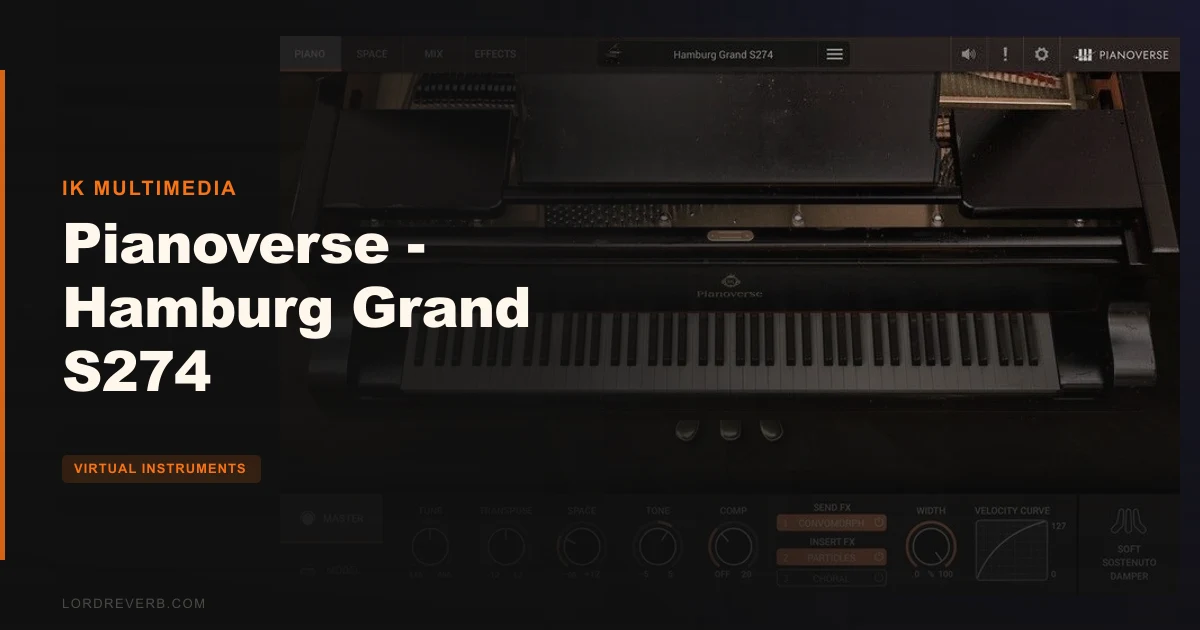
Pianoverse Hamburg Grand S274 suits wide, open ballads and cinematic pieces best: the kind of track where one big piano carries the whole emotional weight and you’d happily pay $99.99 for a concert grand that doesn’t flatten your CPU. Whether it’s your piano depends on how you feel about a dry, characterful Steinway you have to dress yourself.
It’s a software instrument built on a 1958 Steinway & Sons Hamburg D-274, sampled with robot assistance at Officine Meccaniche studios in Milan. IK Multimedia packages it inside the Pianoverse engine, with Spaces, effects and a pile of piano-specific controls.
We like it. We also have reservations, and they’re real ones.
If you write pop, singer-songwriter, film cues or lo-fi jazz, read on. If you want a pristine classical recital sound out of the box, we have bad news further down.
Where It Belongs
Think of a slow, sparse ballad. A few chords, a vocal sitting right on top, and a piano that has to sound big without a band behind it. That’s the Hamburg’s home turf.
IK Multimedia says the Hamburg design gives expanded tonal variety, with a gradual timbre shift from bass to treble and articulate, round voicing in the tenor and mid-treble. Owners back that up. Several describe the tonal variety as putting other libraries to shame.
Cinematic writing is the second fit. The engine ships with 30 generative sound Spaces and 12 high-end cinematic effects, so a plain piano line can turn into an ambient bed without leaving the plug-in.
Singer-songwriter work lands here too. A dry, close piano under a vocal is often exactly what you want, because you aren’t fighting a built-in hall for space.
Owners also say jazz noodling works well. One reviewer called the aggressive midrange better suited to jazz than classical. For a trio session or a smoky late-night bounce, that bite can be a feature.
And if your laptop wheezes under big sample libraries, the CPU story matters. Owners report remarkably low processor load compared with competing piano libraries. Remarkable is their word, and it’s the kind of claim worth checking on your own machine with a dense, pedal-heavy passage.
Where It Doesn't
Skip it for pure classical work. We’d say that plainly.
Some owners describe the instrument as less responsive than Garritan or Vienna Symphonic Library, with unconvincing reverbs. Others call the notes uneven, with that aggressive midrange. For a Chopin nocturne where every voice has to sit perfectly, you’ll hear the seams.
It’s also a poor fit if you hate building your own signal chain. The samples were captured with no EQ or compression, and owners report they’re extremely dry. One described it as being forced to play staccato all the time.
Imagine you’ve loaded it, hit a long chord with the pedal down, and the sustain just keeps going. Owners say sustain is very long and everything gets muddy really fast. For dense, fast, pedal-heavy writing, that’s annoying.
Finally, think about workflow. Preset loading reportedly takes 6 to 14 seconds. If you flick between sounds constantly while sketching, that delay adds up.
The Sound and the Source Piano
The piano is a Steinway Hamburg D-274 from 1958. IK Multimedia says handcrafting a D-274 takes over a year, from wood selection to string voicing.
The company’s pitch is that Hamburg Steinways were designed as stand-ins for orchestras in smaller halls with ideal acoustics. Mid-century models are now irreplaceable, it argues, because standardised modern materials have reduced the regional differences between instruments.
That’s a developer claim, and it’s a nice story. Whether the story reaches your speakers is for your ears to decide.
What we can say is what owners hear. They praise natural note decay and responsive playing dynamics, and they describe the sound quality as exceptional. The developer says the recordings capture the singing voice of the piano and the prominent impact of the pedals.
How It Was Recorded
The multisampling is robot-assisted and deep. Close mics are DPA 4011, with Coles 4038 mics in a Blumlein configuration for the stereo image.
IK Multimedia says it used the same preamps as other Pianoverse instruments, with no EQ or compression on capture. That explains the dry character owners describe.
It’s an honest choice. A dry capture gives you control. It also hands you the work.
The Sound Engine: Round Robin and Voice Management
The new sound engine brings redesigned round robin and voice management. Round robin matters on repeated notes, where identical samples make a piano sound like a machine gun.
Hit the same key four times at a steady dynamic and listen for the repeats. A good round-robin setup breaks up the pattern.
We can’t tell you how well this one does it. That’s something to check with a fast repeated-note figure.
Pedal Control and Its Problems
Continuous pedal control enables half-pedaling and catch-pedaling. On paper, that’s the feature a serious piano player wants.
Half-pedaling lets you partly lift the dampers for blurred, controlled resonance. Catch-pedaling lets you change harmony cleanly without a muddy overlap. Both depend on a controller that sends continuous values, so a basic on/off sustain switch won’t get you there.
Here’s the catch. Owners report pedal functionality problems. That’s a real concern for a feature this central, and we’d verify pedal behaviour before you build a session around it.
Lid Position, Harp Resonance and Mechanical Noise
The advanced controls cover lid position, harp resonance, pedal noise and piano mallets noise. These are the controls that make a software piano feel like an object in a room.
Lid position changes how open or closed the instrument sounds. Harp resonance adds sympathetic string behaviour. Pedal and mallet noise add the mechanical sounds of the instrument itself.
Pedal noise is a love-it-or-hate-it detail. On a close-miked ballad it adds intimacy. On a polished pop mix it can clutter the quiet moments.
We love that the controls exist. We wish the notes told us more about how far each one goes.
Microphone Options and the Dry-Sound Problem
You get multiple instrument and room microphone options. In theory, that lets you move from tight and close to wider and airier.
The trouble is the room. Owners keep coming back to the dryness, and they say the reverbs inside the product are unconvincing. So the mic options give you perspective, but the sense of a real space still often needs a third-party reverb.
Put a good plate or hall on a bus and send the piano to it. That’s the general fix for any dry piano library, and it works here as well as anywhere.
Cut the low end of the reverb return so the tail doesn’t pile onto an already long sustain. A high-pass on the return is a simple, sensible move.
Spaces and Cinematic Effects
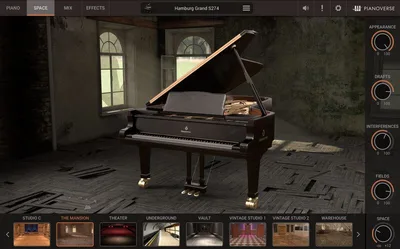
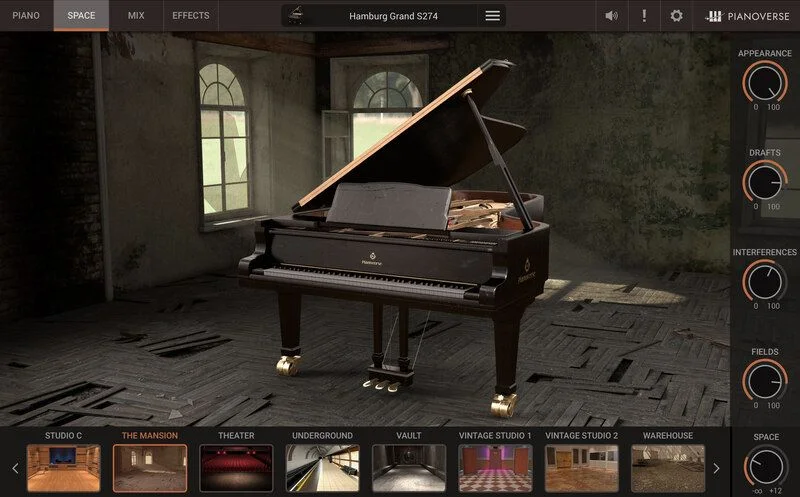
Pianoverse includes 30 generative sound Spaces. IK Multimedia says they recreate the immersive experience of playing the world’s finest pianos in sound-shaping environments.
There are also 12 high-end creative cinematic effects. For film cues and ambient pieces, that’s a decent reason to stay inside the plug-in.
Be sceptical, though. Some owners find the built-in reverbs unconvincing. Test the Spaces against your own reverb before you decide which one lives on the track.
The Built-In Mixing Tools
The studio tools include EQ, compression, limiting and stereo width. That’s a handy kit for shaping the piano without opening extra plug-ins.
Stereo width is the one to be careful with. A very wide piano can collapse oddly in mono. Check your mix in mono before you commit.
It’s convenient. It isn’t a substitute for the console-quality processing you may already own.
MIDI Learn, Interface and Presets
MIDI learn is supported, so you can map controls to your hardware. The interface is optimised and resizable, which helps on small laptop screens.
Pianoverse as a whole includes 8 remarkable instruments paired with unique spaces and loaded with presets. This review covers the Hamburg Grand S274 title, so judge the rest of the line separately.
Presets are where the pain shows. Owners report loads of 6 to 14 seconds. If you browse presets like a kid in a sweet shop, you’ll feel every one.
Install, Disk Space and System Needs
Each piano title needs 30 GB of disk space. Put it on a fast drive if you can.
The software runs as a 64-bit plug-in or standalone on Mac and PC. On macOS the formats are Audio Units, VST 2, VST 3 and AAX. On Windows they’re VST 2, VST 3 and AAX.
macOS needs 10.13 or later, 8 GB of RAM minimum with 32 GB suggested, and an OpenGL 2 compatible graphics adapter. It runs natively on Apple M1 processors. Windows needs Windows 7 or later, the same RAM guidance, an OpenGL 2 compatible graphics adapter and an ASIO compatible sound card.
Now the unpleasant part. Owners report installation bugs, and they describe the product manager as very buggy, with download failures. A 30 GB download that keeps failing is frustrating.
Plan your install for a quiet evening, not an hour before a session.
CPU and Value
Owners say the CPU load is remarkably low next to competing piano libraries. That’s the standout practical strength.
They also call it a steal of a deal for a concert grand simulation at $99.99. An All-access subscription option exists too, if you want several pianos.
Value is good, with conditions. You’re paying for a characterful grand, then spending time and possibly money on reverb and patience.
How To Use It Well
Start with the reverb problem. Treat the piano as a dry source and build the room around it with a send.
Second, manage the sustain. If the low register clouds, shorten the pedal or high-pass the reverb return. Don’t let the tail swallow the next chord.
Third, play to the strengths. Use the pedal control for slow, expressive passages, and keep dense fast writing for a different library if the mud bothers you.
A few general habits help with any big grand library:
Check your velocity curve against your keyboard. Test repeated notes at a steady dynamic. Listen in mono before you bounce.
Against the Field
The comparisons owners make are worth taking seriously.
| Product | Strongest point | Weakest point |
|---|---|---|
| Pianoverse Hamburg Grand S274 | Characterful Hamburg tone, low CPU load | Dry samples, slow loads, install trouble |
| Vienna Symphonic Library pianos | More robust sample quality, multiple mic positions | Not what we'd call a character piece for pop |
| Garritan pianos | Superior playability and responsiveness | Less of the Hamburg flavour |
| VI Labs pianos | Superior playability and responsiveness | Different tonal personality |
| Embertone Walker | More vintage sounding | Not a concert-grand tone |
Vienna wins when sample quality and mic choice matter most. Garritan and VI Labs win when playability is the priority. Embertone Walker wins when you want a vintage feel.
The Hamburg wins on character and lightness. It loses on polish.
The Verdict
Buy it if you want a big, singing concert grand for ballads, cinema and jazz-leaning writing, and you already own a reverb you trust. Keep your expectations modest on convenience.
Don’t buy it if you play classical, need instant presets or can’t stomach install bugs. In those cases, Garritan, VI Labs or Vienna look like better fits.
Specs & Technical Details
| Spec | Detail |
|---|---|
| Developer | IK Multimedia |
| Price | $99.99 |
| Plugin Format | VST 3 / AAX / AU on macOS; VST 2 / VST 3 / AAX on Windows |
| OS Support | Mac / Windows |
| Activation | N/A |
| CPU Usage | N/A |
| Trial Available | N/A |
| Version Reviewed | N/A |
Score Breakdown
| Category | Score | Notes |
|---|---|---|
| Sound Quality | 3.5/5 | Characterful tone, but dry and uneven for some owners |
| Value for Money | 4.0/5 | Owners call it a steal for a concert grand |
| Ease of Use | 2.5/5 | Install bugs and slow preset loads hurt |
| Features | 4.0/5 | Continuous pedal, lid position, Spaces, built-in tools |
| CPU Efficiency | 4.0/5 | Owners report remarkably low load |
| Overall | 3.4/5 | Characterful and light, held back by dryness and install pain |
Alternatives to Consider
Vienna Symphonic Library pianos
Pick these if sample quality and mic positions matter more than character. Owners call them more robust.
Garritan pianos
Pick these if playability is your priority. They’re cited as more responsive.
VI Labs pianos
Another playability-first choice, and a sensible comparison if the Hamburg feels stiff under your fingers.
Final Call
For $99.99, you get a lively Steinway with a light CPU footprint and a pile of controls. You also get dry samples, long loads and an installer that owners describe as very buggy.
Buy it for ballads and jazz sketches where you’ll bring your own reverb. Walk away if you need a polished, classical-ready piano that works on the first try.
Verdict in one line: a flawed, characterful grand that rewards the patient.
Frequently Asked Questions
Is Pianoverse Hamburg Grand S274 good for classical music?
Not ideal. Some owners say it's less responsive than Garritan or Vienna Symphonic Library, with uneven notes and aggressive midrange. It leans toward jazz and contemporary styles.
How much disk space does it need?
Each piano title requires 30 GB. Put it on a fast drive and expect a long download.
Does it need external reverb?
For most uses, yes. The samples were recorded dry with no EQ or compression, and owners say the built-in reverbs aren't convincing.
Does it run on Apple M1 Macs?
Yes, it runs natively on Apple M1 processors. It's 64-bit only and needs macOS 10.13 or later.