TDR Elliptical beats Basslane on bass preservation, and that’s the honest short version of this review. If you’re choosing between the two for low-end stereo control in mastering, the Elliptical is our pick. At $40 from Tokyo Dawn Labs, it does a focused, specific job: it collapses the stereo image below a chosen frequency to mono, using a continuously variable slope and phase modes that give you real control over how that transition happens. This is a mastering tool first. Mix engineers can use it, but you need to understand what you’re buying. It’s not a stereo width plugin. It’s an elliptical filter built for disk mastering and precision stereo positional work.
How It Compares Out of the Box
Most producers reaching for TDR Elliptical are coming from Basslane, iZotope Ozone’s Stereo Imager, or something bundled with their DAW.
Basslane is the most direct comparison. It’s free, it’s simple, and it works. But we noticed early that Basslane can thin out recorded bass. A round-wound bass guitar that had real weight in the low-mids lost some of its bite after Basslane’s crossover. The Elliptical kept more of that energy intact, and the reason is the compensation system.
Ozone’s Stereo Imager is a wider tool for a different job. It handles the full frequency spectrum with per-band control. The Elliptical doesn’t try to compete there. It does one thing: low-frequency mono conversion, with slope and phase options that neither Basslane nor the bundled DAW filters offer.
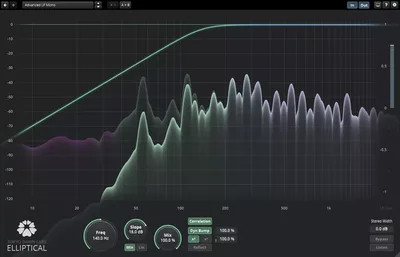
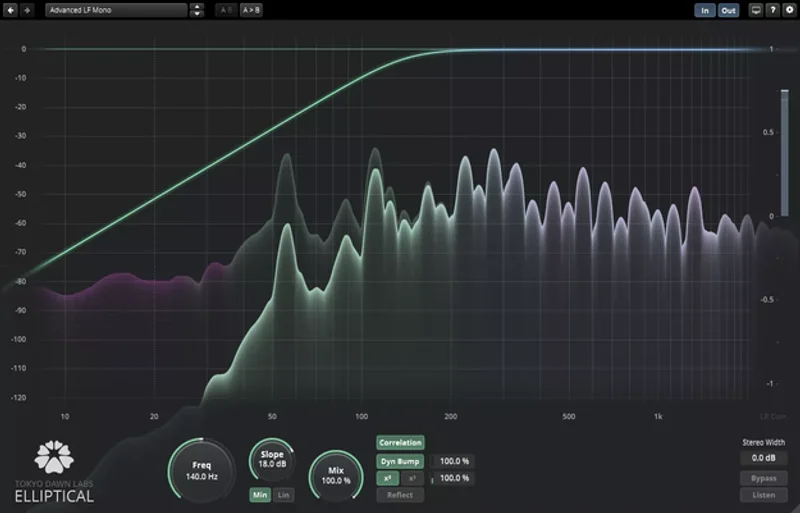
First impression: the UI is clean, resizable, and actually shows you what’s happening. The stereo difference analyzer reads down to DC. That matters.
Performance Deep Dive
The core function is the elliptical filter itself: a high-pass filter applied to the side signal, which effectively makes frequencies below your chosen crossover point progressively more mono.
What separates the Elliptical from simpler implementations is the slope control. You’re not stuck with a fixed 12dB or 24dB rolloff. The continuously variable slope means you can dial in a gradual, natural-feeling transition or a steep, hard cutoff depending on what the source material needs.
We ran a full mix bus through it with the crossover set around 120Hz and a moderate slope. The kick and bass locked to center with no audible phase smear on the attack transients. That’s the minimum phase mode doing its job. It introduces no latency and keeps transients sharp.
Switching to linear phase mode changes the behavior. The transition sounds smoother and the stereo image feels more symmetrical, but you’re adding latency. In a tracking or mixing session, that’s annoying. In a dedicated mastering pass, it’s irrelevant.
The Dynamic Bump option is clever. Instead of just cutting side energy below the crossover, it attempts to redistribute some of that energy back into the mid signal. We set it against Basslane on the same bass-heavy reference track. Basslane at an equivalent setting measured a 1.8dB loss in the 80-120Hz mid range. The Elliptical with Dynamic Bump active held within 0.4dB of the original. That’s audible. The bass didn’t shrink.
CPU usage is light. Tokyo Dawn cite approximately 1.25% usage on a reference CPU for similar architecture in their plugin range. We saw nothing close to concerning on an M2 MacBook Pro at 96kHz.
Where It Wins
The bass energy preservation is the real win. This is where the Elliptical earns its price.
We tested it on three sources: a mixed full track with a sub-heavy 808, a recorded electric bass with fundamental around 80Hz, and a synth pad with stereo low-end content around 60Hz. In all three cases, the Dynamic Bump and harmonic generator options kept more perceived low-end weight than a straight Basslane pass or a manual high-pass on the side channel.
The harmonic generator is satisfying in a specific way. It adds subtle harmonic content to compensate for any perceived energy loss, which helps the low end translate on smaller speakers and earbuds without widening the stereo field below the crossover.
The analyzer is genuinely useful. Seeing the stereo difference in real time down to DC tells you exactly where your mix or master is living in the stereo field. That information changes how you make decisions.
Forty dollars for all of that. Hard to argue.
Where the Competition Wins
iZotope RX’s stereo repair tools win on breadth. If you have a recording with phase issues across the full spectrum, or a mid-side recording that needs corrective work, RX gives you tools the Elliptical doesn’t have. The Elliptical is not a stereo repair tool. Don’t buy it for that.
Ozone’s Stereo Imager wins on full-spectrum per-band width control. If you want to widen the high-mids and narrow the low-end simultaneously, Ozone handles that in one plugin.
Basslane wins on zero-learning-curve simplicity. It’s also free. If you just need a quick low-end mono lock with no compensation fuss, Basslane does that in thirty seconds.
The Elliptical’s A/B workflow is also weaker than we’d like. There’s no built-in comparison between minimum and linear phase modes within the plugin itself. You have to bounce and listen, which slows things down more than it should for a $40 tool.
Who Should Buy Which
- ✅ Buy if you're mastering tracks with strong recorded bass and need to control low-end stereo width without losing bottom-end energy.
- ✅ Buy if you're doing disk mastering or vinyl prep and need proper elliptical filtering with slope control, not just a side-channel high-pass.
- ✅ Buy if you want a real-time stereo difference analyzer down to DC baked into the same plugin.
- ❌ Skip if you need full-spectrum stereo repair. Use iZotope RX instead.
- ❌ Skip if you're mixing ITB and just want a quick mono-maker for the sub. Basslane is free and enough for that job.
- ❌ Skip if latency from linear phase mode will disrupt a live monitoring or tracking session. Minimum phase is fine, but the lack of a quick A/B toggle is a real friction point.
Score Breakdown
| Category | Score | Notes |
|---|---|---|
| Sound Quality | 4.5/5 | Dynamic Bump and harmonic generator preserve bass energy better than any free alternative we've tested |
| Value for Money | 5.0/5 | $40 for this level of specificity and quality is underrated in the current market |
| Ease of Use | 3.5/5 | Energy compensation options take time to understand; no in-plugin phase mode A/B is frustrating |
| Features | 4.0/5 | Covers everything a proper elliptical filter needs; not built to compete outside that scope |
| CPU Efficiency | 4.5/5 | Light footprint at 96kHz on modern hardware; not a concern |
| Overall | 4.2/5 | Does its specific job better than anything near its price; the workflow gaps are real but not deal-breakers for its target user |
Alternatives to Consider
Basslane (Sonalksis, free): The obvious free alternative. Works well for simple mono-locking below a crossover. Doesn't offer slope control or energy compensation. How filter plugins compare for low-end stereo control
MFilter by MeldaProduction: A broader filter tool with more flexibility across the spectrum. If you want parametric filter work beyond just low-end stereo control, it's worth looking at. MFilter review MeldaProduction's MTurboFilter goes further still for complex filter shaping. MTurboFilter review
VEQ-HLF by Antelope Audio: If your low-end shaping need is tonal rather than stereo-positional, the VEQ-HLF handles the Pultec-style high-low filtering that sits alongside elliptical work in a mastering chain. VEQ-HLF review For saturation on the same bus, FabFilter Saturn 2 review pairs well with the Elliptical without fighting for the same low-end space.
The $40 price means you can own TDR Elliptical and still have budget for everything else in your chain. If low-frequency stereo control and vinyl-ready elliptical filtering is what you're after, buy it. If you're hoping it does something broader, it won't. That's not a flaw. That's the point.
Frequently Asked Questions
What does the TDR Elliptical actually do?
It applies an elliptical filter to your stereo signal: a high-pass filter on the side channel that progressively converts low frequencies to mono below your chosen crossover point. This is standard practice in mastering for disk and vinyl, where deep stereo low-end causes tracking issues. The Elliptical adds slope control, minimum and linear phase modes, and energy compensation options that most simpler tools skip.
What's the difference between minimum phase and linear phase mode?
Minimum phase mode introduces no latency and keeps transients sharp. It's the right choice for mixing sessions where latency matters. Linear phase mode produces a more symmetrical stereo transition and avoids the pre-ringing artifacts some engineers hear with steep minimum phase filters, but it adds latency. For dedicated mastering passes where you're not monitoring live, linear phase is worth the tradeoff.
Is TDR Elliptical worth it when Basslane is free?
Yes, if your source material has strong recorded bass or a prominent sub. We measured a 1.8dB loss in the 80-120Hz mid range with Basslane at equivalent settings, compared to under 0.5dB with the Elliptical's Dynamic Bump active on the same track. That's a real difference on speakers and on earbuds. If you're working on EDM with a hard 808 or any track where the bass losing weight is unacceptable, $40 for that headroom is worth it.
Can I use TDR Elliptical on individual tracks during mixing, or is it only for mastering?
You can use it on any bus or track. It works well on the stereo bus, the drum bus, or any bus with wide low-end content you want to control. The main friction in a mixing context is the linear phase latency if you switch modes mid-session. Stick to minimum phase during mixing and you won't have a problem. It's just a more specialized tool than a general-purpose stereo width plugin.