The real doubt with Odin 2 isn't whether it sounds good. It's whether "free and open-source" is code for "a weekend project that sounds like one." It isn't. Odin 2 is a serious hybrid synthesizer that holds its own against costly instruments, and we'd reach for it on a paid session without embarrassment.
Built by TheWaveWarden and released in early 2020, Odin 2 runs on Windows, macOS, and Linux. It ships as VST, VST3, AU, and standalone. The price is zero dollars. The license is GNU GPL, which means you can use it on commercial releases without worrying about clearing rights.
It's best suited to producers who already know their way around a synth. If you understand oscillator routing, envelope stages, and what a filter resonance peak does to a bass patch, you'll find a lot to work with here. If you're looking for a preset browser to drag and drop into a loop, this isn't it.
Does It Actually Deliver on Its Promises?
TheWaveWarden describes Odin 2 as a "mighty 24-voice hybrid synthesizer." That's an accurate summary, not marketing stretch.
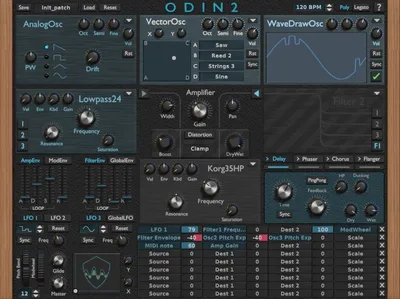
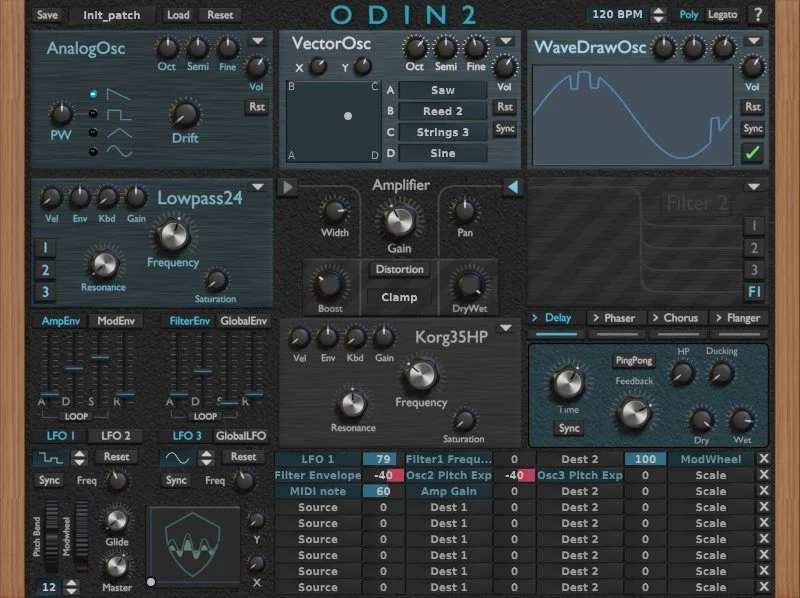
The engine supports subtractive, FM, phase modulation, wavetable, and chord synthesis within a semi-modular signal path. Three oscillator slots each accept different oscillator types independently, so you can layer a wavetable osc against an FM pair without bouncing between instruments. That's genuinely clever design for a free tool.
We tested version 2.4.0, which shipped with a full UI overhaul. The interface is cleaner than previous versions. Resizable from 100% to 200% means it works on both a cramped laptop screen and a large studio monitor.
Five onboard effects cover the basics: distortion, delay, phaser, chorus, and reverb. None of them are deep. They're functional finishing touches, not replacements for dedicated FX plugins in your chain.
The short answer: yes, it delivers. Fully.
Where Odin 2 Shines
The filter section is where we spent most of our time, and it's the strongest argument for taking this synth seriously.
The Moog Ladder emulation holds up under abuse. We pushed the resonance to self-oscillation on a bass patch and cut around 80Hz by 4dB to tighten the low end. The sweep stayed musical. No ugly digital clicking at the transitions, no phase weirdness on the output. The Korg 35 model is a satisfying alternative for brighter, more aggressive tones. Running a sawtooth through it with resonance at 60% and the cutoff modulated by a slow LFO at 0.3Hz produced a moving pad that felt warm in the way that matters: the harmonic content shifted without thinning out above 3kHz.
The semi-modular routing is the other standout. We patched an envelope from oscillator 2 into the FM amount of oscillator 1, with attack set to 180ms and decay to 600ms. The result was a metallic pluck with a controlled tail that we'd normally reach for an FM synth bundle for. Odin 2 handled it natively, no additional instrument needed.
24-voice polyphony is enough for almost any production context. We stacked five-note chords with stereo unison spread at 30 cents and didn't clip the output or choke the voice allocation.
Where It Falls Short
The preset library is thin and, frankly, inconsistent. There are some useful starting points, but too many patches feel like they were included to prove the synth's range rather than to be genuinely usable. A producer opening Odin 2 for the first time hoping to grab a working bass or a pad for a session will be annoyed within ten minutes.
No AAX support. That's a hard wall for anyone working natively in Pro Tools. The workaround is running Odin 2 standalone and routing audio via a virtual cable, which is annoying and adds latency you don't want in a tracking context.
CPU usage is manageable on simple patches, but complex wavetable patches with multiple modulation sources running at 12-plus voices push CPU load visibly higher than comparable light instruments. On an older machine, you'll want to freeze tracks before the mix gets dense.
The effects section is where we felt the most limitation. Five effects, all shallow. The reverb in particular has a short tail and a limited character. You'll be routing to a send bus for anything serious.
How It Stacks Up Against Paid Alternatives
The obvious comparison is Serum by Xfer Records. Serum costs more and has a wavetable engine that's more flexible, a deeper effects rack, and a significantly larger preset ecosystem. Serum wins on workflow speed and wavetable editing. Odin 2 wins on cost, and its FM and PM oscillator models give it synthesis territory Serum doesn't cover as naturally.
Surge XT is the other free hybrid synth worth mentioning. It's arguably broader, with more oscillator algorithms and a deeper modulation matrix. But Surge XT's interface is dense to the point of being frustrating for new users. Odin 2 is more approachable without sacrificing real depth.
If you're after bass-specific synthesis, see how LOW compares for dedicated bass work. That's a different tool with a narrower focus. Odin 2 is wider by design.
For anyone already spending money on instruments, Odin 2 fills gaps in your toolkit without touching the budget. It's not a Serum replacement. It's a permanent addition to a well-rounded plugin folder.
Is the Price Fair?
It's free. Completely. Zero dollars, forever.
The GNU GPL license means your commercial releases are clear. You don't owe TheWaveWarden a royalty, a credit, or an email. That's an extraordinary position for an instrument at this quality level.
The honest answer: Odin 2 would still be worth a look at any price. At zero, the value discussion ends immediately. Download it. The only thing you're spending is an hour learning the interface.
Score Breakdown
| Category | Score | Notes |
|---|---|---|
| Sound Quality | 4.3/5 | Filter emulations and FM routing punch above the price point by a wide margin |
| Value for Money | 5.0/5 | Free with commercial use rights. There is no ceiling on this score. |
| Ease of Use | 3.3/5 | Rewarding for experienced sound designers; frustrating for preset-first producers |
| Features | 4.0/5 | Hybrid architecture covers serious ground; effects section is the weak link |
| CPU Efficiency | 3.5/5 | Clean on simple patches, spikes on complex wavetable builds with high voice counts |
| Overall | 4.4/5 | An underrated instrument that earns a permanent place in any production toolkit |
Alternatives to Consider
Serum (Xfer Records): The industry standard wavetable synth. Deeper preset library, better wavetable editor, and a more polished effects chain. The current price is shown in the buy box on this page. Worth the spend if wavetable design is your primary workflow. Read our wavetable synth overview
Surge XT (free): Odin 2's closest free rival. More oscillator modes and a deeper modulation matrix, but a steeper learning curve. If you can handle the interface, it's brilliant. If you can't, you'll hate it within an hour.
Chromaphone 3 (Applied Acoustics Systems): A completely different synthesis approach based on physical modelling. Better for organic textures and acoustic-adjacent sounds. Read our Chromaphone 3 review if you need sounds Odin 2 simply can't generate.
ABX3 Bundle (Audio Blast): Worth considering if you're building an acid or bass-heavy workflow. See our ABX3 bundle review for how it compares on resonant bass sounds specifically.
Our honest position: download Odin 2 today. Use it alongside whatever commercial instruments you already own. It costs nothing and fills synthesis gaps that surprise you once you start patching.
The only producers who should skip it are those locked to Pro Tools with no interest in a standalone workaround, and those who need a preset-first instrument they can drop into sessions without a learning curve. Everyone else: it's already in our plugin folder and it's not leaving.
Frequently Asked Questions
Is Odin 2 really free for commercial use?
Yes, fully. Odin 2 is released under the GNU General Public License, which covers commercial use without royalty payments or attribution requirements. You can release music made with Odin 2 commercially, license it to sync, and sell it on any platform. There are no hidden conditions.
Does Odin 2 work in Pro Tools?
Not natively. Odin 2 ships as VST, VST3, AU, and standalone, but not AAX. Pro Tools requires AAX for native plugin support. The workaround is running Odin 2 in standalone mode and routing audio into Pro Tools via a virtual audio driver, but that adds complexity and latency. If you're a Pro Tools user, factor that limitation in before building a workflow around it.
How does Odin 2 compare to Serum for sound design?
Serum has a more sophisticated wavetable editor and a much larger preset ecosystem, making it faster for preset-based workflows. Odin 2 covers FM and phase modulation synthesis that Serum doesn't address as directly, and the analog filter emulations hold up well in a direct comparison. For pure wavetable work, Serum wins. For a broader hybrid toolkit at zero cost, Odin 2 is the answer.
What DAWs is Odin 2 compatible with?
Any DAW that accepts VST, VST3, or AU plugins on Windows, macOS, or Linux. That covers Ableton Live, FL Studio, Logic Pro, Cubase, Reaper, Studio One, and most other hosts. The standalone version runs independently of a DAW entirely. The one notable exception is Pro Tools, which requires AAX format support that Odin 2 doesn't currently provide.