
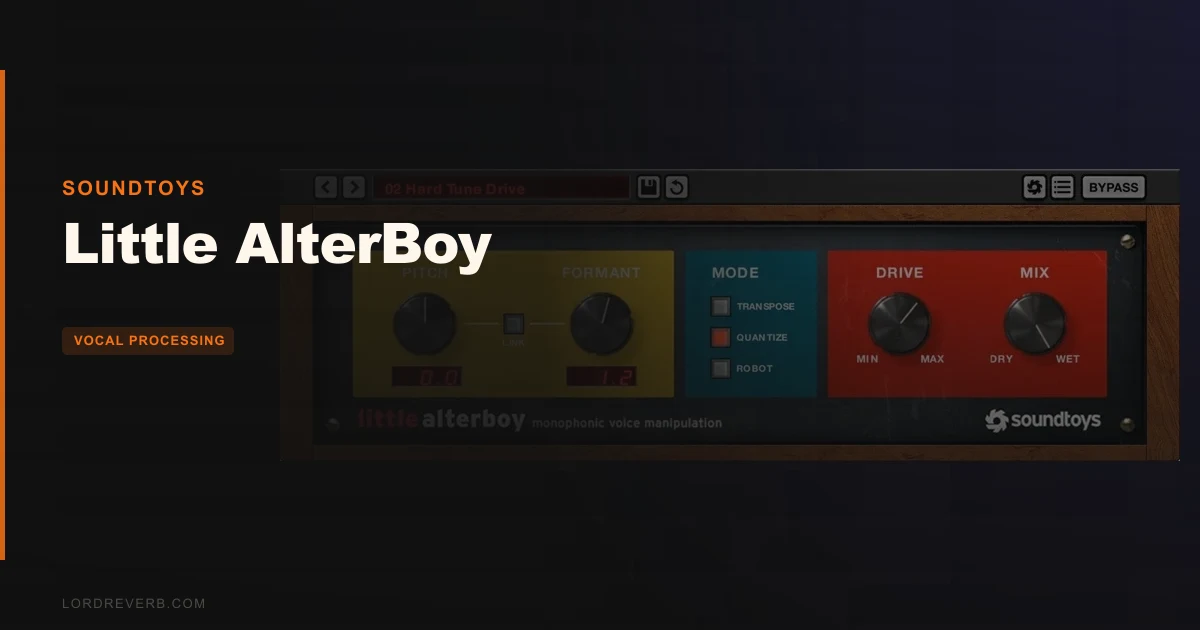
You've got a raw vocal take, and it's close. The melody is right. The performance is there. But the pitch is wandering, the tone needs gender-shifting, and you want that locked, quantized hard-tune sound without sending it through three different plugins and burning half your session trying to dial it in. That's the exact problem Little AlterBoy by Soundtoys exists to solve. It's a monophonic voice manipulator built for pitch shifting, formant shifting, hard-tune effects, and vocoder-style MIDI control, all from one four-knob interface. At $99, it's not cheap. But we've put it through sessions and the results are hard to argue with.
The Vocal Production Problem Nobody Talks About Enough
Most pitch correction tools are built for subtlety. Nudge a flat note up 12 cents. Smooth a phrase. Stay invisible. That's fine for natural correction, but it's useless the moment you want something creative.
What producers actually need is a plugin that handles the full range. Transparent correction, sure. But also hard quantize, robot lock, gender shifts, and harmonic layering from a single vocal track. Chasing that across Auto-Tune, a separate formant shifter, and a saturation plugin costs you time, CPU, and routing headaches.
Little AlterBoy collapses all of that into one plugin. Four knobs: Pitch, Formant, Drive, Mix. Three mode buttons: Transpose, Quantize, Robot. That's it. The simplicity is the point, and it works.
How Little AlterBoy Actually Performs
We dropped Little AlterBoy on a dry lead vocal tracked at 44.1kHz and worked through each mode. Transpose mode handles smooth pitch shifting. We pushed it to -7 semitones and the formant stayed independent, which means you can shift pitch without the "chipmunk" artifact that kills lower-quality pitch shifters.
Formant control is where it gets interesting. Pulling the Formant knob left masculinizes the voice. Push it right and it reads as lighter, more feminine. We've heard reviewers describe this as convincing on a well-recorded vocal, and our ears agree: it holds up at moderate settings before it starts to break apart.
Robot mode locks the pitch to a single frequency. We set it to A2 and ran a sung phrase through it. The result was exactly the robotic, monotone lock you'd expect, clean enough to use without additional treatment. This is the mode Illangelo reportedly used building textures for The Weeknd's sessions.
MIDI control is where Little AlterBoy separates from its competition. Route MIDI notes to the plugin and you're rewriting the vocal's melody in real time. We mapped a MIDI keyboard and played chord tones under a held vowel. Instant vocoder-style harmonics, no vocoder required. That's a feature most plugins in this category don't touch.
The built-in Drive knob pulls from the same tube saturation model used in Soundtoys' Decapitator. At low settings, it adds harmonic warmth. Past halfway, it pushes into obvious grit. That saves you a second plugin on the chain when you just need a little edge.
CPU load sits light. We had 12 instances running in an Ableton session on an M2 MacBook Pro before we felt any push. That's a satisfying result for a vocal-heavy project.
What's Good and What's Frustrating
The pitch shifting sounds clean. That's not a throwaway compliment. Soundtoys' founders helped build the Eventide H3000 and created PurePitch TDM, the first real-time pitch and formant shifter in Pro Tools. That history shows in the output quality.
The Mix knob is underrated. Blend the processed signal back against the dry and you've got instant harmonies. One vocal, two parts, no extra tracks. Clever, and producers keep finding new uses for it.
The MIDI integration is the headline feature that most reviews bury. It's not just for robot effects. Feeding it chord patterns turns one held vocal into a full vocoder arrangement. We wish more producers knew this existed before reaching for a full vocoder plugin.
Now the frustrating part. Little AlterBoy is strictly monophonic. Stack two background vocals on the same instance and it falls apart. You'll need one instance per track, which is fine given the light CPU draw, but it's a workflow limitation worth knowing before you buy.
The preset count lands between 11 and 12 depending on version. That covers the core use cases. Hard-tune, gender shift, robot, harmony blend. But if you want a deep preset library to explore, this isn't it. You'll be turning knobs yourself, which some people love and some find annoying.
iLok account requirement. No physical dongle needed, but you do need an ilok.com account. For some producers this is a non-issue. For others it's the kind of friction that kills the purchase.
Is the Price Justified?
At $99, Little AlterBoy sits in the middle tier of vocal processing tools. It's not a budget buy. But it's replacing at least two or three plugins in most signal chains: a pitch shifter, a formant tool, and a saturation stage. That consolidation has real value.
The pitch quality alone justifies most of the cost. Cheap pitch shifters sound like cheap pitch shifters. This doesn't. If you're producing regularly and vocals are part of your work, the per-session amortization makes it an easy call.
If you only occasionally touch vocals, it's a harder sell. A casual producer might find the Soundtoys bundle approach a smarter entry point.
Who Should and Shouldn't Buy Little AlterBoy
- ✅ Buy if you produce hip-hop, pop, or R&B and want hard-tune and robot effects dialed in fast without routing across multiple plugins.
- ✅ Buy if you already use MIDI in your vocal sessions and want to experiment with melody rewriting and vocoder-style textures.
- ✅ Buy if you're already a Soundtoys user and want a focused vocal tool that fits their workflow logic.
- ❌ Skip if you work primarily with polyphonic background vocal stacks where a monophonic tool becomes a bottleneck.
- ❌ Skip if you're a casual producer who touches vocals twice a year. The price doesn't justify that use frequency.
- ❌ Skip if iLok cloud licensing is a dealbreaker in your setup. That friction doesn't go away.
Specs & Technical Details
| Developer | Soundtoys |
| Price | $99 |
| Plugin Format | VST2 / VST3 / AU / AAX Native / AAX AudioSuite |
| OS Support | macOS 10.12+ (Intel & Apple Silicon) / Windows 7+ (64-bit) |
| Activation | iLok account (no physical USB iLok required) |
| CPU Usage | Light |
| Trial Available | Yes (Soundtoys offers a trial period) |
| Version Reviewed | Version 5 |
| Supported Sample Rates | 44.1kHz to 192kHz |
| DAW Support | Pro Tools 12+, Logic Pro X 10.7+, Ableton Live 10+, Studio One 4.5+, Cubase 9.5+, Nuendo 8+, Reaper 6+, Bitwig 4+ |
Score Breakdown
| Category | Score | Notes |
|---|---|---|
| Sound Quality | 4.5/5 | Pitch-shifting heritage from Eventide H3000 lineage is audible; artifacts stay minimal at moderate settings |
| Value for Money | 4.0/5 | Replaces multiple tools; less convincing for occasional vocal producers |
| Ease of Use | 4.5/5 | Four knobs, three modes: you're running in under two minutes |
| Features | 4.0/5 | MIDI melody control and built-in Drive add real depth; monophonic limitation and thin preset library hold it back |
| CPU Efficiency | 4.5/5 | Light enough to run a dozen instances without breaking a session sweat |
| Overall | 4.3/5 | A focused, high-quality tool that earns its place on a vocal chain |
Alternatives Worth Considering
If you want a broader creative FX palette that includes vocal manipulation alongside other processing, the BLEASS Creative FX Bundle offers a different angle. It's not a direct pitch-shifter replacement, but it covers experimental territory Little AlterBoy doesn't touch.
Antares Auto-Tune is the obvious comparison for pitch correction. Auto-Tune wins for precise, track-by-track pitch repair with note-level editing. Little AlterBoy wins for speed, formant control, and MIDI-driven creative work. They solve different things. Don't let anyone tell you one replaces the other.
For producers already deep in the Soundtoys world, the Crystallizer is worth pairing. It handles granular pitch echo territory that Little AlterBoy deliberately ignores.
Serato's creative tools have also entered this space. Serato Hex FX takes a performance-focused approach that suits live sets more than studio sessions, but it's worth knowing it exists if that's your context.
If you're producing vocals seriously, Little AlterBoy deserves a spot in your chain. It's not a Swiss Army knife. It doesn't try to be. It does a specific set of things at a quality level that holds up against much more expensive tools, and the MIDI melody control alone is a feature most producers discover too late. At $99, the producers most likely to feel shortchanged are those who buy it expecting a full pitch correction suite. This isn't that. It's a voice manipulator. Buy it as one.
Related reviews: Should You Crossgrade to Cloudmax Breeze?
Frequently Asked Questions
Does Little AlterBoy work on polyphonic signals or background vocal stacks?
Little AlterBoy is strictly monophonic. Feed it a polyphonic source and the pitch detection breaks down quickly. For stacked background vocals, you'll need one instance per track. That's manageable given its low CPU draw, but it's a workflow constraint worth planning around before you commit to it as your main vocal processor.
Do I need a physical iLok dongle to run Little AlterBoy?
No physical dongle is required. You do need a free iLok.com account for license management, but the license can live on your computer. If you're already in the Soundtoys ecosystem, you know this drill. If you're new to iLok, the setup takes about five minutes.
Can Little AlterBoy create vocal harmonies on its own?
Yes, and this is one of its most underused features. The Mix knob blends the pitch-shifted signal against the dry vocal, which gives you an instant harmony without duplicating the track. Combine that with MIDI control and you can drive full melodic harmony lines from a single vocal recording in real time.
How does Little AlterBoy compare to Antares Auto-Tune for hard-tune effects?
Both do hard-tune, but they approach it differently. Auto-Tune gives you per-note editing, a piano roll, and scale-based correction. Little AlterBoy gives you a single Quantize button that locks pitch to the nearest semitone instantly. For fast, creative hard-tune on hip-hop or pop, Little AlterBoy is quicker to set up. For surgical correction and detailed pitch editing, Auto-Tune has more control.