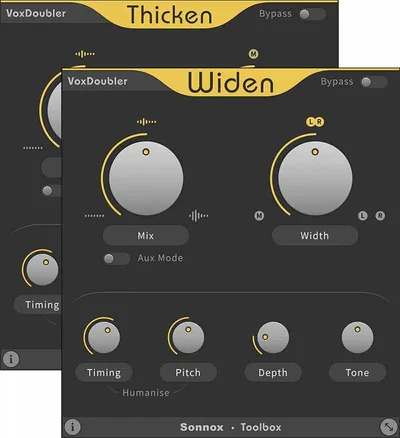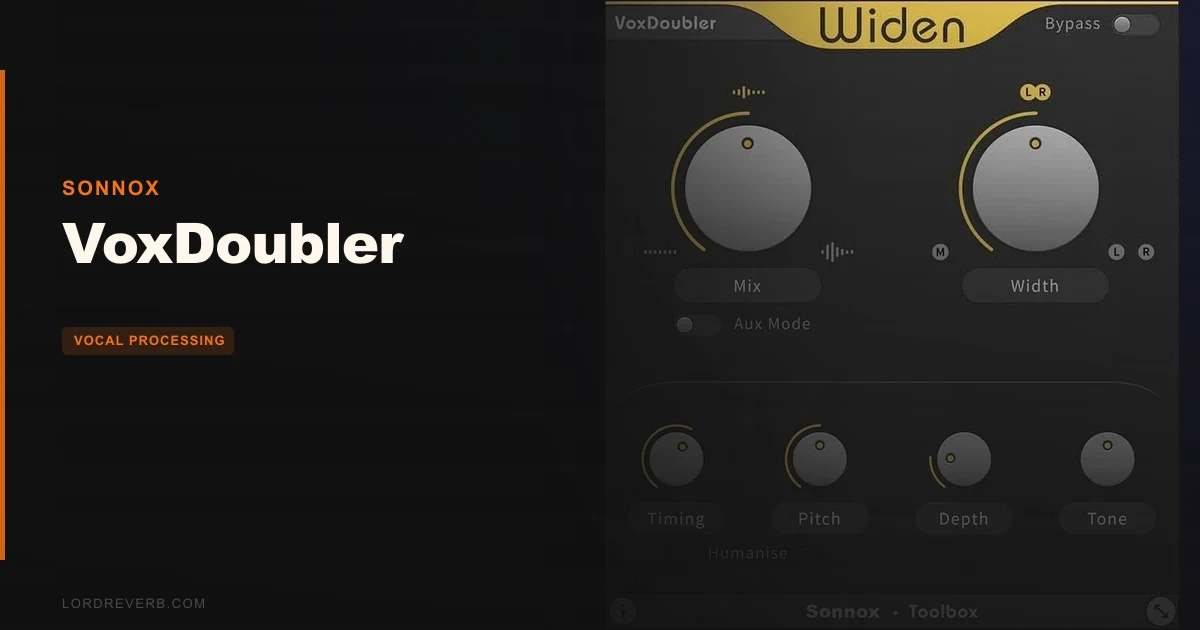
VoxDoubler is the plugin people hold up against Waves Doubler, Soundtoys MicroShift and Abbey Road ADT. At $23 it comes down to your sessions: how much CPU load and delay you can live with.
If you track vocals in a laptop session with 60 channels and a tight buffer, the latency and CPU load may bite. If you mix at the desk with headroom to spare, this might be the best-value doubler around.
That’s the balanced answer. Here’s the detail.
How Does VoxDoubler Compare Out of the Box?
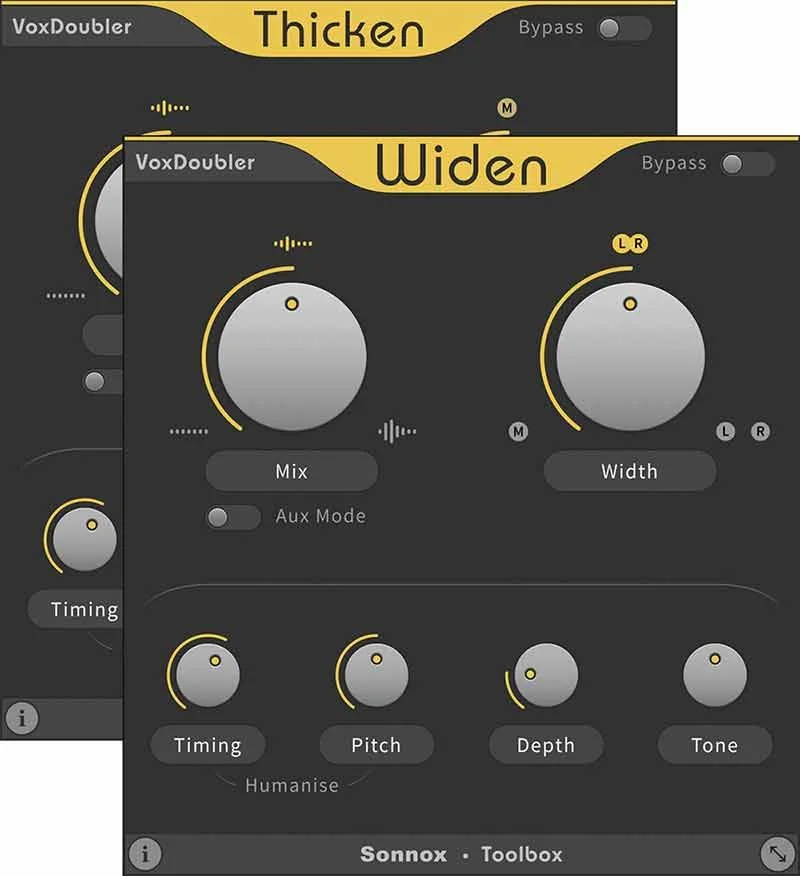
Open it and you don’t get one plugin. You get two: Widen and Thicken. They’re separate plugins with different jobs.
Waves Doubler and MicroShift lean on pitch and delay tricks that can sound obviously processed on a lead vocal. Owners who’ve swapped to VoxDoubler describe the doubles as more natural. Take that as a pattern in owner feedback, not a guarantee.
iZotope Vocal Doubler is the easy option. It’s simpler and friendlier to beginners, but you get less depth of control. VoxDoubler asks a little more of you and hands back more.
Abbey Road ADT is the premium option professionals reach for. VoxDoubler is the cheaper route to a similar idea, and it doesn’t pretend to match it.
How Do Widen and Thicken Work?
Two plugins, two ideas.
Widen
Widen generates two new mono voices and pans them left and right of your original vocal. The original stays put in the middle. The doubles frame it.
This is the classic wide-chorus move. Think of a pop hook where the vocal suddenly stretches across the whole stereo field.
Thicken
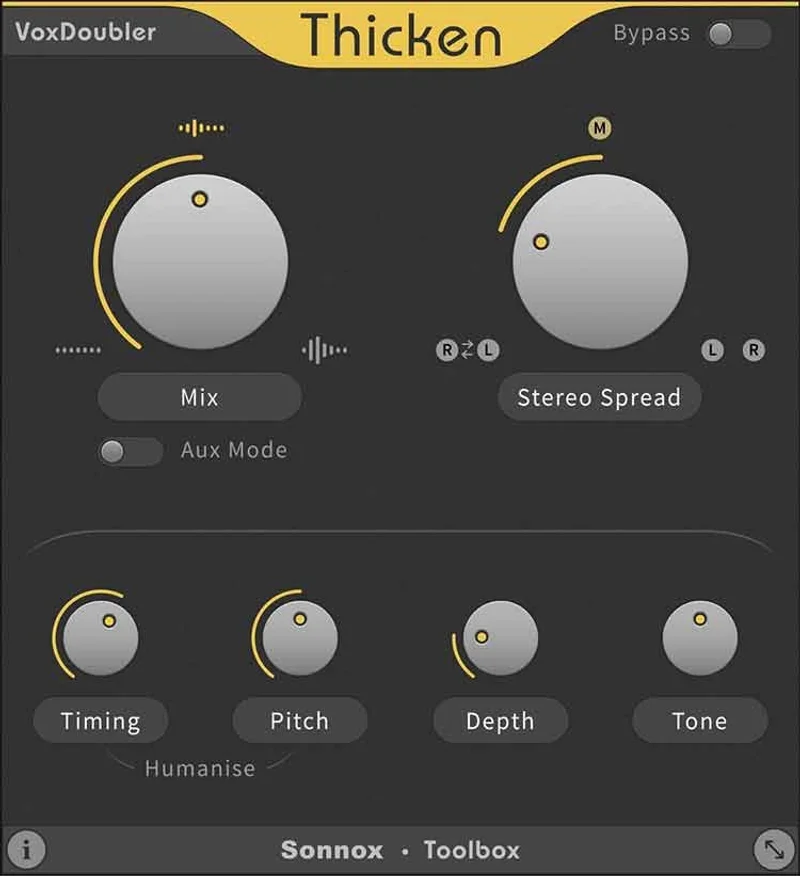
Thicken does something different. It generates one new stereo doubled voice that overlaps the original.
You’re not spreading the vocal wider. You’re making the centre fatter. That’s the one to reach for on a verse that feels thin.
Why you'll want both
Owners report that each plugin is fairly subtle on its own. Stack them and the effect turns transformative. We like that honesty, because it tells you the real workflow: run Thicken on the lead, add Widen on a parallel bus, and balance the two by ear.
What Does the Humanise Section Do?
This is the feature that earns the price.
Humanise adjusts the timing and pitch of the doubles relative to the original vocal. Real double-tracking is never identical. The singer drifts early, drifts late, lands a few cents sharp.
A doubler that copies the vocal perfectly sounds like a copy. Humanise fakes the drift. Owners call it amazingly effective, and it’s the main reason the doubles read as separate performances.
Push it too far and the vocal starts to sound sloppy. Back it off until the doubles feel loose but not wrong.
How Do Depth and Tone Shape the Doubles?
Two more controls do the finishing work.
Depth
Depth pushes the doubled voices further back in the mix. It does this with a high-shelf filter and a fixed delay.
That matters because a double that sits level with the lead steals attention. A double that tucks behind it supports the lead. Owners rate Depth as amazingly effective too.
Tone
Tone is a tilt EQ. It has two jobs.
First, it tames sibilant doubles. If your lead has crispy S sounds, doubling them makes them worse, and Tone pulls the top end down so they don’t become distracting.
Second, it brightens muddy doubles. A dull vocal can get some air back without reaching for a separate EQ.
Track Mode, Aux Mode and Your Signal Chain
VoxDoubler has a Track/Aux switch. Track mode works in place, as an insert on the vocal channel. Aux mode runs the effect in parallel on a return.
Use Aux for most jobs. Send the lead to the return, keep the dry vocal untouched, and ride the double level on the aux fader. You get control over how much of the effect lands in the mix without touching the lead.
Use Track mode when you’re printing the effect into a stem or working with a track-count limit.
The developer says VoxDoubler is engineered for vocals but it works on instruments. It’s worth trying on a guitar line or a synth lead when you want it wider without a chorus pedal’s wobble.
Performance Deep Dive: CPU, Latency and Sound
Here’s the part nobody wants to read. It’s heavy.
Owners report a serious CPU hit. They also report that latency is higher than ideal, with roughly 5500 samples of delay in Pro Tools. That’s well over 100 ms at 48 kHz. Pro Tools can compensate on playback, but it will hurt if you track through the plugin.
Don’t monitor through it. Print your vocal dry, add VoxDoubler at mix time, and you sidestep most of the pain.
On sound, owners say a carefully set-up VoxDoubler is all but indistinguishable from real double-tracking. Note the word carefully. Out of the box you won’t get there.
Mono compatibility is a strength. Owners report it lacks the phasing sound common to other doubling effects, so your vocal won’t collapse when someone plays the mix on a phone speaker or a mono Bluetooth box.
The Problems Owners Run Into
We’d rather you hear this from us than find out at 2 a.m.
Logic Pro 11 on M1 Mac
Owners report that version 2.02.0 on an M1 Mac doesn’t always load Logic Pro 11 sessions properly and introduces huge latency. If that’s your setup, check the current version before you pay. We can’t confirm whether it’s been fixed.
iLok Cloud and the internet
Each licence includes 2 activations through an iLok account. You can authorise one machine, an iLok2 or iLok3 device, or iLok Cloud.
The Cloud option needs an active internet connection. That means no offline work while you travel. A physical iLok removes that problem, but costs extra.
No presets
There are no presets. You start from zero every time. It’s annoying for a plugin this controllable, and it slows the first few sessions.
Where VoxDoubler Wins
Value comes first. At $23, you get two plugins and a Humanise section that most doublers don’t match. That’s a lot of control for the money.
Naturalness comes second. Owners prefer the doubles over Waves Doubler and MicroShift on vocals, and the Humanise and Depth controls are why.
Mono safety comes third. Phasey doubling is a real mix problem, and this avoids it.
Ease of use is the fourth win. Owners call it easy, and the control set is small enough to learn in one sitting.
Where the Competition Wins
Abbey Road ADT wins on prestige and, for professional work, trust. VoxDoubler doesn’t match it, and owners say so plainly.
iZotope Vocal Doubler wins on simplicity. If you want one knob and a result, it’s friendlier. It gives up depth of control to get there.
Real recorded doubles win over everything. VoxDoubler doesn’t completely replace a singer doing a second take, and anyone who says otherwise is selling something. A real double has breath, mood and tiny mistakes that no algorithm invents.
Then there’s the licensing. If you hate iLok, the competition may simply be less hassle.
Is VoxDoubler Worth the Money?
At $23, yes for the right buyer.
You’re paying for the Humanise section, the Depth and Tone controls, and two plugins covering both the wide and the thick sound. A cheaper free doubler gets you a basic effect. It won’t give you timing and pitch drift you can dial in, and it won’t sit back in the mix as easily.
What you don’t get is just as clear. No presets. No offline-friendly authorisation unless you buy a physical iLok. No escape from the CPU and latency cost.
If your sessions are light and you mix at the desk, the money is well spent. If you work on a travelling laptop with a tight buffer, the same money buys frustration.
The developer claims lifelike results and savings over manual doubling. The first claim holds up in owner reports when the plugin is set up carefully. The second is true only if you were going to pay a singer or spend hours editing doubles by hand.
Who Should Buy Which?
✅ Buy if you mix vocals at the desk and want convincing doubles without recording a second take.
✅ Buy if mono compatibility matters and you’ve been burned by phasey doublers.
✅ Buy if you like controls you can tweak, and don’t mind starting without presets.
❌ Skip if you monitor and track through plugins on a laptop with a tight buffer.
❌ Skip if you travel without internet and don’t own a physical iLok.
❌ Skip if you want a drop-in replacement for real doubles or for Abbey Road ADT.
Specs & Technical Details
| Spec | Detail |
|---|---|
| Developer | Sonnox |
| Price | $23 |
| Plugin Format | AAX Native, AU (Mac only), VST3 (Windows VST3 only) |
| OS Support | macOS 10.13 High Sierra or later (64-bit, Intel and M1); Windows 10 or later |
| Activation | iLok account, 2 activations per licence; iLok2/iLok3 or iLok Cloud (internet required) |
| CPU Usage | Heavy (owner-reported) |
| Trial Available | N/A |
| Version Reviewed | N/A |
Score Breakdown
| Category | Score | Notes |
|---|---|---|
| Sound Quality | 4.8/5 | Owners say it's all but indistinguishable from real doubles when set up carefully |
| Value for Money | 4.8/5 | Two plugins and a Humanise section at $23 |
| Ease of Use | 4.8/5 | Simple controls, but no presets to start from |
| Features | 4.8/5 | Widen, Thicken, Humanise, Depth, Tone and Track/Aux modes |
| CPU Efficiency | 2.0/5 | Serious CPU hit and approximately 5500 samples of delay in Pro Tools |
| Overall | 3.5/5 | Strong sound and value held back by latency, CPU load and iLok limits |
Alternatives to Consider
Abbey Road ADT
The premium option for professional work. Choose it if you want the name and have the budget, and accept that it costs more than VoxDoubler.
iZotope Vocal Doubler
Simpler and more accessible, with less depth of control. A good first doubler if VoxDoubler’s controls feel like too much.
Waves Doubler
Users find it less natural sounding on vocals. It can still do the job for backing parts that sit low in the mix.
Soundtoys MicroShift
Same story: less natural on vocals, but a different flavour that suits stylised widening on non-vocal sources.
Our Verdict: Buy It at the Desk, Skip It on the Road
VoxDoubler earns its $23 if you mix vocals in a decent-sized session and want doubles that read as real takes. The Humanise and Depth controls are clever, the mono behaviour is clean, and the stack of Widen and Thicken is satisfying once you’ve balanced it.
It’s the wrong buy if your sessions are tight on CPU, your laptop lives on a small buffer, or you work offline without a physical iLok. It also won’t replace a singer doing a second pass.
Mix with it, don’t track through it, and keep a real double for the chorus that matters.
Related reviews: Supertone AIR Review 2026
Frequently Asked Questions
Is VoxDoubler good for beginners?
Owners call it easy to use, and the control set is small. But there are no presets, so you start from a blank slate. iZotope Vocal Doubler is simpler if you want one-knob results, though it gives you less depth of control.
Does VoxDoubler cause latency?
Yes. Owners report about 5500 samples of delay in Pro Tools, and higher latency than ideal in general. Print your vocal dry and add the plugin at mix time rather than monitoring through it.
Does VoxDoubler work offline?
Only with a physical iLok2 or iLok3. The iLok Cloud option needs an active internet connection, so it blocks offline work while travelling. Each licence includes 2 activations through an iLok account.
Can VoxDoubler replace real double-tracking?
Not completely. Owners say a carefully set-up VoxDoubler is all but indistinguishable from the real thing in many mixes, but it doesn't fully replace recorded doubles or rival Abbey Road ADT. Use it when you can't or won't record a second take.