
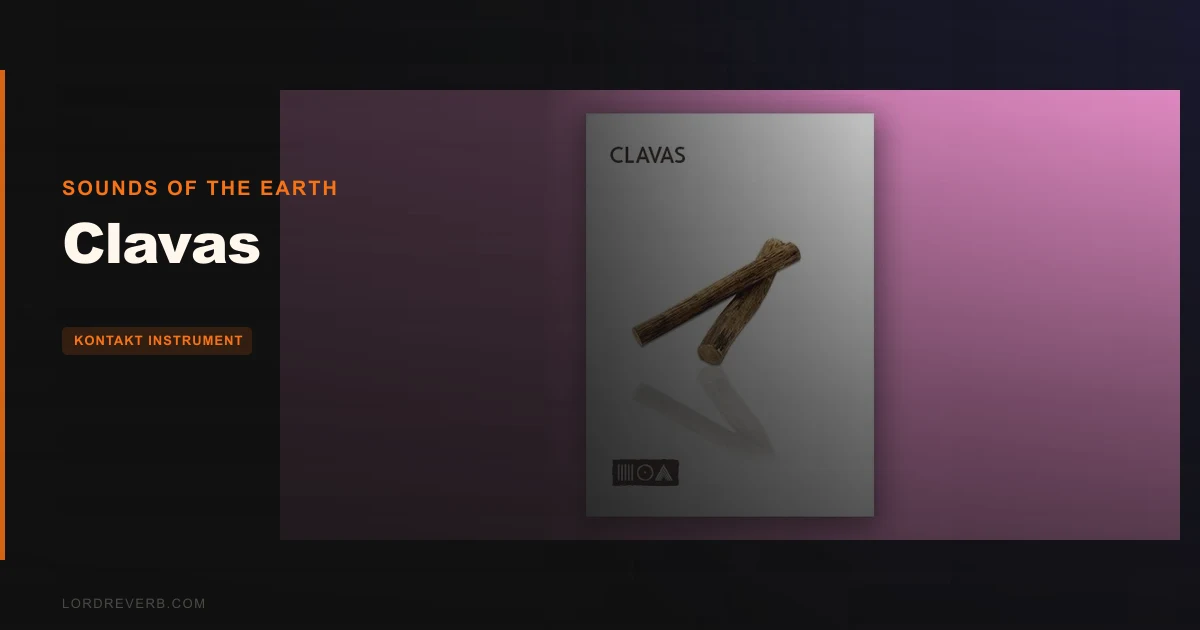
Clavas is a Kontakt 7 library built around a single percussion instrument: claves, the two wooden sticks that have kept the clave pattern locked in Latin music for generations. It sells for $7.90 and it's aimed at producers who know exactly what a pair of well-recorded claves sounds like and are tired of settling for a thin sample buried somewhere in a drum kit pack.
Quick verdict: At $7.90, Clavas is a satisfying micro-purchase if you already own full Kontakt 7 and you need authentic clave samples you can actually dial in across multiple mic positions. It's not trying to be a full percussion library. It's one instrument, done with care. If you're sitting on the free Kontakt player or you're hoping this covers your whole Latin percussion rig, skip it. But for what it is, it earns its shelf space.
The Problem With Clave Samples in Most Libraries
You're building a salsa arrangement or scoring a scene that calls for something rooted in Afro-Cuban tradition. You reach into your go-to drum library and find one clave hit, sampled from what sounds like a plastic ruler. You layer it, tune it, throw a transient shaper on it. It still sounds wrong.
The issue isn't EQ. It's the source. Generic percussion packs don't prioritise claves. They treat them as an afterthought, one sample in a folder labelled "misc_latin_perc". The character of real claves comes from the wood, the player's grip, the room. You can't fake that with a single mono hit and a pitch algorithm.
That's the frustration Clavas exists to fix. Sounds of the Earth recorded a real pair of claves, handcrafted from guácimo ternero wood by Daniel Mora, and gave you 8 microphone options to work with. That's the proposition.
How It Performs
Claves produce a sharp, penetrating crack when struck together. There's very little sustain. The pitch sits in that upper-midrange presence zone where it cuts through a dense mix without competing with kick or bass. What separates a brilliant clave recording from a mediocre one is exactly that crack: how much air is around it, how the wood grain comes through, whether it sounds like it was recorded in a space or squeezed through a limiter.
With 8 microphone positions on offer, you've got real range here. Close mics give you that dry, focused attack. Room mics let the body breathe. You can blend positions to get the clave sitting exactly where you need it in the stereo field, whether that's tucked tight into a drum bus or sitting wide on its own send.
The library holds 337 Kontakt sample files across 30 audio files, all inside a 160MB package. That's light. It loads fast and won't tax your session. The instrument itself is simple by design, which is either clever or frustrating depending on what you came here for.
Strengths and Weaknesses
The honest strength here is the source material. Guácimo ternero is a hardwood native to Central America, and it gives these claves a specific density and brightness. You get a tone that doesn't sound like a sample pack. Strike your clave hit at different velocities and you'll hear the wood respond differently, which is what you want when you're programming a groove that needs to feel human.
The 8 mic options are a genuine win. Put the close mic on the clave and push it into a parallel compression bus. That's where it gets tight and satisfying in a way a single-sample library never could.
The weakness is just as obvious. This is a one-instrument library. No shakers. No congas. No other Latin percussion to round out a full arrangement. If you need a complete toolkit, this won't do it alone.
The other annoying constraint: you need full Kontakt 7 retail. The free Kontakt player runs this in demo mode only. At a library this size, that requirement feels steep for some budgets, even if it's a standard industry limitation.
Value for the Price
At $7.90, the question isn't whether this is a bargain in absolute terms. It is. The question is whether it earns a slot in your library when you already have Latin percussion covered somewhere.
If your current clave sample sounds thin or plastic, this is a direct upgrade for almost nothing. If you already own a detailed Latin percussion library with multiple mic positions and round-robin samples, you might not feel the gap this fills. The wood, the detail, and the mic variety are all real. The scope is just narrow by design, and you should go in knowing that.
Who Should (and Shouldn't) Buy This
- ✅ Buy if you produce Latin, Afro-Cuban, or Caribbean music and want a clave that sounds like actual wood, not a factory preset.
- ✅ Buy if you score for picture and need a historically and sonically accurate clave patch for an Afro-Cuban or Latin cue.
- ✅ Buy if you already own Kontakt 7 full retail and $7.90 represents genuine value for a single precise sample set.
- ❌ Skip if you only have the free Kontakt player. It will run in demo mode. That's a hard wall.
- ❌ Skip if you need a full Latin percussion library. This is one instrument, nothing else.
- ❌ Skip if you're hoping for a complex, multi-articulation instrument with extensive scripting. It's wood sticks. That's the point.
Specs & Technical Details
| Developer | Sounds of the Earth |
| Price | $7.90 |
| Plugin Format | Kontakt Instrument (.nki) |
| OS Support | Mac (OSX 10.10 or later) / Windows (7, 8, 10) |
| Activation | Pulse Installer |
| CPU Usage | Light (160MB, single instrument) |
| Trial Available | N/A |
| Version Reviewed | N/A |
| Kontakt Requirement | Full Retail Kontakt 7 or later |
| Sample Files | 337 Kontakt sample files / 30 audio files |
| Microphone Options | 8 |
| File Size | 160MB |
Score Breakdown
| Category | Score | Notes |
|---|---|---|
| Sound Quality | 4.0/5 | Real wood, real character; 8 mic positions lift it well above standard library fare |
| Value for Money | 4.0/5 | Priced low enough that the narrow scope is forgivable if you need exactly this |
| Ease of Use | 3.5/5 | Simple instrument, but the Pulse installer and Kontakt 7 requirement add friction upfront |
| Features | 3.0/5 | 8 mic positions are great; everything else is deliberately minimal |
| CPU Efficiency | 4.5/5 | 160MB, single instrument; it barely touches your session resources |
| Overall | 3.5/5 | A focused, honest library that does one thing well and nothing else |
The Bottom Line
If you've been reaching for a clave sample that actually sounds like someone struck two pieces of hardwood together in a real space, Clavas answers that. Not loudly. Not with a feature list. Just with a well-recorded pair of sticks and 8 ways to hear them.
You need full Kontakt 7 to use it properly. That's the real qualifier. If you've got it, $7.90 is barely a decision. If you don't, this isn't the library that justifies the upgrade on its own.
It's a small, specific tool. The producers who love it will reach for it on every Latin session without thinking twice. Everyone else will wonder why they'd buy one instrument when a bigger pack exists. Both reactions are fair. Know which camp you're in before you click.
Frequently Asked Questions
Will Clavas work with the free Kontakt player?
No. The free Kontakt player runs Clavas in demo mode only, which means it'll time out mid-session. You need the full retail version of Kontakt 7 or later. That's a firm requirement, not a workaround situation.
What are claves, and why does the wood type matter?
Claves are two cylindrical hardwood sticks, typically 20 to 25 centimetres long, struck together to produce a sharp, percussive crack. They're the rhythmic backbone of a lot of Latin and Afro-Cuban music. The wood species changes the density and brightness of the tone, which is why this library specifies guácimo ternero wood rather than a generic hardwood. Different wood, different character.
How do the 8 microphone options affect the sound in practice?
Each mic position captures the claves from a different distance or angle, so you're choosing between dry and upfront versus more open and roomy. You can blend positions to sit the clave exactly where you need it in a mix. If you're working on a Latin track that needs the clave locked into the rhythm section, a close mic does that. If you need it to breathe in a more spacious arrangement, pull in a room position.
Is 160MB large or small for a Kontakt library?
It's light. Most full-featured Kontakt instruments run into several gigabytes, so 160MB loads fast and barely registers in your session. For a focused, single-instrument library this size, that footprint is exactly right. It won't compete with your orchestral libraries for drive space.