
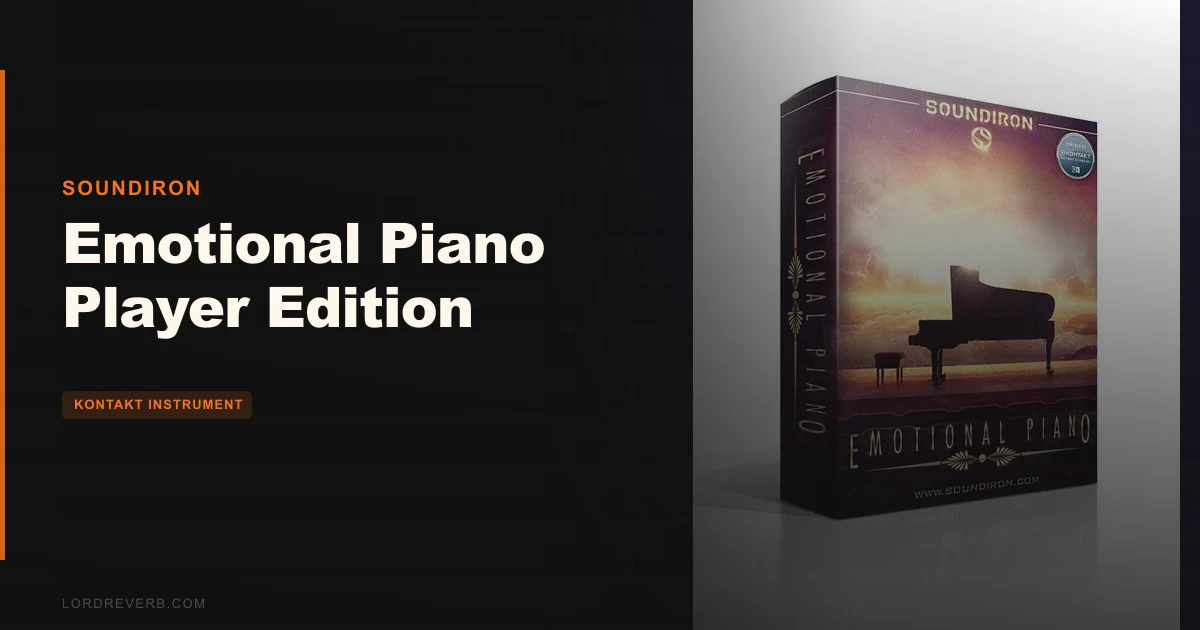
The Emotional Piano Player Edition review starts with a hard truth: this is a Kontakt instrument, and if you don't own Kontakt 5.5.2 or later, you cannot use it. Full stop. There's no standalone app. There's no bundled player. You need a licensed copy of Kontakt from Native Instruments, and that's the first thing to check before reading another word.
Past that gate, what you're looking at is a walnut-bodied Kawai grand piano recorded close, deep, and with strong personality. It's available at $74.50 and it is built for a specific kind of work: film scoring, TV music, modern indie-pop, anything that wants a piano with weight and colour rather than clinical neutrality.
It's not for everyone. Some experienced users have called it poorly suited to serious mixing. That matters, and we'll get into exactly why.
The Catch Up Front
Kontakt dependency aside, the complaints from owners are consistent enough to take seriously.
There's no sympathetic resonance. On a real grand piano, strings ring in response to other strings. Here, that physical interaction is absent. You'll notice it on sustained chords where a real piano would bloom and breathe.
The close-mic recording is the only option. You get one perspective: dry, present, intimate. There's no stereo room pair to blend in and no way to push the sound back in the mix naturally without reaching for the reverb tools yourself.
Preset patch levels run hot. Play a full fortissimo chord and you'll clip before you've had a chance to dial in your gain staging. That's annoying and it's fixable, but you shouldn't have to fix it out of the box.
Key release noise sits prominently in the signal. Some owners find it distracting. At least one user flagged out-of-phase issues that caused real mixing problems. And a few experienced composers called it unusually disappointing for a Soundiron title.
What You Get If You Clear It
If none of those limits bother you, here's what you're actually buying.
The library ships with 1,716 samples at 24-bit / 44.1 kHz in lossless NCW format. Installed, it sits at 2.57 GB. Uncompressed it's 4.6 GB. The piano covers 88 keys with an average of 10 dynamic velocity layers per key note and release. That layering is where the low-velocity expressiveness lives.
You get 41 NKI presets, including some with an adaptive arpeggiator system. The FX panel runs a 10-bay modular effects chain with full routing control, 18 built-in Kontakt DSP effects, and a convolution reverb loaded with over 100 custom environments. Those aren't just stock halls. There are FX-flavoured spaces in there for sound design territory.
Pedal action samples are included. Snapshot Presets let you save and recall complete effect configurations. And the whole thing integrates with Komplete Kontrol and S-Series keyboards with Light-Guide support if that's your setup.
Where It Shines
The low-velocity performance is where this instrument earns its keep. Close mic proximity means soft notes are captured with detail that disappears in room-recorded alternatives. When you're writing a quiet scene, playing at pianissimo, every subtle dynamic shift comes through without that digital smear you get from libraries that weren't recorded carefully at low levels.
One professional composer reported using it across 30 film scores and over 100 TV episodes. That's not a casual endorsement. It tells you this instrument holds up under deadline pressure and survives the scrutiny of picture editors and music supervisors.
System resource use is low. For a library of this depth, that's a genuine strength. If your session is already taxed, you can drop this in without watching your CPU meter climb.
The 10-bay FX chain earns its keep for sound design work. Push the drive through the convolution reverb and the top end turns textured and strange. That's where this piano stops being a piano and starts being an atmosphere.
Against the Field
Ivory II and Vintaged CG7 are both mentioned as alternatives with a more generic, clear character. If you need a piano that disappears into the mix and sounds like "piano," they're the stronger call. The Emotional Piano Player Edition is a character instrument. It has a voice. That's a feature for some work and a liability for others.
SampleTekk is cited in the same breath by people shopping this category.
Radical Piano comes up as the more flexible option. Users who compared both say Radical Piano is more tweakable and can get to a similar emotional sound while also covering more neutral ground. If you want one instrument that does both, that comparison is worth your time before committing.
Who Should Buy This
- ✅ Buy if you score to picture and need a close, characterful piano that responds beautifully at low velocities.
- ✅ Buy if you produce modern indie-pop or ambient music and want piano with personality baked in.
- ✅ Buy if you already own Kontakt and want deep FX routing without reaching for separate plugins.
- ❌ Skip if you need a neutral, mix-ready piano for sessions with demanding engineers or live band production.
- ❌ Skip if sympathetic resonance matters to your playing feel and realism expectations.
- ❌ Skip if you don't own Kontakt. There is no workaround here.
Specs & Technical Details
| Developer | Soundiron |
| Price | $74.50 |
| Plugin Format | VST / AU / AAX (via Kontakt) |
| OS Support | Mac (OSX 10.9+) / Windows (XP+) |
| Activation | Native Instruments / Kontakt license required |
| CPU Usage | Light (owners report low system resource use) |
| Trial Available | N/A |
| Version Reviewed | 3.0 |
Score Breakdown
| Category | Score | Notes |
|---|---|---|
| Sound Quality | 3.5/5 | Excellent at soft velocities; no sympathetic resonance and release noise hurt the ceiling |
| Value for Money | 3.5/5 | Fair at $74.50 for a scoring specialist, weak as a general piano replacement |
| Ease of Use | 3.5/5 | FX chain is powerful but preset levels ship too hot, requiring immediate gain adjustment |
| Features | 4.0/5 | 10-bay FX chain, 100+ convolution spaces, adaptive arpeggiator and Snapshot Presets are strong |
| CPU Efficiency | 4.0/5 | Low resource draw confirmed by multiple owners; runs comfortably in busy sessions |
| Overall | 3.5/5 | A well-built character instrument for scoring work that falls short as an all-purpose piano |
Alternatives to Consider
Ivory II suits you if you want a clearer, more neutral grand that sits in a mix without asking for attention. Owners of both describe it as the opposite personality to the Emotional Piano.
Vintaged CG7 is another clean-character option mentioned alongside Ivory II for work where the piano needs to be a foundation rather than a feature.
Radical Piano is the one we'd push hardest as an alternative if you're on the fence. It's described by people who've used both as more tweakable, capable of reaching the Emotional Piano's expressive sound while also covering more conventional territory. If you're buying a single piano instrument and you're not sure how often you'll need the character sound, Radical Piano gives you more room to move.
The Bottom Line
You're at $74.50 for a library that does one thing with real craft: it captures a walnut-bodied Kawai at close range with enough velocity detail to make quiet moments feel alive. That's genuinely satisfying for a certain kind of work.
But the missing sympathetic resonance, the single mic position, the hot presets, and the release noise make it a frustrating proposition if you need a piano that sounds like it was recorded in a room and behaves like it was played in one.
If you score to picture and want expressive soft-velocity response with a deep FX chain already built in, this is a clever specialist tool. If you need a workhorse grand that a mixing engineer won't question, the alternatives are a better match and you should look there first.
Frequently Asked Questions
Do I need a full Kontakt license to use Emotional Piano Player Edition?
Yes. This library requires Kontakt version 5.5.2 or later. It does not run in the free Kontakt Player. If you only have the Player, you won't be able to load it. Check your Native Instruments license before buying.
How large is the installed library?
Installed with lossless NCW compression, the library takes up 2.57 GB on your drive. The uncompressed size is 4.6 GB. It's not a heavy footprint by modern standards, and owners report it runs lightly on CPU as well.
Is Emotional Piano Player Edition good for live performance?
It's compatible with Komplete Kontrol and S-Series keyboards with Light-Guide, so the hardware integration is there. Whether the library suits live use depends on your genre. The close, character-driven sound works for solo performance or singer-songwriter sets. For live band contexts needing a neutral piano sound, it's less ideal.
Why do some reviewers say it's not good for mixing?
The main criticisms point to three things: preset levels that clip on loud chords, key release noise that sits prominently in the signal, and at least one reported out-of-phase issue. These are real limits that affect how the instrument behaves once it's in a full mix. It's also close-mic only, with no room pair to blend, which makes it harder to place naturally in a dense arrangement.
How does Emotional Piano Player Edition compare to Ivory II?
They're built for different things. Ivory II has a clearer, more neutral character and is built to work as a general-purpose piano. The Emotional Piano is a character instrument with a warm, close, intimate voice that suits scoring and atmospheric work. Owners mention them as complementary rather than interchangeable. Buy the Emotional Piano if you want personality; buy Ivory II if you need versatility.