
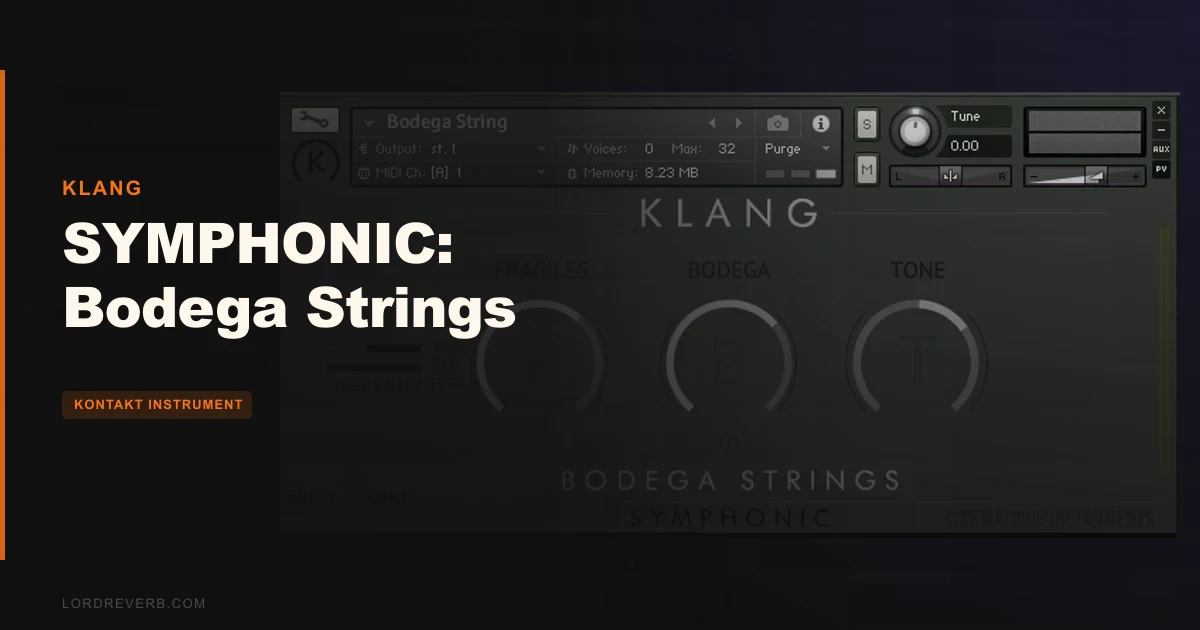
Every composer eventually hits the wall with stock string libraries: everything sounds too clean, too polished, too eager to please. You need something that sounds like it's falling apart. Something fragile. Something that sits in a cue and makes the listener uncomfortable without them knowing why. SYMPHONIC: Bodega Strings by KLANG is built for that exact problem. At $6, it's a Kontakt instrument that leans into deep, scratchy, processed string textures instead of running from them. It's not for everyone, and that's the whole point.
Quick verdict: Bodega Strings is a narrow, characterful instrument that does one thing with conviction: it sounds broken in an interesting way. The halftime violin layer, the modular effects processing, and the quiet, fragile violin notes add up to a tool for atmosphere and unease rather than traditional orchestral writing. At $6, the ask is low enough that if the aesthetic fits your work, the risk is minimal. But if you need a workhorse string library, this isn't it. We'd score it 3.5/5 for what it is.
The Problem This Actually Solves
Standard string libraries are engineered to sound neutral and majestic. That's most of the market. But a lot of film, ambient, and experimental work needs the opposite: strings that sound weathered, intimate, or processed beyond recognition.
The frustration is real. You spend hours layering normal strings, running them through tape saturation and pitch-shifting, trying to get that fragile, half-broken quality, and it still sounds like a clean recording being pushed through effects. The source material fights you.
Bodega Strings starts at the other end. The recordings were captured from different perspectives, processed through modular effects, and the violin layer includes a halftime version baked into the instrument. That scratchy, deep character isn't something you dial in after the fact. It's already there in the raw material.
How It Performs in Practice
The core character here is the violin work. These are very quiet, fragile violin notes. Not quiet in the dynamic sense alone, but fragile in texture: the kind of bowing where you hear the bow hair and the rosin more than the note itself.
Push into that halftime layer and the sound gets heavy. Slow. It sits underneath a cue like something wrong is about to happen. That's a genuinely useful quality for anyone scoring suspense, horror, or slow-burn drama.
The flutes and French horns round out the instrument. KLANG describes it as capturing familiar instruments from different perspectives, which in practice means you're not always hearing these instruments the way a session player would position a microphone. Some of that is disorienting. That's the idea.
The special and uncommon articulations are where Bodega Strings earns its place as a sound-design tool rather than a straight orchestral instrument. If you want conventional legato runs, you'll probably find the palette frustrating. If you want textures that don't behave predictably, this is satisfying territory.
The modular effects processing on the recordings matters. It means the source itself is coloured, not just the output. You're not undoing this with a dry mix knob and getting back to something neutral. What you hear is what it is. Some producers will love that. Others will find it annoying.
Strengths and Weaknesses
The clearest strength is the character. There are very few string instruments at any price that commit this hard to a specific, damaged aesthetic. The quiet and fragile violin notes aren't a bug. They're the whole product.
The different recording perspectives give you some spatial flexibility. You're not locked into one fixed room sound, which matters when you're building a layered cue and need elements to sit at different distances in the mix.
The halftime layer is clever. It adds a kind of weight to the violin recordings that you'd normally have to construct manually. It doesn't feel tacked on.
The weaknesses are real though. The full Kontakt requirement is an annoying friction point in 2026. No Kontakt Player support means you need a paid licence before this instrument costs you anything. That changes the value equation for some buyers.
The character that makes Bodega Strings interesting is also its hard limit. You cannot dial out the deep, scratchy quality and use this as a clean orchestral instrument. It's not built for that. If you need a library that covers both moods, look elsewhere.
The lack of published technical detail makes it genuinely hard to know what you're getting before you commit. How many round-robins? How deep is the sample pool? Not clear from what KLANG has shared publicly.
Value for the Price
At $6, this is priced as an impulse buy rather than a main purchase. And that's probably the right way to frame it.
If you already own full Kontakt, the barrier to entry is low. You're buying a texture, a mood, a specific kind of broken string character. You're not buying a complete orchestral toolkit. Judge it on that basis and $6 is easy to justify if the aesthetic lands in your work at all.
If you'd need to buy full Kontakt just to access it, the math shifts sharply. That changes this from a bargain to a conversation about whether you need Kontakt anyway.
Who Should (and Shouldn't) Buy This
- ✅ Buy if you score films, games, or trailers where fragile, unsettling string textures are part of your regular palette.
- ✅ Buy if you already own full Kontakt and want a cheap, characterful texture layer for ambient or experimental production.
- ✅ Buy if you work in electronic music and want real acoustic material that's already been pushed into strange territory by modular processing.
- ❌ Skip if you need clean, traditional orchestral strings for any application where polish matters.
- ❌ Skip if you only have Kontakt Player. This won't load.
- ❌ Skip if you need a broad library with many instruments, articulations, and dynamics covering a full orchestral range.
Specs & Technical Details
| Developer | KLANG |
| Price | $6 |
| Plugin Format | Kontakt Instrument (.nki) |
| OS Support | N/A |
| Activation | N/A |
| CPU Usage | N/A |
| Kontakt Version Required | 5.6.8 or higher (full version) |
| Trial Available | N/A |
| Version Reviewed | N/A |
Score Breakdown
| Category | Score | Notes |
|---|---|---|
| Sound Quality | 4.0/5 | Commits hard to a specific character; fragile violin textures are genuinely distinct |
| Value for Money | 4.0/5 | At this price the ask is minimal if the aesthetic fits; full Kontakt requirement complicates it |
| Ease of Use | 3.0/5 | Kontakt dependency and limited public documentation add friction before you even load it |
| Features | 3.0/5 | Special articulations and halftime layer are clever; overall scope isn't wide |
| CPU Efficiency | N/A/5 | No data available |
| Overall | 3.5/5 | A narrow, honest instrument for a specific kind of producer working in a specific kind of dark |
Bodega Strings is a tool for a specific kind of work, and it doesn't pretend otherwise. If your sessions involve fragile, unsettling, broken-sounding orchestral textures, this is a genuinely underrated addition to a full Kontakt setup. If that description doesn't match what you do, skip it without guilt. The violin notes are quiet and fragile by design. Your job is to decide if that quality serves you.
At $6, the wrong person buys this and wastes almost nothing. The right person buys it and finds something they'll keep reaching for in the ugly, slow-burning cues that need a string sound with something wrong underneath it.
Frequently Asked Questions
Does SYMPHONIC: Bodega Strings work with the free Kontakt Player?
No. It requires the full version of Native Instruments Kontakt, version 5.6.8 or higher. Kontakt Player will not load it. If you only have the free Player, you'll need to upgrade to full Kontakt before this instrument is accessible to you.
Is Bodega Strings suitable for traditional orchestral film scores?
Not really. The instrument is built around a deep, scratchy, processed string character with a halftime violin layer and modular effects processing baked into the recordings. That design makes it brilliant for fragile, unsettling atmospheres but rules it out for clean, traditional orchestral writing where polish is the goal.
What instruments are included in SYMPHONIC: Bodega Strings?
The library includes violins, flutes, and French horns, recorded from different perspectives and processed through modular effects. The violin section includes very quiet, fragile notes and a processed halftime layer. Special and uncommon articulations are part of the instrument's design focus.