Grindhouse by Big Fish Audio is a Kontakt instrument library built specifically for the filthy, sun-bleached sonic world of 1950s-to-1970s exploitation cinema, B-movies, and the crate-digging producers who love that era. At $69.97, it's a focused tool, not a swiss-army sampler. If that's your world, it delivers. If it's not, don't bother.
Quick verdict: Grindhouse scores 4.1 out of 5. It earns that score by doing a narrow thing with real commitment: 12.4 GB of 24-bit samples, genuine lo-fi processing controls, and over 70 patches that all sound like they came off a double-feature reel from 1972. At $69.97, it's honest value for anyone scoring a Spaghetti Western short, building a cinematic hip-hop beat, or producing music that needs to feel borrowed from a dusty VHS tape. The missing legato transitions are a real frustration for melodic work. For everything else in this lane, it's hard to argue with.
What It Is (and What It's Not)
This is a character library. It is not a general-purpose orchestral toolkit or a clean bread-and-butter sample set.
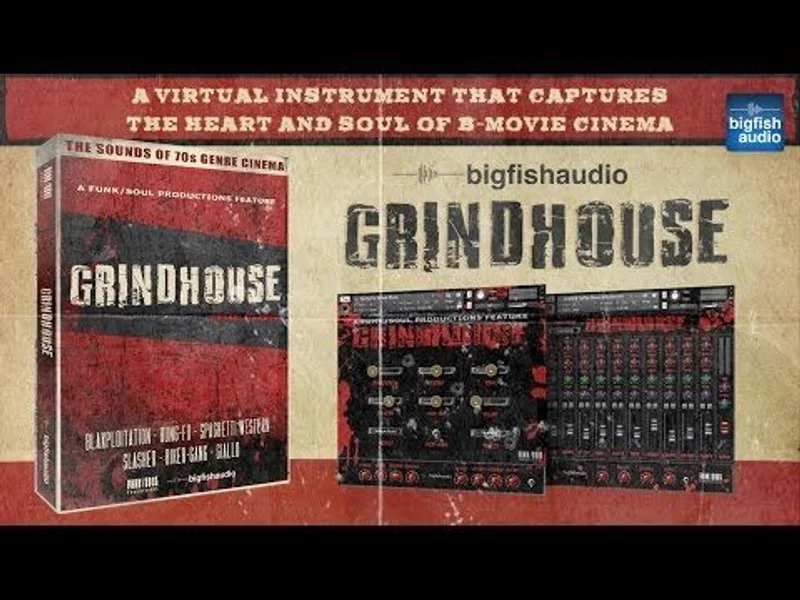
Grindhouse runs in Kontakt 5.6 or higher and loads 12.4 GB of uncompressed 24-bit WAV content. The 70+ patches span Spaghetti Western electric guitars, melodramatic string sections, psychedelic flutes, mariachi horn sections, filthy electric basses, funky guitars, and 1960s cliché jungle movie drums. There are even audio clips pulled from actual public domain Grindhouse films sitting inside the library.
What it is not: a legato string library, a hyper-realistic orchestral tool, or anything you'd reach for when a client wants "clean and modern." The lo-fi character is baked in. That's the point. If you need conventional instrument sounds, this won't be your answer.
Where It Fits In Your Session
Picture this: you're scoring a low-budget horror short. The director keeps saying "make it feel cheap, like a drive-in movie." You've been stacking generic orchestral patches and nothing is landing.
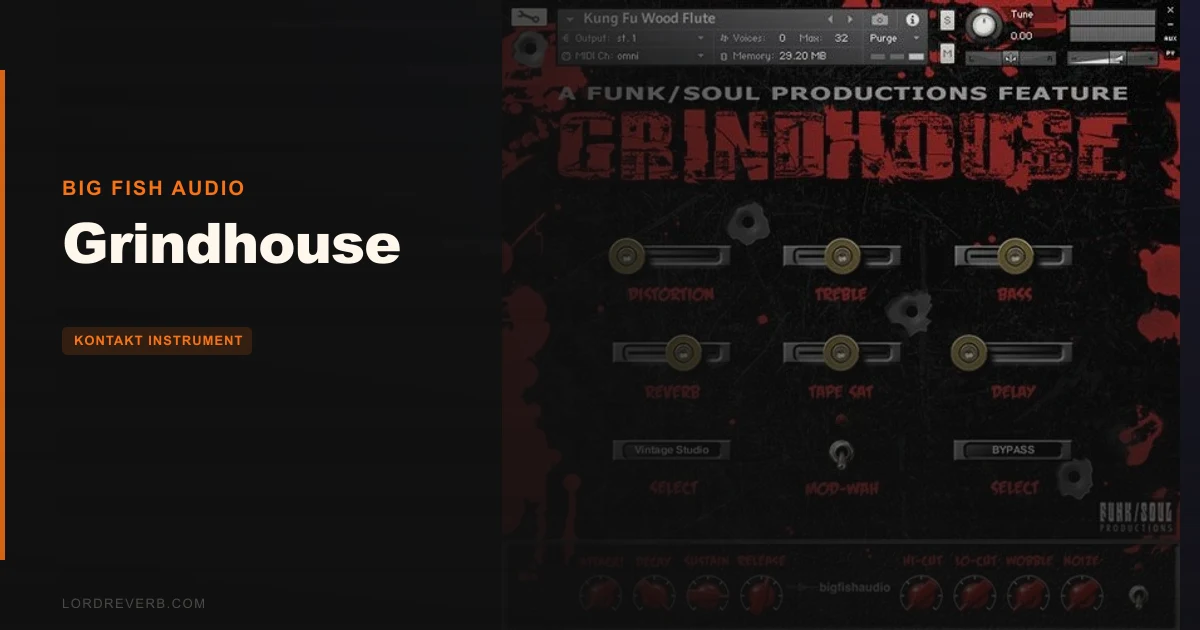
That's exactly where Grindhouse earns its place. Load a Melodramatic String Section patch, push the Wobble control until the pitch starts to drift the way old celluloid warps, then hit the Tape Saturation to let it compress and limit like a battered reel-to-reel. Turn the Noise control up until you can hear the actual hum and crackle sampled from 1970s exploitation films sitting underneath the notes. Suddenly the room changes.
The GUI keeps the workflow fast. Bass and Treble controls are bipolar, so you can cut or boost from one knob. The Hi-Cut filter pushes things dull and muffled when you want that buried, off-screen feel. The Lo-Cut strips the low end out if you need thin and tinny instead. A Distortion control adds simulated tube-amp grit. The Delay section offers tempo-synced options via a drop-down, and the Reverb control gives you 10 convolution choices. Mod-Wha lets your mod wheel double as a wah pedal, which is a satisfying little trick on the funky guitar patches. ADSR is fully accessible.
Patches also include keyswitched articulations, so you can flip between variations without leaving the keyboard. Useful.
The Trade-Offs
The character here is brilliant. Owners consistently report that these instruments feel jam-packed with exactly the right B-movie energy, and reviewers praise the range from mariachi brass to psychedelic flutes to genuinely filthy bass tones. That lo-fi footprint, the distortion, the tape saturation, the wobble, it all works together in a way that feels considered rather than bolted on.
But the lack of legato sample transitions is annoying if you're writing any kind of melodic line that needs to breathe. Notes don't blend. They articulate individually. For stabs, hits, rhythmic textures, and the kind of choppy Spaghetti Western phrasing this library clearly loves, that's fine. Try to write a smooth flute melody and you'll hear the join every time.
Limited dynamic layers compound that frustration. Expressive playing is harder to fake when the velocity response is narrower than you'd want. And some of the patches, reviewers flag this honestly, tip into cheesiness. That may be exactly what you're after. It may also be one dial-turn past useful, depending on the project.
The specialization is both the strength and the ceiling. Outside exploitation-film and B-movie territory, this library has very little to offer. That's not a flaw in design. It's a deliberate identity. Know what you're buying.
The Real Verdict
If you're building retro film scores, cinematic hip-hop, or any music that needs to feel like it was recorded in 1971 on equipment that had already seen better days, Grindhouse is worth $69.97 without much debate. The processing controls are genuinely clever and the sample content has a character that generic lo-fi plugins can't replicate.
Skip it if you need clean, modern, or versatile. Skip it if you rely on legato melodic lines. Skip it if B-movie cheese sounds like a problem rather than an aesthetic. This is a love-it-or-ignore-it library, and there's nothing wrong with that.
Specs & Technical Details
| Developer | Big Fish Audio |
| Price | $69.97 |
| Plugin Format | Kontakt Instrument (requires Kontakt 5.6+) |
| OS Support | N/A |
| Activation | N/A |
| Library Size | 12.4 GB (uncompressed 24-bit WAV) |
| Number of Patches | 70+ |
| CPU Usage | N/A |
| Trial Available | N/A |
| Version Reviewed | N/A |
Score Breakdown
| Category | Score | Notes |
|---|---|---|
| Sound Quality | 4.5/5 | Era-specific character is deep and convincing; no legato limits melodic realism |
| Value for Money | 4.0/5 | 12.4 GB of specialized content at $69.97 is fair for the target audience |
| Ease of Use | 4.0/5 | GUI is clean and direct; processing controls are logically laid out |
| Features | 4.0/5 | Wobble, Noise, Tape Saturation and convolution reverb are well-chosen; dynamic layers are thin |
| CPU Efficiency | N/A | Not verifiable from available data |
| Overall | 4.1/5 | A focused, characterful library that delivers exactly what it promises for one specific aesthetic |
Grindhouse is one of those libraries that knows exactly what it is and doesn't pretend otherwise. That kind of honesty in a sample product is underrated. If your session has a Spaghetti Western credit sequence, a drive-in horror cue, or a hip-hop beat that needs to smell like a thrift store record bin, this is where you go. Everyone else can walk on past.
Frequently Asked Questions
Do I need the full version of Kontakt to run Grindhouse?
Grindhouse requires Kontakt 5.6 or higher.
Is Grindhouse useful for hip-hop producers, or is it only for film scoring?
The developer specifically mentions crate-digger vibes and loop creation, so beat makers are clearly in the target audience. The funky guitars, filthy electric basses, and Noise and Wobble controls make it a solid fit for lo-fi hip-hop or cinematic trap. It's not a drum machine replacement, but layered with your existing drum samples it can add serious texture.
Can you turn off the lo-fi character if you want a cleaner sound?
The processing controls like Distortion, Tape Saturation, Wobble, and Noise are adjustable, so you can dial them back toward zero. That said, the underlying samples themselves carry inherent character. Owners and reviewers describe the library as capturing a 1950s-to-1970s sonic footprint, so expecting a fully clean result from these patches would be wishful thinking.