
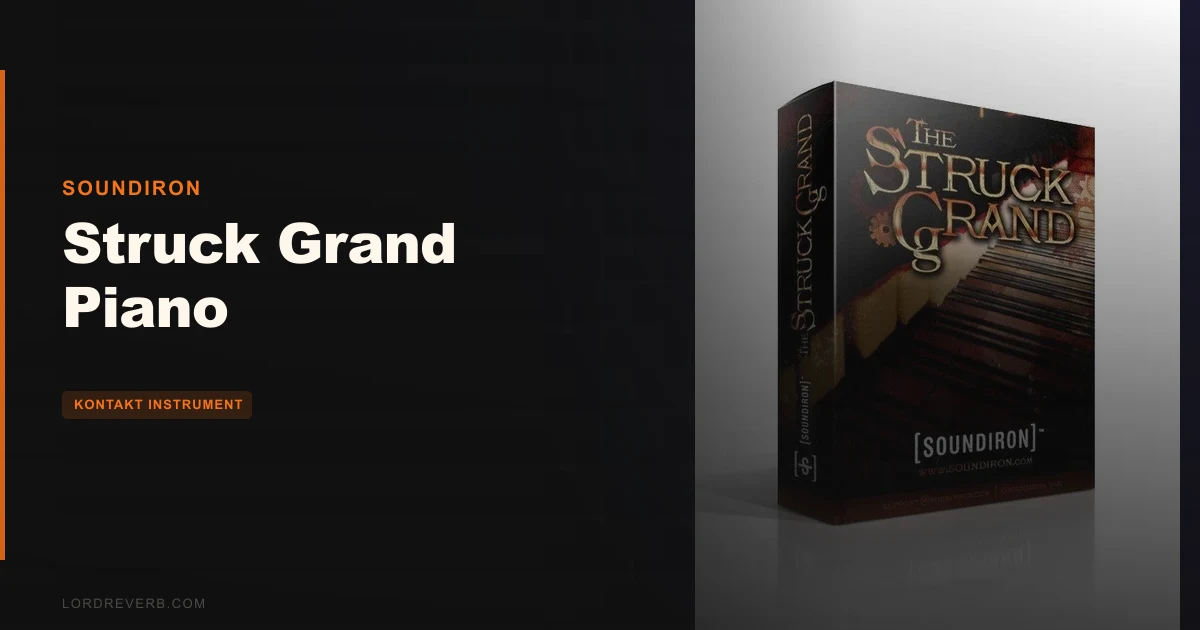
Is Struck Grand Piano worth $79 for prepared piano sounds? Yes, if you score drama, tension or textural film cues and you own full Kontakt.
It’s a harder sell if you want a clean concert grand to play ballads on. That’s not what this library does, and Soundiron never claims otherwise.
This is a Kontakt instrument built from a 1926 Steinway Model L parlor grand. Soundiron recorded it with mallets, plucks, finger mutes, steel slides, scrapes, harmonics and metal hammer hits.
One note on how this review was made. It is based on the product page, the developer’s published specs and the documented feature set. No free trial is mentioned in the material reviewed, so nothing here comes from hands-on sessions. Where a claim can’t be verified yet, we say so.
Who Needs a Prepared Piano Library?
You need it if your cues keep calling for something between a piano and a zither. A scene wants tension, but a string pad feels generic.
Picture a thriller cue. The bed is a low drone and you need a pulse that feels human and slightly wrong. A prepared piano gives you that.
It also suits classical and ethnic-leaning writing. The developer positions the Steel Hammer, Slide and Picked sections for a nuanced classical feel.
If you only ever write pop and singer-songwriter material, skip it. A normal piano library will serve you better for less friction.
What Struck Grand Piano Actually Does
The core idea is simple. Soundiron sampled the strings of a grand piano the way a sound designer would, not the way a pianist would.
The developer describes it as working both as a melodic tuned percussion instrument and as a massive stringed zither. That’s the right mental model.
The sample set is large. The product page lists 4,058 samples across the full 88-key range, at 24-bit/48kHz uncompressed PCM wav. Installed size is 9 GB.
That figure is lower than the roughly 4,100 you may see quoted elsewhere. We’re using the product page numbers because they’re the ones Soundiron publishes for this release.
The source is a 1926 Steinway Model L parlor grand. That’s a smaller instrument than a concert grand, with its own character.
Soundiron describes rumbling bass and glistening highs, captured up close. The recording is close-miced and dry, which suits a library like this. You add the room afterwards.
The Articulations: One Instrument, Many Abuses
This is the heart of the library. The tuned instruments are organised by how the strings are attacked.
Tuned articulations
The tuned section covers seven playable sets, plus presets:
- Choked Piano
- Hammered Piano
- Picked Piano
- Scraped Piano
- Struck Piano
- Steel Slide Piano
- Steel Harmonic Piano
- Master Layer Builder Presets
Each is a full-range instrument you can play like a keyboard patch. The names tell you most of what you need.
Struck and Hammered sit in the percussive, dramatic end. The developer points at Struck, Harmonic, Mallet and Gliss for suspenseful scoring.
Steel Hammer, Slide and Picked lean classical. That split is useful. It tells you where to reach first for a given mood.
Effects articulations
The effects folder is for gestures, not melodies. It lists Fingered Glisses, Picked Glisses, Mallet Struck Strings, Scrapes, Steel Harmonics and Steel Slides.
These are the sounds that make a cue feel handmade. A scrape under a sustained note does more than another reverb layer.
We like that these are separate from the tuned sets. You can sketch a part on Struck Piano, then drop a gliss over the top.
Sustains and ambiences
There’s a third category: full-range tuned ambiences and ambient soundscapes. The developer calls out atmospheric pads, tonal drones and evolving textures.
They can be morphed and shaped in real time. That’s a smart addition for a library aimed at scoring.
Pads built from a piano’s own strings tend to sit better with the piano layers than a generic synth pad would. That’s the logic, and it’s sound logic. Whether it holds in a dense mix is something to check yourself.
Layer Builder: The Feature That Justifies the Library
The Layer Builder is the new control system we’re most curious about. It lets you blend up to 12 independent articulation sound layers.
Twelve layers is a lot. You could stack a Struck attack, a Steel Harmonic shimmer and a Scraped noise bed in one patch.
The Master Layer Builder Presets are listed in the tuned section. That’s your starting point so you aren’t building from silence.
Here’s why it matters. Most prepared piano libraries make you load articulations separately and layer them in your DAW. Doing it inside one instrument keeps the key mapping and dynamics together.
It also means one instance instead of several. That’s a sensible CPU and organisation win, though we can’t give you a measured figure.
The honest caveat: twelve layers means twelve things to balance. Soundiron’s own presets will carry most of the early work.
Gliss/Strum Creator: Where It Gets Interesting
The Gliss/Strum Creator is the second big system. The developer says it performs life-like strums and string glisses.
It’s built around several controls:
- Key and chord constraining
- Stroke direction
- Alternation
- Speed
- Dynamic sequencing
- Arpeggiation
- Palm muting
Key and chord constraining is the one that matters for musicians. It keeps your strum inside the harmony you’re playing, so it doesn’t clash.
Stroke direction and alternation are what make a strum feel played. Up-down patterns sound different from a single sweep.
The developer says each parameter can be automated on the fly. That allows organic performances, with the strum evolving across a cue.
Palm muting and arpeggiation give you rhythmic options. You can turn a gliss into a pulse.
We’d want to hear how convincing the alternation sounds at speed. That’s the sort of thing a spec sheet can’t tell you.
Sound Shaping and the Interface
The library ships with a custom Kontakt GUI. The product page says it provides a wide range of sound shaping controls.
Everything is described as automation-ready in your host or in Kontakt’s stand-alone mode. That’s what you want for evolving cues.
The page lists a fully automatable LFO, EQ, filter and custom room/FX reverb types. These are the standard tools, built into the interface.
It’s a competent set. Nothing exotic, but it means you can shape a patch without leaving the instrument.
Be realistic about the effects. Close-miced dry samples give you a clean starting point. A convolution reverb in the instrument saves you routing for quick sketches.
Kontakt Format, Requirements and Openness
This is the part to read before you buy. It’s a standard Kontakt open-format library.
That means the free Kontakt Player can’t run it properly. The product page says it works only in demo mode there.
The page lists the full retail version of Native Instruments Kontakt. It gives 4.2.4 or later in one place and 5.5 or above in the important notes. If you own an old Kontakt, check which applies to you before paying.
The library contains 40 .nki files in open format, 36 for Kontakt 4 and 4 for Kontakt 5. The wav samples and presets are unlocked.
That’s a real advantage. You can import the samples into other wav-compatible samplers and synths.
The special Libraries tab doesn’t support open-format libraries. You’ll load from the File browser tab, or import into the Kontakt database and Quickload.
If you’re new to all this, our Kontakt Instruments Guide covers the Player versus full Kontakt split. Kontakt Instruments Guide
Quickstart
- Confirm you own full Kontakt, not the free Player.
- Install the 9 GB library to a fast drive (the developer recommends SATA or SSD).
- Open Kontakt and load a Master Layer Builder Preset from the File browser.
- Play across the range to hear how the layers respond to dynamics.
- Open the Gliss/Strum Creator and set key and chord constraining before you perform.
Specs and Requirements
| Spec | Detail |
|---|---|
| Developer | Soundiron |
| Price | $79 |
| Plugin Format | Kontakt instrument (open format .nki) |
| OS Support | Mac OS X 10.9 or higher / Windows 7 or higher |
| Activation | Download and load in full Kontakt, no separate activation mentioned |
| CPU Usage | Medium (not measured, expect more with many layers) |
| Trial Available | Not stated; Kontakt Player demo mode only |
| Version Reviewed | Product page version |
| Samples | 4,058, 24-bit/48kHz uncompressed PCM wav |
| Installed Size | 9 GB |
| Files | 40 .nki (36 K4 / 4 K5) |
| Recommended System | Dual-core CPU, 2 GB RAM, SATA or SSD |
Where Struck Grand Piano Wins
It wins on control. Layer Builder and the Gliss/Strum Creator turn a sample library into something closer to a playable instrument.
It wins on source material. A 1926 Steinway Model L recorded close and dry has real character, and the articulation list is deep.
It wins on openness. Unlocked presets and wav samples mean you aren’t trapped. Few libraries give you that freedom.
It wins on focus. Soundiron knows what this library is for, and it doesn’t pretend to be a general piano.
Where It Falls Short
The hardware and software gate is real. You need full Kontakt, and the Player runs only a demo.
It’s also not a quick pick-up tool. Twelve layers and a strum engine reward patience.
We can’t verify performance claims. CPU load with several layers active isn’t something the page quantifies, so test it in your own template.
It’s the wrong tool for conventional piano work. If you want a ballad piano, spend elsewhere.
The product page has no reviews or audio walkthroughs we could weigh. Treat the descriptions as the developer’s claims until you’ve heard it.
How Struck Grand Piano Compares
Prepared piano isn’t a new idea, and this isn’t the first library to chase it. Our Palm Mute Piano review covers a different take on a damped, unconventional piano. Palm Mute Piano review
Sonic Couture’s Xtended Piano is a name that comes up in this category. We’d check it if prepared piano is your main interest.
The difference in scope is the Layer Builder and the strum engine. Struck Grand puts articulation blending and performance tools in one instrument. Check competitors’ feature lists against that.
Soundiron’s own catalogue is worth a look for the same house sound. Our Ancient Greek Compendium review covers a very different library from the same developer. Ancient Greek Compendium review
Pricing and Value
It costs $79. The product page doesn’t mention a free trial or a discount, so we won’t suggest one exists.
The value case is straightforward. You get 4,058 samples, 40 patches, two deep control systems and unlocked wav files.
If you’ll use prepared piano on several projects a year, that’s good value. If it’s a one-off sound, a cheaper bundle may fit better.
Who Should Buy This
- ✅ Buy if you score film, games or TV and need dramatic or suspenseful piano textures.
- ✅ Buy if you already own full Kontakt and like designing your own patches.
- ✅ Buy if you want unlocked wav samples to use in other samplers.
- ✅ Buy if you want strums and glisses that stay in key.
- ❌ Skip if you only have the free Kontakt Player.
- ❌ Skip if you need a clean, conventional grand piano.
- ❌ Skip if you want instant results with no learning curve.
Score Breakdown
These scores rest on the documented feature set and Soundiron’s published figures. We’ll revisit them after longer use.
| Category | Score | Notes |
|---|---|---|
| Sound Quality | 4.5/5 | Close-miced 1926 Steinway with deep articulation coverage |
| Value for Money | 4.0/5 | Large library plus unlocked wavs, but needs full Kontakt |
| Ease of Use | 3.5/5 | Layer Builder and Strum Creator take learning |
| Features | 4.5/5 | 12 layers, strum engine, LFO, EQ, filter, reverb |
| CPU Efficiency | 4.0/5 | Not measured, one instance holds many layers |
| Overall | 4.2/5 | Strong prepared piano with real control, limited by Kontakt and focus |
Alternatives to Consider
Palm Mute Piano
If you want a damped, intimate piano rather than a full abuse toolkit, start with our Palm Mute Piano review. Palm Mute Piano
Sonic Couture Xtended Piano
A well-known name in prepared and extended piano sounds. Worth comparing if articulation variety is your priority.
Soundiron Angklung
Not a piano, but a good example of Soundiron’s approach to a single exotic instrument. See our Soundiron Angklung review. Soundiron Angklung review
The Verdict on Struck Grand Piano
Buy it at $79 if you write dramatic music and own full Kontakt. The Layer Builder and Gliss/Strum Creator are what lift it above a plain articulation library.
Skip it if you want a normal piano, or if you only have the free Kontakt Player. It’s the wrong tool for both.
We’d still like to hear how the strum alternation and 12-layer patches behave inside a busy template. That’s the claim we can’t confirm from a product page.
Pick it up for the scrapes and the glisses. They’re the sounds you’ll hear in your head the next time a cue needs something broken.
Frequently Asked Questions
Does Struck Grand Piano work with the free Kontakt Player?
No. It's an open-format library and the free Player only runs it in demo mode. You need the full retail version of Native Instruments Kontakt.
What piano is Struck Grand Piano sampled from?
Soundiron sampled a 1926 Steinway Model L parlor grand piano. The developer captured more than 4,000 samples across the full 88-key range with close, dry miking.
How big is Struck Grand Piano?
The product page lists 9 GB installed and 4,058 samples. Audio is 24-bit/48kHz uncompressed PCM wav, spread across 40 .nki files.
What is the Layer Builder?
It's a control system that lets you blend up to 12 independent articulation sound layers in one instrument. Master Layer Builder Presets are included so you don't start from scratch.
Can I use the samples in other samplers?
Yes. The sample directories are accessible and the presets and wav files are unlocked. The developer says you can import them into other wav-compatible software, samplers and synth formats.
Is Struck Grand Piano good for normal piano playing?
Not really. It's built for prepared and unconventional sounds like scrapes, slides and mallet strikes. For a conventional grand, a standard piano library is the better choice.