Yes, Hyperion Brass Micro is worth $49 if you want a forward, usable ensemble brass sound in the free Kontakt Player without a steep learning curve.
It's a great fit for beginners, songwriters and working composers sketching arrangements. It's a harder sell if you need solo lines, true legato or surgical realism for a finished orchestral mockup.
What Hyperion Brass Micro Is, and Where It Stops
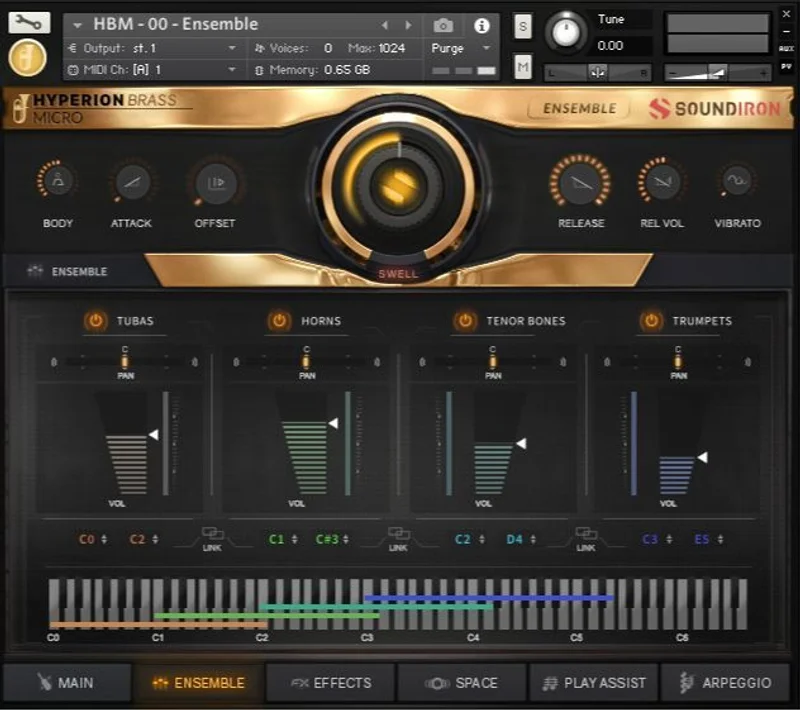
Hyperion Brass Micro is Soundiron's entry-level chamber brass library, built for the free Kontakt Player (version 6.2.2 or newer). It covers section ensembles of 6 trumpets, 4 tenor trombones, 4 French horns and 3 tubas, plus a combo ensemble preset.
The developer lists 2,963 samples, 1.1 GB installed (1.8 GB as WAV), recorded at 24-bit, 48 kHz stereo and stored in lossless NCW format. That's small by orchestral library standards, and it's the point.
It's a Powered-By-Kontakt Player Edition. You don't need the full paid Kontakt. It also works with the Kontakt Libraries browser, Native Access, Komplete Kontrol, S-Series keyboards and NKS.
The release is aimed at what the developer calls "instant gratification." Load it, play it, hear brass. That's the pitch.
Is This a Source-Based Review?
Yes. This review is based on the product page, the developer's published feature list and general knowledge of how Kontakt brass libraries behave.
No hands-on session is claimed here. Anything the material doesn't let us verify is marked as unverified.
Numbers quoted below are the developer's figures, labelled that way. CPU and RAM behaviour in real projects is one thing we can't confirm from the documentation, so we flag it instead of guessing.
Who Should Be Looking at This?
The producer who needs brass hits, swells and pads under a song and doesn't want to spend a weekend learning a keyswitch map.
The student who just downloaded the free Kontakt Player and wants something that sounds like a real section for the price of a lunch.
The working composer who needs fast sketches that survive a client demo. Micro is built for getting ideas out quickly, and the documented feature set backs that up.
Here's who it isn't for: the person delivering a fully exposed brass feature in a film cue. That job needs solo instruments and real legato.
What Hyperion Brass Micro Actually Does
The core idea is simple. You get four Master section presets and a combo ensemble preset, each with a trimmed set of fundamental articulations.
Each preset has real-time performance options, keyswitch and mapping options, and performance tools. You blend between sustains, shorts and tempo-based expressions without rebuilding anything.
The developer's phrase is "content symmetry." In practice that means every section is laid out the same way. Learn the trumpets and you've learned the horns. That's good design for beginners and we like it.
Easy-Lead: The Feature That Defines This Library
Easy-Lead is the headline. Play a quick note and you get a tight staccato. Hold the key and it becomes a long, dynamic sustain.
No keyswitching. No articulation juggling mid-take.
This is the part we'd try first, because it removes the single biggest friction point in brass sampling. Keyboard players who can't think in keyswitches will get a convincing line out of one patch.
Where Easy-Lead Probably Struggles
Any note-length-triggered system has a decision boundary. Notes that sit near the threshold can land on the wrong articulation. That's a general trait of this approach, not something the developer documents as a flaw.
Expect to edit a few notes by hand in dense passages. That's an inference from how these systems work, not a tested result.
The Sound: Forward, Robust and Chamber-Sized
The developer describes a "forward and robust" sound with a strong tone and wide dynamic range. The brass was recorded up close in Studio A at Fantasy Studios in Berkeley, CA.
Close miking is a trade. You get presence and punch. You lose some natural room bloom, which is why the library leans so heavily on its built-in spatialization.
A close-miked 6-trumpet section will cut through a pop mix far more easily than a distant, hall-heavy recording. That's a real advantage for songwriters and producers.
The developer says the samples were hand-edited and balanced, aiming for a "balance between polished refinement and natural humanism." We read that as clean and even, with some of the rough edges smoothed off. That's great for speed. It can make a section feel a touch too tidy.
The Articulation List
The documented articulations are modest but sensible.
- Sustains with real-time control over vibrato and dynamic transitions
- Simulated legato (not true sampled legato)
- Staccato and staccatissimo with multiple dynamics and 4x round-robin
- Triple tongue for fast repeated notes
- Dynamic expressions including crescendos, decrescendos and swells
The expressions are the sleeper feature. They come in a range of lengths, timings and dynamics, with time-stretching, tempo-syncing and automatic release.
That means a swell lands on the beat without you drawing in automation. For arrangers sketching hits and builds, that's a real time-saver.
The Legato Caveat
Simulated legato isn't sampled legato. The developer is clear that true legato lives in Hyperion Brass Elements, the bigger sibling.
Simulated legato smooths the join between notes. It won't capture the actual slur between pitches that a real player produces. For ensemble pads and chords this barely matters. For exposed melodic lines it matters a lot.
Spatialization, Rooms and Positioning
This is where Micro punches above its size. The developer lists free soundstage positioning for each section within dozens of custom rooms, halls, chambers and FX environments.
Because the source recordings are close and fairly dry, the built-in space is doing real work. You can place the trumpets forward and push the tubas back without reaching for an external reverb.
That's useful if you're short on CPU or you want a self-contained patch.
We'd still send the library through a bus reverb for glue in a full mix. That's standard practice and doesn't mean the internal tools are weak.
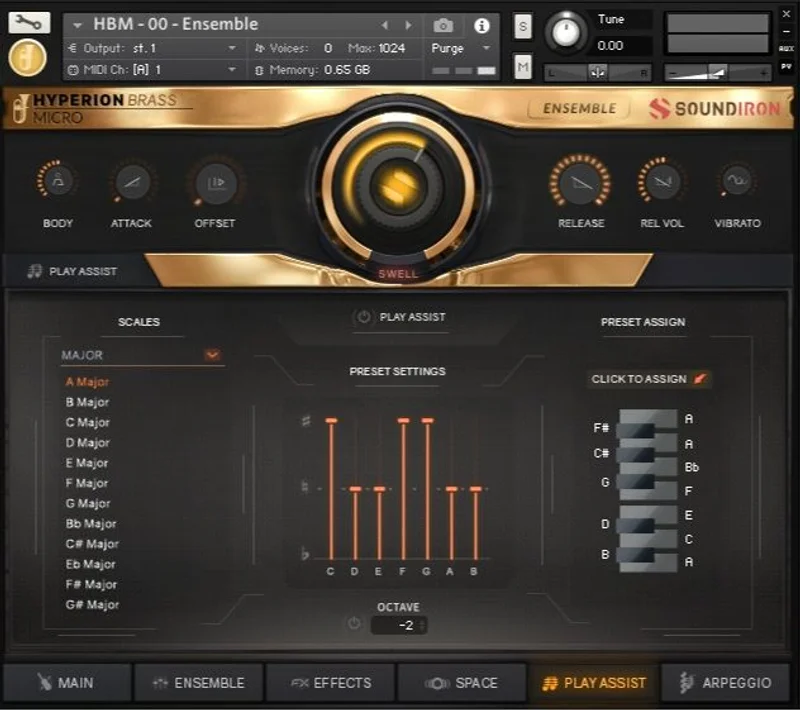
Play Assist and Arpeggio Systems
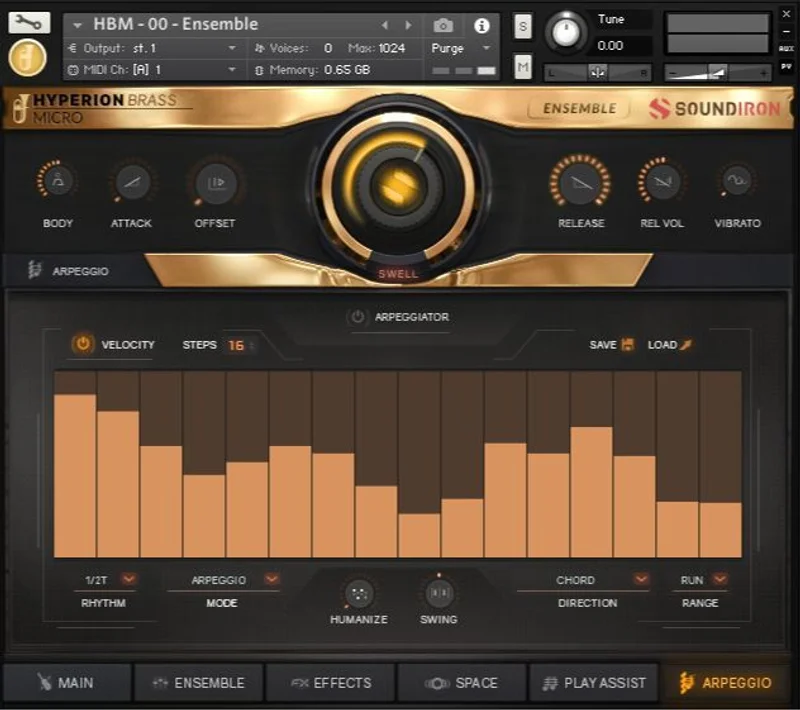
The developer lists Adaptive Play Assist and Arpeggio systems for "instant inspiration."
These are idea generators. Hold a chord, let the engine build a rhythmic figure, then pick what works.
Some producers will love this. Others will leave it off and never think of it again. We'd treat it as a sketching aid, not a finished-part machine.
Interface and Workflow
The developer describes the interface as flexible and intuitive, with pro features, deep customizability and a simple workflow.
The modular layout is the reason a beginner can get going quickly. Core controls sit up front. Deeper options sit behind them.
The balance matters. A beginner library that buries everything is useless to professionals. One that exposes everything overwhelms beginners. Soundiron's stated goal is to serve both.
Whether the execution fully delivers on that is something only hands-on use can confirm. The documented layout suggests it's a serious attempt.
Quickstart: Getting Brass Playing in Minutes
- Install the free Kontakt Player (6.2.2 or newer) through Native Access.
- Add Hyperion Brass Micro to your Libraries rack.
- Load the combo ensemble preset first for a quick overview of the sound.
- Turn on Easy-Lead and play short, then held notes.
- Open the positioning controls and pick a room that suits your genre.
- Switch to a single section (say, horns) and compare.
That workflow follows the documented design. Expect the first useful sound inside five minutes.
Specs and Requirements
| Spec | Detail |
|---|---|
| Developer | Soundiron |
| Price | $49 |
| Plugin Format | Kontakt Player (VST / AU / AAX host) |
| OS Support | Windows 7 or higher, macOS 10.12 or higher |
| Activation | Native Access / Kontakt Libraries browser |
| CPU Usage | Light to medium (not independently verified) |
| Trial Available | N/A (none mentioned in the material reviewed) |
| Version Reviewed | N/A (documentation-based review) |
| Samples | 2,963 |
| Install Size | 1.1 GB (1.8 GB WAV) |
| Format | 24-bit, 48 kHz stereo, lossless NCW |
| Min. Hardware | Dual-core CPU, 3+ GB RAM, SATA or SSD drive recommended |
The hardware requirement is gentle. A dual-core CPU and 3 GB of RAM won't scare anyone with a laptop from the last decade.
Where Hyperion Brass Micro Wins
It wins on speed. Easy-Lead removes keyswitch hunting, and the expressions land on the beat.
It wins on footprint. At 1.1 GB installed, it loads quickly and won't eat your drive.
It wins on the upgrade path. The developer says your full purchase amount can be applied toward Hyperion Brass Elements. That makes Micro a low-risk way to try the Hyperion sound.
And it wins on accessibility. It runs on the free Kontakt Player, so there's no extra purchase to get started.
Where It Falls Short
Legato is the big one. Simulated legato won't fool anyone on an exposed solo line.
The library is section-only. There are no documented solo instruments, which limits you in intimate arrangements and chamber writing.
The sound is clean and polished by design. Some producers will want more grit and bite in the attack. Whether Micro offers it depends on controls we can't test from here.
We also can't verify real-world CPU and RAM behaviour. The developer's hardware minimums are modest, but heavy sessions with multiple instances haven't been measured in the material reviewed.
What We Can't Verify Yet
Independent benchmarks for CPU load and RAM usage don't appear in the source material. Neither do side-by-side comparisons with competing entry-level brass libraries.
We also can't confirm how often Easy-Lead mis-triggers in fast passages. Treat those as open questions.
How Hyperion Brass Micro Compares
It isn't the only entry-level brass option for Kontakt Player. Libraries like Spitfire Audio's LABS Brass, Native Instruments' Session Horns series, and Output's Analog Brass & Winds each take a different approach.
Session Horns leans toward pop and funk with a tighter, more stylistic character. LABS offers free, character-driven brass. Micro sits closer to a general-purpose orchestral chamber sound.
The difference in scope is plain. Micro aims at sections and fast workflow, not specialist styles or solo detail.
For a closer look at Soundiron's other work, see our Hyperion Brass Elements review, which covers the upgrade path and the true legato Micro lacks.
If you're new to the format, our Kontakt instruments guide for beginners explains the Player, libraries and Native Access.
Pricing and Value
At $49, the value case is straightforward. You get a polished chamber brass library, a distinctive playability feature and a credited upgrade path.
The credited upgrade matters. If you outgrow Micro, you're not throwing money away.
The limit is scope. If you already own a deep brass library, Micro adds less. If you own nothing, it's a sensible starting point.
Who Should Buy This
- ✅ Buy if you're a beginner using the free Kontakt Player and want a real brass section fast.
- ✅ Buy if you sketch arrangements and value speed over solo-level detail.
- ✅ Buy if you might upgrade to Hyperion Brass Elements later and want the credit.
- ✅ Buy if you want a self-contained patch with built-in rooms and positioning.
- ❌ Skip if you need true sampled legato for exposed melodic lines.
- ❌ Skip if you need solo trumpet, trombone or horn.
- ❌ Skip if you want a gritty, raw-edged brass character out of the box.
Score Breakdown
These scores rest on the documented feature set and the developer's published figures, and we'll revisit them after longer use.
| Category | Score | Notes |
|---|---|---|
| Sound Quality | 4.3/5 | Close-miked Studio A recording, clean and forward by the developer's description |
| Value for Money | 4.5/5 | Credited upgrade path and free-Player compatibility |
| Ease of Use | 4.5/5 | Easy-Lead and symmetrical section layout |
| Features | 4.0/5 | Strong expressions and spatial tools, but simulated legato only |
| CPU Efficiency | 4.0/5 | Modest published requirements, not independently benchmarked |
| Overall | 4.2/5 | A fast, accessible chamber brass library that stops short of solo and true legato work |
Alternatives to Consider
Hyperion Brass Elements. The upgrade. It adds true legato and a larger articulation palette. Read our Hyperion Brass Elements review if you already know Micro won't be enough.
Native Instruments Session Horns. Better for pop, funk and R&B horn lines with a tighter stylistic focus. Weaker as a general orchestral brass section.
Spitfire Audio LABS Brass. A free, characterful option worth trying before you spend anything. It's more limited in depth and control than a dedicated library.
For another example of how Soundiron approaches a focused library, see our Soundiron Angklung review.
The Verdict on Hyperion Brass Micro
Buy it if you want a fast, polished chamber brass section inside the free Kontakt Player. Easy-Lead alone justifies the cost for keyboard players who hate keyswitching.
Skip it if you need exposed solo lines or true legato. That's what Hyperion Brass Elements is for, and Soundiron's credited upgrade makes starting with Micro a safe bet at $49.
What we still want confirmed: real-world CPU and RAM numbers, and how reliably Easy-Lead handles fast, borderline-length notes.
Micro gets you a brass section quickly. Elements gets you a brass performance. Know which one you're after.
Frequently Asked Questions
Is Hyperion Brass Micro worth it?
Yes, for beginners, songwriters and composers who need a fast, convincing brass section. It's a poor fit if you need solo instruments or true legato. The credited upgrade path to Hyperion Brass Elements lowers the risk.
Do I need the full version of Kontakt to run Hyperion Brass Micro?
No. It's a Powered-By-Kontakt Player Edition, built for the free Kontakt Player version 6.2.2 or newer. It also works with Native Access, the Libraries browser, Komplete Kontrol and NKS hardware and software.
What is Easy-Lead in Hyperion Brass Micro?
Easy-Lead is a performance feature that switches articulation based on how long you hold a note. Quick notes trigger tight staccatos, while held notes become dynamic sustains. It removes the need for keyswitching during playing.
Does Hyperion Brass Micro include true legato?
No. It includes simulated legato, not sampled legato. The developer positions true legato as part of Hyperion Brass Elements, the larger library you can upgrade to.
How big is Hyperion Brass Micro?
The developer lists 1.1 GB installed (1.8 GB as WAV) with 2,963 samples. They're 24-bit, 48 kHz stereo files in lossless NCW format, so the library loads quickly on modest hardware.
What are the system requirements for Hyperion Brass Micro?
The developer lists Windows 7 or higher, or macOS 10.12 or higher. A dual-core CPU, 3+ GB of RAM and a SATA or SSD drive are recommended. The free Kontakt Player (VST, AU, AAX) is required.