The honest worry about Hyperion Brass Elements is that $99 brass libraries always sound like $99 brass libraries. This one mostly doesn’t.
We spent three weeks running Soundiron’s Hyperion Brass Elements through actual cues: trailer stabs, underscore swells, a marching band mockup, and a jazz-adjacent combo piece that had no business working. The short version: it earns its price. The long version is below.
Hyperion Brass Elements is a Kontakt instrument built for composers who need a broad, usable brass palette without paying a premium price. It covers six trumpets, four tenor trombones, four French horns, three euphoniums, three bass trombones, and three tubas. That’s a full ensemble stack, and it plays like one.
It’s not right for everyone. If you need a solo trumpet front and center in a mix, stop reading here.
Does It Actually Deliver on the Budget-Brass Promise?
Soundiron recorded Hyperion Brass Elements at Studio A, Fantasy Studios in Berkeley, California. That room has a reputation. You can hear it in the natural decay on sustained notes: not hyped, not dead, just an honest mid-size studio with decent low-mid body.
The library ships with 12,000+ samples across 10.2GB of 24-bit/48kHz WAV files. After installation, that compresses to 4.71GB on disk. Manageable.
What Soundiron actually built here is a system. The True-Legato engine isn’t just velocity-switched sustains with a crossfade. It captures real interval transitions, and the speed control lets you adjust how quickly the legato phrase responds. Set it slow for expressive swells. Set it tight for faster melodic lines. We’d call this clever, because it is.
The 16 presets (10 combo ensembles plus 6 master/True-Legato section presets) give you a real starting point. You won’t be building from scratch on a deadline.
Where Hyperion Brass Elements Shines
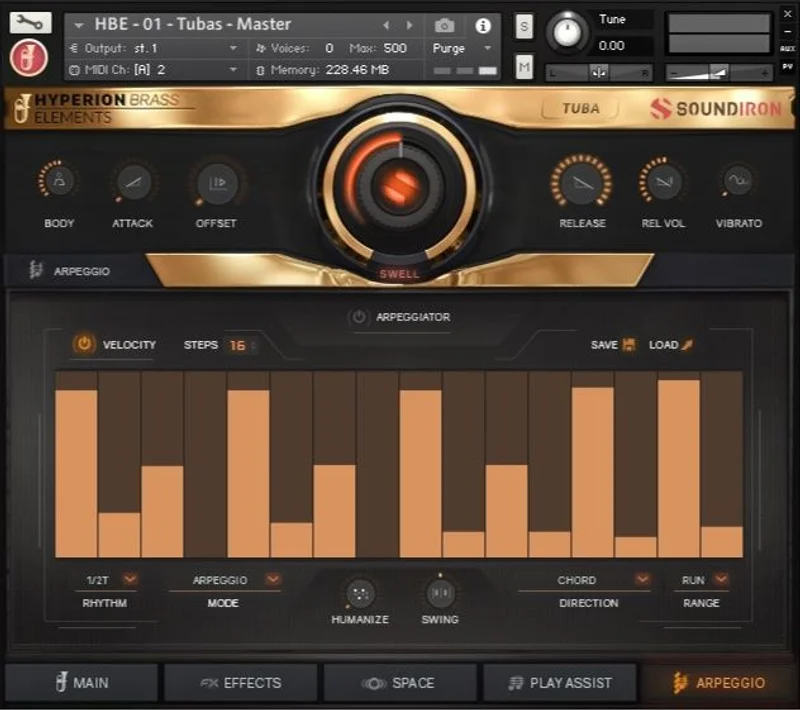
The Easy-Lead feature is the one we kept coming back to. It handles transitions between staccatos and sustains automatically based on note length. Short notes trigger the staccato samples. Hold longer, it shifts to sustain. No keyswitch hunting mid-performance.
We tested this on a fast horn figure at 140 BPM. Eighth notes came back as tight staccatos. Quarter notes bloomed into full sustains. One pass. No edits. Annoying that more libraries don’t do this.
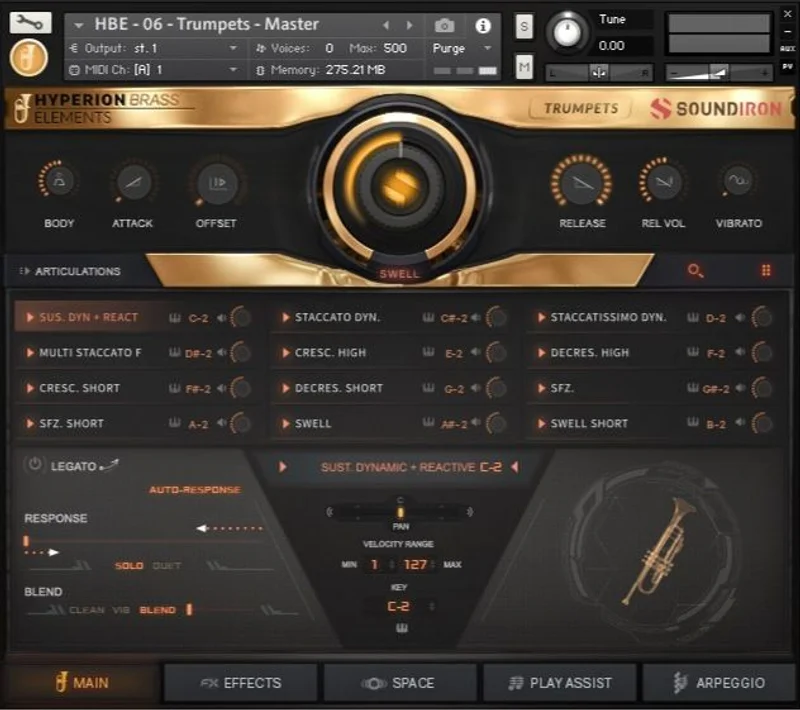
The articulation set is wider than the price suggests: sustains, True Legato, flutter tongue, standard staccatos, double tongue, and triple tongue. The flutter tongue alone is worth something for trailer work. We dropped it on a low brass hit under a picture cut and it sat right without needing to bury it in reverb first.
At the street price we have seen, you are getting an ensemble with a legitimate legato engine, a smart auto-articulation system, and a professional recording environment. That’s a hard combination to beat at this tier.
Where It Falls Short
No solo instruments. Full stop. If your cue calls for a solo trumpet playing a melody over the ensemble, Hyperion Brass Elements leaves you stranded. You’ll need a second library. That’s a real cost and a real workflow interruption.
The customization depth is genuinely frustrating for beginners. We love that the engine is flexible. But Soundiron’s documentation assumes you already know what you’re doing with Kontakt’s interface. We spent 25 minutes figuring out how to properly layer two presets and control their velocity curves independently. A short onboarding guide would fix this. There isn’t one.
Realism has a ceiling. At full orchestral dynamics, particularly on aggressive fortissimo trumpet passages, the ensemble starts to sound slightly homogenous. The samples are clean, but there’s a compression to the top end that reminds you this isn’t Berlin Brass. It’s not a dealbreaker. It’s just honest.
How It Stacks Up Against the Competition
Cinebrass Core is the closest premium comparison. It offers solo instruments, a deeper round-robin system, and more convincing fff dynamics. It also costs two to three times as much. For mockup work and media scoring, Hyperion closes that gap faster than you’d expect. For orchestral realism at full dynamic range, Cinebrass Core pulls ahead.
Spitfire Symphonic Brass is not a fair financial comparison, but it is the ceiling worth knowing about. Spitfire’s mic positioning options and ensemble size are in a different league. If you’re delivering to picture at a professional level and budget is no object, that’s your target.
Cinebrass Core review
Hyperion wins on accessibility and workflow speed. Spitfire and Cinebrass win on raw realism. Pick based on your budget and what the cue actually needs.
best bras s Kontakt libraries
Is the Price Fair?
At $99 MSRP, yes. At the street price, it is borderline ridiculous value.
You’re getting 12,000+ samples, a True-Legato engine with speed control, six ensemble sections, and a room that sounds like it cost money to book. The Micro version is available if you want to test the waters. That’s a reasonable trial run before committing to the full library.
The price is fair. The only caveat: if you need solos, add a meaningful amount to your real budget. The ensemble sounds great. It just can’t do everything alone.
Score Breakdown
| Category | Score | Notes |
|---|---|---|
| Sound Quality | 3.8/5 | Fantasy Studios room sounds real; fff dynamics show the budget ceiling |
| Value for Money | 4.8/5 | Legato engine plus 12,000 samples at this price point is hard to argue with |
| Ease of Use | 3.5/5 | Easy-Lead is brilliant; deep customization has no onboarding support |
| Features | 4.0/5 | Six articulations including flutter and double/triple tongue; no solos is the gap |
| CPU Efficiency | 4.0/5 | 4.71GB installed footprint; light on CPU in single-preset use |
| Overall | 4.1/5 | Overachieves at its price; has specific gaps that matter only in specific contexts |
Alternatives to Consider
Cinebrass Core is the step-up option if you need more realistic dynamics and solo instruments. It runs at a higher price and has a deeper round-robin system. Worth it if you’re delivering broadcast or film.
Cinebrass Core review
Spitfire LABS Brass is free and serves as a useful sanity check before you spend anything. It’s thin and single-mic, but it helps you figure out what articulations you actually use before committing to a bigger purchase.
Spitfire LABS review
8Dio New Century Brass sits at a mid-tier price point and offers a more cinematic, processed tone. Works best for producers who want ready-to-go trailer sounds with less natural room character.
8Dio brass library comparison
Our Verdict
Three weeks in, Hyperion Brass Elements is still on our template session. That says something.
It’s not flawless. The solo instrument gap is real. The documentation for deep customization is thin. And if you’re scoring for a major film at full dynamics, you’ll hit the ceiling and know it.
But for media scoring, trailer mockups, game audio, and any situation where a convincing ensemble matters more than a featured solo voice, this library earns its keep. At the street price and with a Micro version for the cautious, the risk is almost zero.
Buy it if you need ensemble brass that works fast. Skip it if a solo horn line is anywhere in your near future.
The brass section that doesn’t embarrass itself at $99 is rarer than it should be. This one doesn’t.
Frequently Asked Questions
Does Hyperion Brass Elements require the full version of Kontakt?
Yes. It runs in Kontakt Player but requires the full licensed version of Kontakt for all features to function correctly. The free Kontakt Player will not provide full access after the 15-minute demo timeout. Check NI's current compatibility list for supported versions before purchasing.
Is there a solo instrument option in Hyperion Brass Elements?
No. The library is ensemble-only, covering six trumpets, four tenor trombones, four French horns, three euphoniums, three bass trombones, and three tubas as section instruments. If you need a solo trumpet or trombone, you'll need a separate library. Cinebrass Core is worth looking at for that use case.
What's the difference between Hyperion Brass Elements and the Micro version?
The Micro version gives you a reduced articulation set and fewer ensemble presets. It's a legitimate entry point if you want to test Soundiron's approach to brass before committing to the full library. The full version at $99 MSRP adds True Legato, flutter tongue, double and triple tongue articulations, and the complete preset set.
How does the Easy-Lead feature actually work in practice?
Easy-Lead monitors note duration in real time and automatically switches between staccato and sustain samples based on how long you hold each note. Short notes trigger staccatos. Longer notes shift to sustains. You don't need to set up keyswitches manually for basic melodic work. It's not perfect on extreme tempo edges, but for most writing scenarios it removes a genuine workflow bottleneck.