
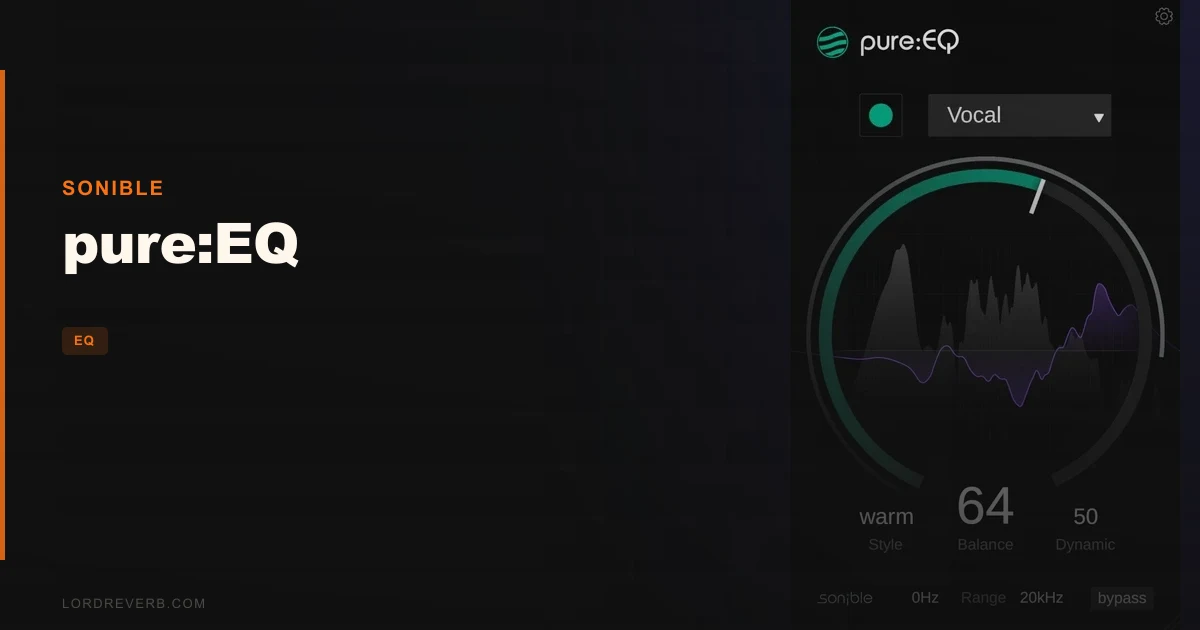
You’re 40 tracks deep into a session, it’s 1 a.m., and the rough mix sounds like someone stuffed a duvet into a PA system. You know EQ will fix it. You just don’t want to spend the next two hours doing it. That’s the exact frustration sonible’s pure:EQ was built around. It’s an AI-assisted EQ plugin that analyzes your signal and applies tonal corrections automatically, with just a few controls standing between you and a cleaner mix. It launched below its regular price and sits in the budget tier. This pure:EQ review will tell you whether it actually delivers on that promise, or whether you’re paying for the idea of speed rather than the reality of it.
The Specific Problem It's Built to Solve
EQ is the most time-consuming part of a mix for a reason. Every source has its own problem frequencies. A vocal recorded in a bedroom has room modes piling up below 200 Hz. An acoustic guitar tracked too close to the body gets boomy around 120 Hz. You can hear the issue. Finding it takes time. Fixing it takes more.
Pure:EQ compresses that workflow. Load it on a track, hit the learn function, let it listen for a few seconds, and it suggests a correction curve. You pick a style. You’re done.
For producers running full-time sessions where EQ is a means to an end, not a craft in itself, that’s genuinely useful. It’s also built to sit in the broader EQ plugin ecosystem without demanding you rethink your whole signal chain.
How It Performs in a Real Session
We ran pure:EQ across a six-track drum bus, a lead vocal, and a DI’d bass guitar. Here’s what actually happened.
On the drum bus, we hit Learn, let it run for about eight seconds, then selected the Neutral style. The plugin pulled about 1.5 dB from a honky 400 Hz buildup that had been making the overheads sound boxy, and lifted a gentle shelf above 8 kHz. Satisfying. The bus breathed a little better without us touching a single band.
On the lead vocal, we tried the Warm style. It softened the presence peak around 3.5 kHz and added a slight low-end body below 200 Hz. It sounded right for a lo-fi RnB context. Slightly wrong for a pop record that needed the vocal to cut. That’s the catch: the AI doesn’t know your genre unless you tell it through the style selection, and three style options is a narrow vocabulary.
The bass guitar was where things got annoying. The AI correction boosted a mid-range presence band that fought the kick. We couldn’t notch it out manually because pure:EQ doesn’t give you individual band access. We ended up stacking it with a traditional EQ after, which partly defeats the point.
For comparison: FabFilter Pro-Q 4 reviewed here gives you full surgical control with dynamic bands. Pure:EQ gives you speed. Those are different tools. Don’t confuse them.
The latency is real. We clocked a monitoring delay we’d describe as modest but noticeable when tracking live through it. This is introduced by the signal analysis engine. Pure:EQ is not your monitoring chain plugin. It belongs on recorded material at mixdown only.
Sample rate support runs from 44.1 kHz up to 192 kHz. Formats covered are VST, VST3, AU, and AAX. Mac and Windows both supported. The plugin is inspired by sonible’s smart:EQ 3, which is the smarter, more complex sibling in their lineup.
Strengths and Weaknesses
The strengths are real. The speed of the workflow is not marketing fiction. We genuinely cut EQ time on a busy mix session by roughly half when using pure:EQ as a first pass on multiple tracks before going in for detail work on the important ones.
The three style options (Warm, Neutral, Bright) work as broad creative directions. Warm rolls off top-end air above 10 kHz and adds subtle low-mid weight. Bright does the inverse. Neutral corrects without obvious character. None of them are ugly choices.
CPU usage is light. We ran 12 instances on a mid-spec session without a hiccup.
The weaknesses are also real. The lack of individual band control is a love-it-or-hate-it design decision. We land closer to hate it, because when the AI gets something wrong, you can’t fix it within the plugin. You either accept it or remove it.
The one-knob philosophy is also a skills trap for beginners. If you’re learning to mix and you rely on pure:EQ, you’re not learning why it made those decisions. That gap will cost you later. This isn’t the plugin that teaches you EQ. It’s the plugin that skips it.
Value for the Price
At $39 standalone, pure:EQ is fair. Not brilliant. Fair.
The better value play is the pure:Bundle. You get pure:EQ, pure:comp, pure:limit, and pure:verb. Four AI-assisted dynamics and processing tools that cover compression, limiting, and reverb alongside EQ. If you’re building a beginner plugin toolkit, that bundle is a clever place to start.
Standalone, you’re paying specifically for AI speed. If that matters to you, it’s justified. If you already own a capable EQ and just need to learn to use it faster, skip it.
Who Should (and Shouldn't) Buy This
✅ Buy if you run high-volume sessions where mix speed matters more than surgical precision.
✅ Buy if you want a fast first-pass EQ on tracked material before detailed work begins on key elements.
✅ Buy if you’re picking up the pure:Bundle and want a full lightweight processing chain.
❌ Skip if you’re learning to mix and want to build real EQ skills. This skips the lesson.
❌ Skip if you mix dense, genre-specific material (metal, jazz, orchestral) where AI broad-strokes often miss.
❌ Skip if you need zero-latency monitoring through your EQ at tracking time.
Score Breakdown
| Category | Score | Notes |
|---|---|---|
| Sound Quality | 4.0/5 | Clean corrections on most material; stumbles on complex or genre-specific sources |
| Value for Money | 3.5/5 | Fair standalone; excellent inside the pure:Bundle |
| Ease of Use | 4.5/5 | As simple as EQ gets; learn, pick a style, done |
| Features | 3.0/5 | Three styles and AI learn are all you get; no manual band access |
| CPU Efficiency | 4.5/5 | Ran 12 instances without issue; analysis engine is well-optimised |
| Overall | 3.8/5 | A clever speed tool that earns its place in the right workflow |
Alternatives to Consider
sonible smart:EQ 4 is the obvious step up. It adds per-band control, cross-track learning, and a more sophisticated AI engine. It costs more, and it’s worth it if you want the intelligence of pure:EQ with the precision of a traditional EQ on top. See our smart:EQ coverage
Auburn Sounds LENS sits in a similar AI-EQ space at a lower price point. It takes a different approach, using spectral matching and dynamic correction rather than preset styles. It’s better for referencing and matching tracks. Harder to use. More powerful.
FabFilter Pro-Q 4 is not really a competitor because it’s in a different category entirely. But if you find yourself wishing pure:EQ gave you more manual control, Pro-Q 4 is where you should be looking. It has dynamic EQ bands, spectral display, and mid/side processing. Read our VEQ-HLF review for a traditional filter approach
If you’re building out a full creative toolkit beyond just EQ, our SEQUND Lite review is worth a read alongside this.
Pure:EQ is a clever plugin that knows exactly what it is. The problem is that “what it is” has limits. At $39 it makes sense as a time-saving tool on a professional’s already-loaded plugin shelf. As a standalone EQ education or as a primary corrective tool on complex material, it’ll let you down. Buy the bundle if you’re buying this. Don’t buy this thinking it replaces learning how to EQ.
Frequently Asked Questions
Is pure:EQ good for beginners?
It's good for beginners who want quick results. It's not good for beginners who want to understand EQ. The plugin makes decisions for you rather than showing you why those decisions are correct. If you're learning to mix, you'll get better results long-term from a traditional EQ where you can see and hear what each band is doing.
Can you use pure:EQ for live monitoring while tracking?
We wouldn't. The AI analysis engine introduces latency that's noticeable in a live monitoring context. Pure:EQ belongs on recorded material at mixdown, not in your tracking chain. If you need a transparent EQ for monitoring, look for a linear-phase or zero-latency option instead.
How does pure:EQ compare to sonible's smart:EQ 4?
Pure:EQ is the simplified, budget-tier version. Smart:EQ 4 adds per-band manual control, cross-track learning (where it can EQ one track relative to another), and a more sophisticated AI model. If budget isn't a constraint, smart:EQ 4 is the better plugin. Pure:EQ wins on speed of setup and low price.
Is the pure:Bundle worth it over buying pure:EQ standalone?
Yes, if you need compression, limiting, and reverb as well. The pure:Bundle gives you four AI-assisted plugins: pure:EQ, pure:comp, pure:limit, and pure:verb. Buying them individually would cost significantly more. If you're building a starter processing chain and like the sonible AI workflow, the bundle is the smarter buy.