It was a Tuesday night session, somewhere around bar 32 of a tech-house track, and we needed a bass that sat in the pocket without a fight. We loaded Monoment Bass, clicked the second preset in the Madison Mars folder, played a two-bar pattern, and had something we’d have spent an hour building from scratch in anything else. That’s the whole pitch. Monoment Bass is Softube’s sample-based bass plugin built for producers who want to skip synthesis class and get to the arrangement. It launched in June 2019, costs $99 (check Softube’s site for current pricing and frequent sales), and runs VST/AU/AAX on 64-bit Mac and Windows. If you need fast, professional bass sounds and you’re still early in your production journey, this is worth your time. If you’re a synthesis nerd, it’ll frustrate you inside of a week.
First Impressions: Suspiciously Fast
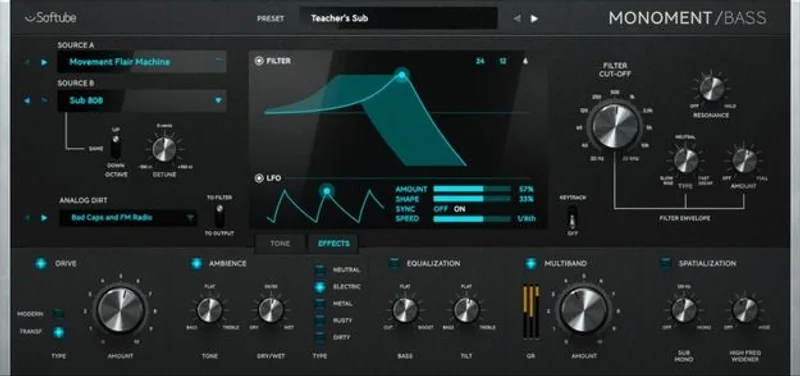
Monoment Bass opens clean. The interface is compact, readable, and unintimidating. Two source layers sit at the top, each loaded with sampled bass content. The Analog Dirt layer sits below that. A low-pass filter with switchable 6, 12, and 24dB slopes takes up the middle third. There’s a basic effects chain at the bottom.
We had sound in roughly 90 seconds from download. No tutorial needed. The preset browser loads fast, previews behave, and the categories are named like a producer named them, not like a developer named them. That’s a small thing. It matters.
The interface doesn’t feel like a deep synth. It feels like a well-organized sample player. Because that’s what it is.
Getting It Into a Real Workflow
Drop Monoment into a bass channel, open the preset browser, and you’ll find content from Madison Mars, Vandalism, Sample Tools by Cr2, WA Production, Black Octopus, and Function Loops. This is the real product. The engine is the delivery mechanism. The presets are the reason people buy this.
We ran it on a 140 BPM techno session with 28 other tracks active. CPU climbed higher than we’d expect from a sample-based instrument. Our monitoring system showed it pulling roughly double what a comparable SynthMaster One review patch would draw at idle. That’s annoying on a busy project.
The three-samples-per-key approach does its job. Velocity layers feel natural. The stereo width on the sources is wide by default, which sounds impressive on headphones and creates mono-compatibility problems in a real mix. You’ll want to check your mono bus before committing.
Gain staging is straightforward. Getting the low end to sit at the right level without the Dirt layer pushing things over is quick work. One knob isn’t labeled clearly enough for what it does, but you’ll work it out in two minutes.
What It's Genuinely Good At
The preset quality is the strongest thing Monoment Bass has going for it. We’re not talking about throwaway factory sounds. Madison Mars contributed patches that translate directly from plugin to finished record. We loaded a sub-bass preset, ran it through our chain at 128 BPM, and it sat in the mix with almost no EQ work. A gentle 2dB cut at 280Hz and it was done.
The Analog Dirt layer is clever. It’s not a full-spectrum saturation stage. It focuses on the attack transient, adding harmonic weight where a clean sample sometimes sounds thin. We pushed it to around 60% on a punchy house bass and the result was more “played” and less “placed.” Satisfying.
Three samples per key reduces the machine-gun effect that makes other bass synth plugins sound programmed. Fast sixteenth-note patterns hold up. The realism ceiling is higher than the price suggests.
The filter slopes are useful. The 24dB setting cuts hard and gives you that squelchy filter-sweep character for house and techno. The 6dB slope keeps the character of the sample while just shaping the top end. We used both.
The Rough Edges
Here’s the honest version. Monoment Bass is a well-made ROMpler. That’s not an insult. But it means the ceiling is fixed and you’ll hit it fast if you work beyond beginner level.
There are no real envelopes. No per-source filtering. No pitch modulation. You can’t build new sounds. You can only select, blend, and sculpt what’s already baked in. Experienced synthesis users will find this frustrating within a session or two.
The stereo source issue is a real problem for bass production specifically. Bass needs to be checked in mono. The sources are all-stereo out of the box, and taming that width requires routing work outside the plugin. It should be handled internally.
CPU draw is the other thing we keep coming back to. For what the engine is actually doing, the resource cost feels wrong. On an older system running macOS, we saw performance hiccups during bounce that we don’t see from other instrument plugins in this price range.
Who This Is Really For
- ✅ Buy if you're new to production and need bass sounds that work without a synthesis background.
- ✅ Buy if you produce house, techno, or EDM and want a reliable drag-and-drop bass toolkit with pro-tier preset content.
- ✅ Buy if you catch it on sale. At this price, this is hard to argue against for what you get.
- ❌ Skip if you want to build bass sounds from scratch. This isn't that plugin.
- ❌ Skip if your system is already CPU-stressed. The overhead isn't justified for a sample player.
- ❌ Skip if you need mono-compatible sources by default. You'll fight that battle every session.
Score Breakdown
| Category | Score | Notes |
|---|---|---|
| Sound Quality | 4.0/5 | Preset library from pro contributors is the real asset; three-samples-per-key realism holds up |
| Value for Money | 3.0/5 | At $99 it is tight; on sale it is a clear yes. |
| Ease of Use | 4.5/5 | Operational in 90 seconds; genuinely no manual required |
| Features | 2.5/5 | No real envelopes, no pitch modulation, no per-source filtering; shallow under the hood |
| CPU Efficiency | 2.0/5 | Disproportionately high draw for a ROMpler; causes problems on loaded sessions |
| Overall | 3.6/5 | Strong presets and instant usability, held back by shallow synthesis and poor CPU behaviour |
Alternatives to Consider
If the shallow synthesis ceiling bothers you, SynthMaster One gives you wavetable and sample-based bass design with far more modulation depth at a comparable price point. The workflow takes longer to learn, but you’re not hitting a ceiling in week two.
If you produce acid or aggressive electronic bass and want something with more character baked into the engine itself, the Audio Blast ABX3 Bundle covers that territory with a different approach to grit and movement.
For producers building more complete synthesis knowledge while staying in beginner-friendly territory, the BLEASS Analog FM Synth Bundle teaches you something while you work. Monoment doesn’t. That’s not always a bad thing, but it’s worth knowing before you buy.
Final Word
We’d tell a friend buying their first bass plugin: catch Monoment Bass on a Softube sale, load the Madison Mars presets, and stop overthinking it. At $99 regular price, the CPU problem and shallow feature set make it harder to recommend when alternatives offer more for the money.
The worst version of this plugin is when an intermediate producer buys it at full price, loves it for a month, and then hates it when they outgrow it six weeks later. That’s the honest risk.
Buy it on sale. Use it for what it is. Don’t expect it to grow with you.
Frequently Asked Questions
Is Monoment Bass good for beginners?
Yes. It's one of the most beginner-friendly bass plugins available. You can load a preset, play a pattern, and have something radio-ready in under two minutes. There's no synthesis knowledge required, and the preset library from contributors like Madison Mars and Black Octopus is strong enough that most beginners won't need to go further than what's included.
Does Monoment Bass work in mono?
It works, but the all-stereo source samples mean you'll need to check your mono bus carefully on every patch. The width can cause phase issues and low-end thinning when collapsed to mono, which is a real problem for bass in professional mixes. Sorting this requires external width reduction outside the plugin itself.
Why is Monoment Bass CPU usage so high?
Softube haven't published a technical explanation, but the three-samples-per-key playback engine plus the stereo streaming overhead likely drives the cost higher than a simpler single-sample-per-key ROMpler. On sessions with 30 or more tracks active, we noticed measurable performance impact. Freeze the track during arrangement if your CPU is already under pressure.
Is Monoment Bass worth buying at full price in 2026?
At $99 it is a harder sell than it was at its introductory price. The preset quality and ease of use are still strong, but competing tools have caught up in those areas and offer more synthesis depth for similar money. If you catch it on sale, it is worth it without much debate. At full price, we'd compare it against current alternatives before committing.