Your drums are lifeless. You’ve tried layer after layer of parallel compression. You’ve added transient designers, clippers, and three different saturators. The snare still sits in the mix like a wet towel on a radiator. Nothing’s sticking.
That’s the exact problem the Empirical Labs Professor Punch-Knuckles exists to solve. Built by Softube after two decades of collaboration with Dave Derr at Empirical Labs, it brings the harmonic character of two pieces of hardware that engineers have reached for since 1995: the Mike-E preamp and the Distressor compressor. No compression here, just saturation and character. At $129 regular and a lower introductory price, it’s pitched at producers who want punch without the patch bay.
What Problem This Actually Solves
Generic digital saturation plugins add harmonics. Most of them do it the same way: a soft-clip curve, some even-order content boosted around the 2nd and 3rd harmonic, maybe a drive knob. They make things warmer in a way that’s hard to argue with and equally hard to get excited about.
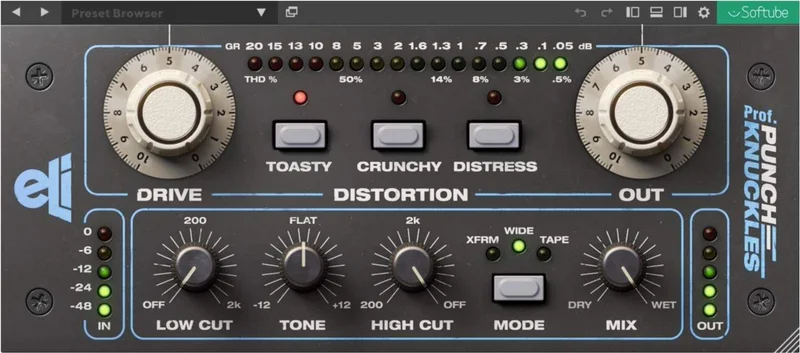
Professor Punch-Knuckles does something more specific. It targets the dynamic character of saturation: how distortion behaves differently at low signal levels versus high ones, the way transformer iron and tape oxide actually compress and saturate in ways that aren’t static. The three modes, Toasty, Crunchy, and Distress, aren’t just different drive amounts. They’re different transfer curves entirely.
That specificity is the point. If your problem is “I want more harmonic distortion,” you don’t need this. If your problem is “I want a drum bus that reacts the way a Distressor reacts,” that’s where this lives.
How It Performs in Practice
We ran a dry, programmed hip-hop drum bus through all three modes at matched output levels.
Toasty is the easy one. We pushed a snare bus through it with Drive around 9 o’clock and got exactly what you’d hope for: a gentle thickening in the 200-400Hz range, maybe 1-2dB of perceived loudness without actual level increase. It’s the mode you’d leave on vocals without worrying.
Crunchy is where it gets interesting. At 12 o’clock Drive on a drum room mic, the transients started to bend without breaking. The attack didn’t disappear but it softened in a way that glued the overhead and room blend. Think of it as what a fast Distressor attack time does to a snare, that slight rounding of the initial crack. This is the mode we kept coming back to.
Distress is the aggressor. At higher drive settings it clips hard and adds odd-order harmonics that push into rock and metal territory. We ran a bass DI through it in Distress mode with the Mode switch engaged and got a usable fuzz texture in under 30 seconds. That’s fast.
The Mode switch is worth separate attention. It applies a filtering profile modelled on transformer and tape-based systems: a presence dip around 3-5kHz and a subtle low-frequency shelf. On kicks and bass, it’s the difference between saturation that sounds bolted-on and saturation that sounds baked-in.
CPU draw sits at moderate. One instance on a mid-spec system (Apple M2 MacBook Pro, 64GB, Logic Pro) ran at roughly 0.8% CPU in our tests. Pile ten instances across a mix and you’re looking at 7-9% from this plugin alone. Not catastrophic. Worth tracking.
Strengths and Weaknesses
The strengths are real. Three modes that genuinely sound different from each other is rarer than it should be in this category. The Distress mode in particular has a character that reminded us of pushing a Distressor’s ratio to Nuke on program material. That’s a satisfying thing to achieve ITB without hardware.
Console 1 integration is a legitimate workflow win. If you’re already mixing on Softube’s platform, Punch-Knuckles slots into the channel strip where a drive stage belongs. That’s clever design, not marketing.
The weaknesses are also real. No compression is the obvious one. The name and the heritage both scream Distressor, and the lack of a compressor will frustrate anyone who buys this expecting that. Empirical Labs’ own Mike-E Comp Mike-E Comp review does the compression side. This is the saturation-only companion. Annoying that marketing doesn’t make this clearer.
The other weakness: the UI has no meters. No input level indicator, no harmonic content display, no output metering. You’re dialling by ear entirely, which is fine philosophically but frustrating practically when you’re trying to match levels between A/B tests.
Value for the Price
At the introductory price, we’d say yes. At $129 regular, it’s tighter.
Soundtoys Decapitator covers similar distortion territory with five modes, a parallel mix knob, and more transparent low-end handling on bass sources. Soundtoys Decapitator review It’s hard not to notice that.
Where Punch-Knuckles wins is specificity. If you want Distressor-character saturation, Decapitator doesn’t give you that. It gives you something different. So the question isn’t which plugin is better generically. The question is whether you specifically want what ELI hardware sounds like. If yes, $129 is defensible. If you’re not already in that wor ld, the regular price is a tough sell.
The Empirical Labs Complete Collection 2 bundle makes more sense if you want the full picture alongside LilFrEQ and Mike-E Comp, especially at a promotional discount off the regular price.
Who Should and Shouldn't Buy This
- ✅ Buy if you're mixing in the Softube Console 1 ecosystem and want a drive stage with real hardware DNA.
- ✅ Buy if you specifically love the Distressor's saturation character and want it across every channel without hardware.
- ✅ Buy if you catch it at the introductory price before November 5, 2025. At that price, the value argument works.
- ❌ Skip if you expect compression. There is none. Full stop.
- ❌ Skip if you already own Soundtoys Decapitator and are happy with it. The overlap is significant.
- ❌ Skip if you're outside the Empirical Labs or Softube world. The heritage framing won't mean much to you, and the price won't feel justified.
Score Breakdown
| Category | Score | Notes |
|---|---|---|
| Sound Quality | 4.3/5 | Crunchy and Distress modes genuinely deliver hardware character; Toasty is usable but less distinctive |
| Value for Money | 3.5/5 | Fair at the introductory price, harder to justify at $129 with Decapitator in the same market. |
| Ease of Use | 3.8/5 | Simple controls help, but no metering makes level-matching tedious |
| Features | 3.5/5 | Three modes and a Mode switch covers the core; the missing compressor is a real gap |
| CPU Efficiency | 3.5/5 | Manageable per instance, but stacks noticeably on dense sessions |
| Overall | 4.1/5 | Specific tool with genuine hardware character; worth it for the right buyer |
Alternatives Worth Considering
Soundtoys Decapitator is the most direct competitor. Five saturation modes, a parallel mix knob, and a kill switch for the low end that saves bass sources from muddiness. Soundtoys Decapitator review It doesn’t sound like a Distressor, but it’s arguably more versatile for general mix work.
Softube Tube-Tech Classics includes the CL 1B compressor and ME 1B EQ. Not a saturation tool directly, but if your goal is analogue colour from a trusted source at a similar price point, it’s worth comparing. Softube Tube-Tech Classics review
Slate Digital VCC takes a different approach: channel-strip-style harmonic colouration across a whole mix rather than per-channel drive. Slate Digital VCC review If you want a mix gluing result rather than individual saturation surgical work, VCC solves a different but adjacent problem.
Professor Punch-Knuckles is a single-purpose tool with a clear sonic identity and a price tag that requires you to care about that identity. If you love the Distressor and want its saturation character ITB, this is the fastest path there. If you’re not already in that camp, spend the $129 on Decapitator instead.
One more thing: don’t buy this expecting a compressor. It’s in the name, not the plugin.
Frequently Asked Questions
Does the Empirical Labs Professor Punch-Knuckles include compression?
No. Despite the Distressor heritage, Professor Punch-Knuckles is a saturation-only plugin. There are no attack, release, ratio, or threshold controls. If you want the compression side of the Distressor in software, Softube's Mike-E Comp is the companion plugin built for that job. These two are designed to work together, not as one combined tool.
What's the difference between the Toasty, Crunchy, and Distress modes?
Toasty produces light, even-order harmonic saturation with minimal transient impact: think tape warmth at conservative drive levels. Crunchy adds more odd-order content and starts to shape transient behaviour, similar to a Distressor with a fast attack. Distress is the aggressive mode, introducing hard clipping and significant harmonic distortion that works best on drums, bass, and sources that can carry the weight.
Is Professor Punch-Knuckles worth buying if you don't use Console 1?
Yes, but Console 1 users get more from it. The plugin runs as a standard VST, VST3, AU, or AAX in any DAW without requiring Softube's hardware. The Console 1 integration just means you can control it from the hardware surface and it slots into the gain stage position in the signal chain naturally. Without Console 1, it's still a capable saturation plugin, just with fewer workflow advantages over the competition.
How does Professor Punch-Knuckles compare to the actual hardware Distressor?
It captures the saturation and harmonic character of the Distressor's output stage, not its compression behaviour. The Distressor's famous 1:1 and Nuke compression modes aren't here. What you do get is the transformer and iron character that makes the hardware's saturation sound different from a standard soft-clipper. For engineers who've used a Distressor, the Distress mode will be immediately recognisable. For engineers who haven't, it still sounds good, just without the reference point.