
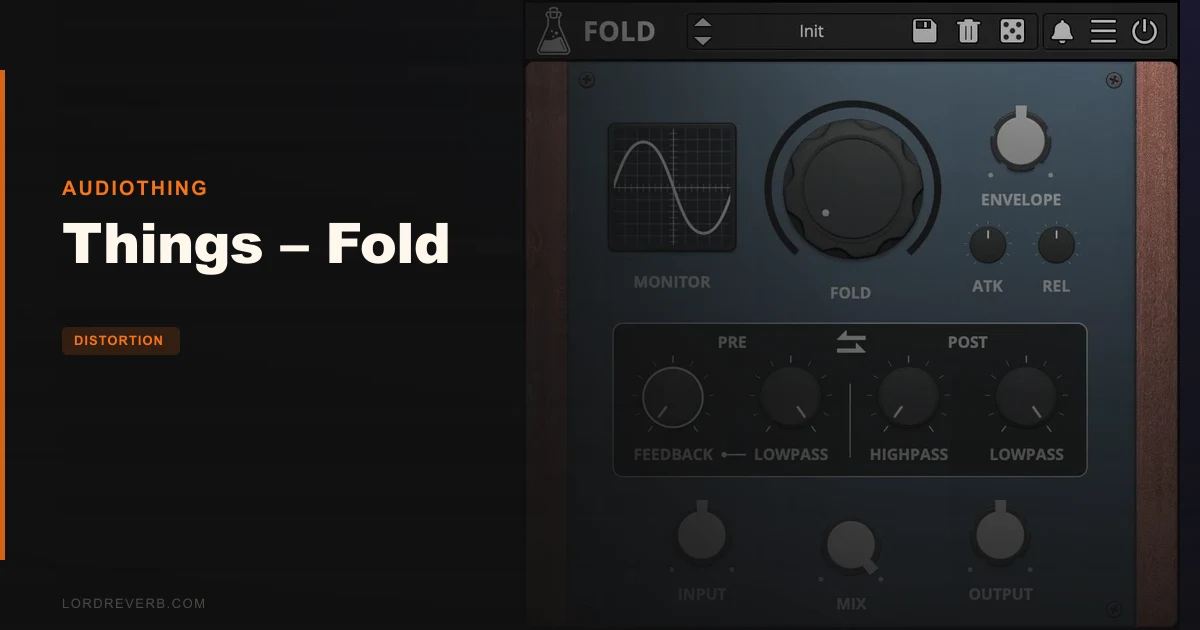
Things – Fold is worth owning if you want one wavefolder that does its job without a menu diving habit, and it earns that on the strength of its envelope follower alone.
That’s the short version. The longer one: this is a focused tool, and it knows it. You won’t get a multiband distortion suite or a modulation matrix here.
What you get is a dynamic wavefolder with filters, feedback and a clever way to make the folding follow your playing. For guitarists, synth people and anyone bored of plain clipping, that’s a good trade.
Not everyone needs it. Some people will call it redundant, and for them that’s fair. We’ll sort out which camp you’re in below.
What You're Actually Getting
AudioThing built this as a wavefolder inspired by the Serge Wave Multipliers, which are known for classic diode-based circuit design. Wavefolding inverts the waveform, creating peaks and valleys, and that turns simple shapes into complex harmonics.
The controls are lean. There’s the dynamic wavefolder itself, an envelope follower, high-pass and low-pass filters, adjustable feedback, and brightness and contrast controls.
A preset system with a randomizer sits on top, with 22 presets to start from. The window resizes, which is nice on a laptop screen.
Formats cover VST2, VST3, AU, AAX and CLAP in 64-bit, depending on your OS. Linux gets VST2, VST3 and CLAP.
The Good
The envelope follower is the reason to care. It modulates the folding based on input signal volume, so loud hits and quiet tails don’t get the same treatment.
Here’s a scene. You’ve got a plucked synth line, and the plain fold sounds flat because every note gets identical grit. Add a small envelope modulation and the harmonics shift with each note’s level. Owners describe this as organic, slightly changing wavefolding, and that’s the right word for it.
Push it and you can enhance transients or lean into the quieter parts, depending on which way you set it.
Moderate settings sound terrific, especially with modulation running. That’s a love-it detail. You don’t have to crank anything to get a result.
Then there’s pre/post mode switching, which owners say has a tremendous impact on tone. Filter before the fold and you shape what gets folded. Filter after and you tame what comes out. Same plugin, two personalities.
Stability matters too. No crashes or bugs reported.
The Not-So-Good
Simple is the selling point and the ceiling. Compared with some alternatives, Things – Fold has fewer features, and that limits advanced workflow options. If you want deep routing or layered modulation sources, you’ll hit the wall fast.
Some reviewers find it too basic or redundant next to other distortion tools. We get it. If your folder already holds a capable wave shaper, this might just be a second way to do the same job.
Documentation is another soft spot. The learning curve and advanced workflows aren’t covered in depth, so you’ll be learning by ear. Annoying if you like a manual. Fine if you like twisting knobs until it sounds good.
It’s also a wavefolder, not a general distortion box. Mild saturation is possible, but it’s not the tool you grab for tape warmth.
Compared to the Alternatives
ChowMultiTool is the obvious rival. It includes a wave shaper, and Things – Fold’s edge over it is the envelope follower, which gives you level-driven modulation in one plugin.
ChowDSP’s wavefolder plugin is another name that comes up for dynamic saturation and distortion. It lands in similar territory, so audition both if the folding sound is what you’re chasing.
Value-wise, the question is simple. If a free or cheaper tool already covers your folding needs, take that. Pay for Things – Fold when the envelope follower and the quick, hands-on layout are what you’ll actually use.
Who Should Buy This
✅ Buy if you want your wavefolding to react to playing dynamics through the envelope follower.
✅ Buy if you play guitar and want bright 90s fuzz tones. Owners report great results pairing it with an amp simulator.
✅ Buy if you prefer a small control set you can dial in fast over a deep feature list.
❌ Skip if you already own a wave shaper you like and rarely automate the folding.
❌ Skip if you want advanced modulation routing or a deep feature set.
❌ Skip if you need thorough documentation and tutorials to get going.
Specs & Technical Details
| Spec | Detail |
|---|---|
| Developer | AudioThing |
| Price | N/A |
| Plugin Format | VST2 / VST3 / AU (Mac) / AAX / CLAP, 64-bit |
| OS Support | Windows 7–11, macOS 10.13–14 (Universal 2 Binary), Ubuntu 20.04 LTS |
| Activation | N/A |
| CPU Usage | N/A (minimum 2GHz CPU, 4 GB RAM) |
| Trial Available | N/A |
| Version Reviewed | N/A |
Score Breakdown
| Category | Score | Notes |
|---|---|---|
| Sound Quality | 4.5/5 | Owners call moderate settings terrific, especially with modulation |
| Value for Money | 4.0/5 | Envelope follower justifies it, but cheaper folders exist |
| Ease of Use | 4.5/5 | Small control set, resizable window, 22 presets plus randomizer |
| Features | 3.5/5 | Focused by design, fewer options than some alternatives |
| CPU Efficiency | N/A | N/A |
| Overall | 4.2/5 | A focused wavefolder with one standout feature |
Alternatives to Consider
If the folding sound is the whole point, compare against ChowDSP’s wavefolder plugin first. See our best distortion plugins roundup for the wider field.
ChowMultiTool is the pick when you want a wave shaper inside a multi-tool package. We cover that kind of choice in ChowMultiTool review.
Still unsure whether wavefolding is what you need? Our saturation vs distortion guide sorts that out.
Final Word
Buy Things – Fold if the envelope follower sounds like the thing your folding has been missing. It’s the part that turns a static effect into one that breathes with your playing.
Skip it if you need deep modulation or already own a wave shaper you’re happy with. For you it’s a nice-to-have, not a need.
For guitarists chasing a bright fuzz and synth players who want folds that move, it’s a solid, no-nonsense pick. Check before you decide, and audition it against your current chain. See our guitar plugin picks for more.
Frequently Asked Questions
What formats does Things – Fold support?
It supports VST2, VST3, AU, AAX and CLAP in 64-bit. Windows gets VST2, VST3, AAX and CLAP. Mac adds AU. Linux supports VST2, VST3 and CLAP.
Does Things – Fold work on Mac, Windows and Linux?
Yes, all three. Windows needs 7–11, Mac needs macOS 10.13–14 (Universal 2 Binary), and Linux needs Ubuntu 20.04 LTS. Each wants a 2GHz CPU and 4 GB RAM.
What does the envelope follower do?
It modulates the wavefolding based on your input signal's volume. Owners say small amounts create organic, slightly changing folds, and it can bring out transients or quieter passages.