
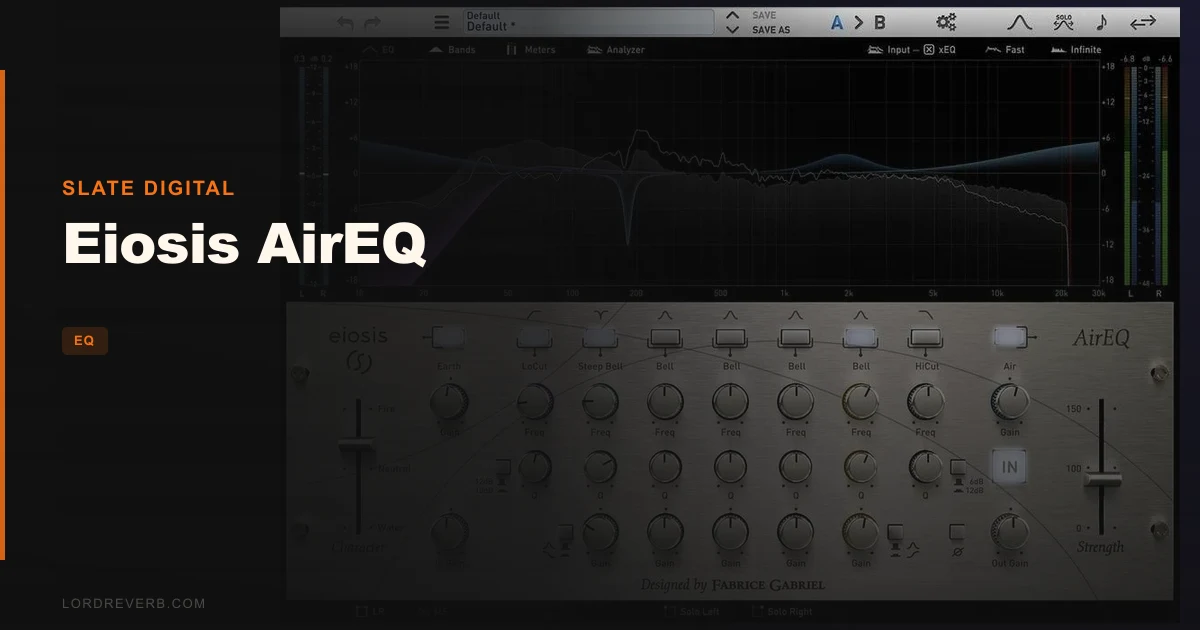
Eiosis AirEQ is a nine-band parametric EQ from Slate Digital priced at $149, but only if you understand what it's actually selling you: not more bands, not more meters, but a smarter way to think about filter character.
The doubt most buyers bring to this page is fair. Nine bands and a novel interface sounds like marketing dressing on a standard EQ. It isn't. The Fire/Water Character system replaces the classic Q knob with something that actually changes how filters behave at the mathematical level, and after running it on everything from overheads to full mixes, we'd call it one of the cleverest EQ designs available ITB in 2026.
It's built for engineers who spend their day on full-session mixing and mastering work. If you need a quick surgical notch tool and nothing more, use something simpler.
Does It Actually Deliver on the Promise?
Eiosis spent three years developing AirEQ before commercial release. That's not a press-release number designed to impress: you can hear it in the consistency of the filters across the frequency range.
The core technology is a proprietary "Analog Matched Linear Transform," which keeps filter shapes symmetrical whether you're boosting or cutting. Most EQs behave differently cutting vs. boosting at the same Q setting. AirEQ doesn't. A 3dB boost and a 3dB cut at 2kHz produce mirror-image curves. That consistency makes iterative gain-staging decisions faster and more predictable.
Slate Digital now owns and distributes the Eiosis brand, so you get their activation infrastructure. That means iLok License Manager is required. No iLok dongle needed, just the free account. It's a minor friction point, but it's there.
The 30-day fully functional trial is a good deal. Use every band, save sessions, export audio. No watermarks.
Where It Shines
The Fire/Water Character slider is the feature that separates AirEQ from every other parametric EQ in this price range. And it took us an embarrassingly long time to appreciate it properly.
We were mixing a dense indie rock track: guitars already pushing 3-5kHz hard, vocals needing presence without adding harshness. We dialled in a 2.5dB boost at 4.2kHz on the lead vocal bus. On Water character (fully counter-clockwise), the curve spread wide, maybe 1.5 octaves, lifting presence without touching the bite. On Fire character (fully clockwise), that same 2.5dB boost tightened to a precise surgical peak. Same gain. Same centre frequency. Completely different result. No Q knob needed. It's satisfying in a way that's hard to explain until you've done it yourself.
The Earth and Air bands are equally clever. Earth is a low-shelf that adds body in the 60-120Hz range without turning bass frequencies into a boom cloud. We pushed it 3dB on a mix bus and the kick got heavier without the low-mids getting congested. Air is a high-shelf with what feels like infinite headroom: +6dB at 16kHz on acoustic guitar added sheen without any of the fizzy digital glare you'd get from a standard bell at that frequency.
Zero-delay operation matters more than people admit. You can use this on a recording input bus without introducing monitoring latency. That's not something every quality EQ can do.
The Strength control acts as a global depth multiplier across all bands simultaneously. Pull it back and every band gets subtler. Push it up and every curve gets more aggressive. It's brilliant for A/B comparisons: match your bypassed and engaged levels instantly instead of hunting through nine individual gain knobs.
Stereo, dual mono, and M/S modes are all there. For mastering work, the M/S capability alone justifies a large chunk of the purchase price.
Where It Falls Short
Nine bands sounds like a lot. Then you realise five of those are standard bell filters. Two can switch to shelves. The Earth and Air bands are fixed-function. So in practice, you have five flexible parametric bells and two additional fixed-character shelves. That's not bad, but it's not the swiss-army arsenal the marketing copy implies.
We wish there was built-in M/S metering. You get M/S processing, but you're flying blind on the stereo image unless you have a separate analyser on a send. Frustrating when FabFilter Pro-Q 4 at a similar price shows you exactly what's happening to your mid and side signal in real time.
Version 1.1 added filter slopes of 6, 12, 18, 24, and 36dB/octave, which filled a real gap. But the UI for switching slopes is tucked away. New users will miss it. The interface prioritises visual cleanliness over immediate discoverability, which is a design choice that will annoy anyone used to Pro-Q's right-click immediacy.
No spectrum analyser built in. Not a dealbreaker, but at $149 in 2026, it's a notable omission.
How It Stacks Up Against FabFilter Pro-Q 4 and UAD Neve 1073
FabFilter Pro-Q 4 is the direct comparison everyone makes. At a similar price, Pro-Q 4 offers a spectrum analyser, M/S metering, unlimited bands, dynamic EQ per band, and one of the best UIs in the industry. It wins on raw feature count. Full stop.
AirEQ wins on sound character. The Fire/Water system produces curves that sit in a mix differently to Pro-Q's clean digital precision. We ran identical boosts on a mix bus with both. Pro-Q 4 at +3dB, 1kHz, Q of 0.8 sounded accurate. AirEQ at the same settings on mid-Water character sounded musical. It's not a placebo difference. If you want the most transparent analytical EQ, get Pro-Q 4. If you want the EQ that makes your cuts sound intentional rather than clinical, AirEQ wins that argument.
The UAD Neve 1073 is a different fight entirely. That's a coloured hardware emulation. AirEQ sits between the two worlds: it adds character through filter behaviour, not saturation or harmonic distortion. For anyone who wants the control of a modern plugin with some of the musical feel of hardware design philosophy, AirEQ is the smarter choice than reaching for a UAD emulation.
If you're also exploring dynamic EQ territory, check out our BLEASS Motion EQ review for live movement-focused EQ for a different angle on musical EQ shaping.
Is $149 a Fair Price?
Yes, but it requires the right buyer. If you're comparing AirEQ to free or budget EQs, the jump feels steep. If you're comparing it to Pro-Q 4 or Ozone's EQ module, $149 is competitive.
The 30-day full-function trial removes the risk. There's no reason not to use it before buying. If the Fire/Water system clicks for you in that first session, the price will feel like nothing. If you find yourself ignoring the Character controls and just using it as a standard parametric, save the $149 and use something cheaper.
For mastering engineers especially, the M/S capability, the symmetrical filter response, and the Strength global control make $149 straightforward to justify.
Score Breakdown
| Category | Score | Notes |
|---|---|---|
| Sound Quality | 4.5/5 | Symmetrical filter response and character system produce genuinely musical results across the frequency range |
| Value for Money | 4.0/5 | $149 is fair given the technology; no built-in analyser dents the value slightly |
| Ease of Use | 4.0/5 | Core workflow is fast; slope switching and some secondary controls are harder to discover than they should be |
| Features | 4.0/5 | Fire/Water/Earth/Air/Strength system is genuinely novel; missing spectrum analyser and M/S metering are real gaps |
| CPU Efficiency | 4.5/5 | Zero-delay design keeps CPU draw low even with all nine bands active |
| Overall | 4.3/5 | A musically intelligent EQ that earns its price, held back only by missing visual tools its competitors include |
Alternatives to Consider
FabFilter Pro-Q 4 is the obvious alternative. More bands, spectrum analyser, dynamic EQ per band, better M/S metering. If analytical precision and visual feedback matter more to you than filter character, Pro-Q 4 is our pick. Check current pricing on the FabFilter site.
Bx_digital V3 by Plugin Alliance is worth a look if M/S mastering is your primary use case. It's more purpose-built for stereo bus work and offers dedicated M/S metering that AirEQ lacks.
TDR Nova is free and covers dynamic EQ territory AirEQ doesn't touch. If budget matters, Nova handles surgical dynamic cuts better than AirEQ's static bands. For a broader look at how EQ plugins shape tonal decisions alongside other processors, see our VEQ-HLF review for Pultec-style filter shaping.
If you're building out a fuller signal chain and want to pair EQ decisions with rhythmic or modulation-based processing, our SEQUND Lite review for sequencer plugin workflow and 510k SEQUND + POLYLLOP Bundle review cover tools that work well alongside precise EQ work in a modern ITB session.
AirEQ is not for everyone. It's not the plugin to reach for if you want unlimited bands, dynamic EQ, or a built-in analyser. But if you've ever boosted 3dB at a frequency and thought "that technically worked but doesn't feel right," AirEQ is probably the EQ that's been missing from your signal chain.
Buy it. Use the 30-day trial first. If the Water/Fire system doesn't change how you think about shaping a mix within the first week, request the refund.
Frequently Asked Questions
Does Eiosis AirEQ require a physical iLok dongle?
No dongle required. You need the free iLok License Manager account installed on your machine, but the license runs locally without any hardware key. It's a minor setup step, not a recurring hardware dependency. If you already use other Slate Digital plugins, you're already set up.
What's the difference between Water and Fire character on AirEQ?
Water character produces wide, smooth, naturally transparent EQ curves. Fire character tightens the filter into a precise, punchy peak at the same centre frequency and gain setting. The slider between them lets you dial in anything in between, replacing the traditional Q bandwidth knob with something that changes filter behaviour more holistically. Think of it as the difference between colouring a broad area and drawing a sharp line.
Is Eiosis AirEQ good for mastering?
Yes, and it's one of the better $149 options for mastering specifically. The M/S processing mode, symmetrical boost/cut filter response, and the Strength global control all suit mastering workflows. The one gap is the lack of built-in M/S metering, so you'll want a dedicated analyser on your output chain alongside it.
How does AirEQ's CPU usage compare to FabFilter Pro-Q 4?
AirEQ's zero-delay processing architecture keeps CPU draw noticeably lower than linear-phase modes in Pro-Q 4, which use FFT processing and introduce latency compensation overhead. With all nine bands active in AirEQ, the load is light enough that we ran it simultaneously on more than a dozen tracks in a 48-track session without performance issues. Pro-Q 4 in zero-latency mode is comparable, but its linear-phase mode costs significantly more CPU.