
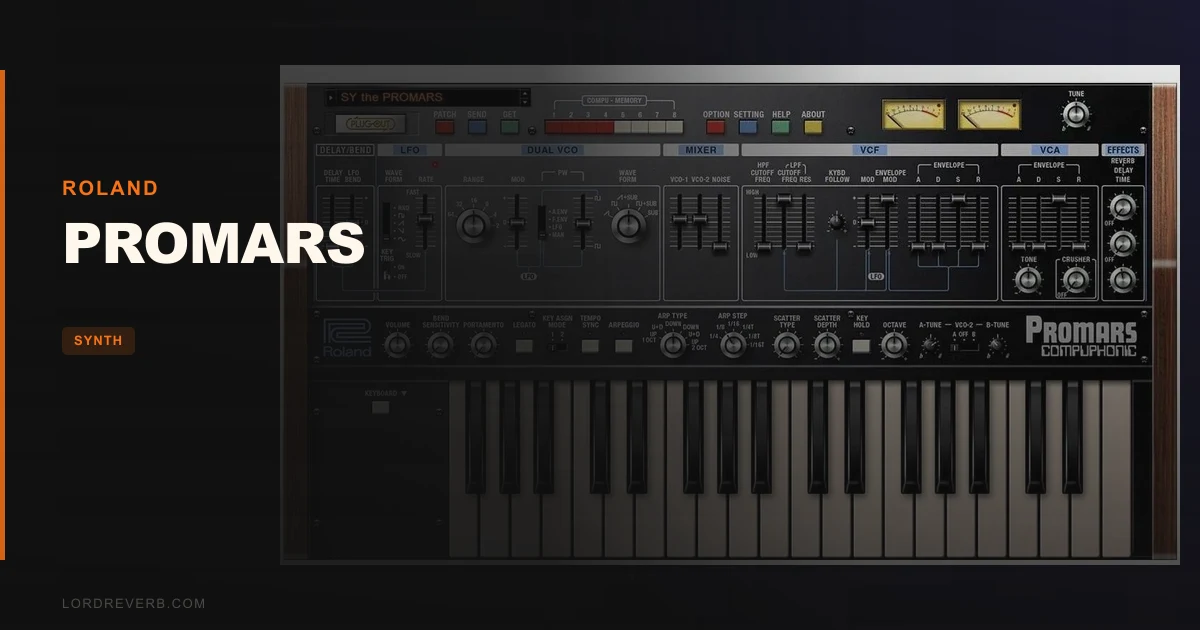
Finding a mono synth that nails that specific, slightly dangerous Roland bass character from the late 1970s is frustrating, mostly because the original hardware is rare and the software options either oversimplify or miss the circuit-level character entirely. Roland's PROMARS plug-out tries to fix that. It's a VST, AU, and AAX instrument priced at $99, built around a circuit-accurate recreation of the 1979 PROMARS synthesizer, and it's the kind of thing that either lands perfectly in your signal chain or sits there unused after the first three sessions. Which camp you fall into depends heavily on what you're actually building.
The Specific Pain Point This Addresses
The original 1979 PROMARS was a sibling to the JUPITER-4 and one of the first synths with onboard memory. It's not easy to find, and when you do find one, it's not cheap and it's not reliable. For producers chasing that era of Roland mono tone, the gap between "vintage hardware I can't afford" and "modern emulation that doesn't feel right" is a real, annoying problem.
The PROMARS plug-out sits in that gap. It's aimed at producers who want dual-VCO, dual-sub-oscillator mono density, the particular BA662 filter character that owners describe as "huge," and the ability to actually recall patches without hoping their hardware hasn't drifted overnight. That's the problem it's here to solve. It doesn't solve all of it, but it solves enough to be worth talking about seriously.
How It Performs in Practice
The core sound is where this earns its price. Owners consistently report a full, transparent quality with the second VCO engaged: no blurriness, just added weight. For monophonic bass and lead work, that dual-oscillator stack gives you density that the JUPITER-4 can't match in mono duties, and that's not a small thing.
The BA662 filter emulation gets specific praise for sounding huge on bass tones. Push the drive and the low-mids fill the picture in a way that's harder to dial in with more clinical modern instruments. For a lead tone, the extended oscillator range beyond the original gives you more sweep to work with than the hardware ever offered.
But here's where it gets complicated. PWM movement only affects one saw waveform, not both as it did on the original hardware. The filter's LFO manipulation doesn't match the original circuit behavior either. If you're building patches that depend on those specific interactions, you'll hit a wall. And with 64 discrete positions per knob due to 6-bit implementation, fine automation moves can step in ways that are audible and frustrating when you're dialing in filter sweeps slowly.
The arpeggiator is legitimately useful: tempo-synced, advanced enough for modern production needs. The built-in reverb, delay, and bit-crusher round out the signal chain without forcing you to load extra plugins. Those are real workflow wins.
Strengths and Weaknesses Side by Side
The strengths are centered on sound and integration. Circuit modeling done part-by-part gives the PROMARS a tonal specificity that broad-stroke emulations miss. Load it up for a monosynth bass line and assign the hardware SYSTEM-8 as a tactile controller for the software version, and the workflow is genuinely satisfying. Patch recall across hardware and software is seamless in a way that hybrid setups usually aren't.
The weaknesses are real and some of them are ugly. Only 8 patch memories is a painful limit that feels like a hardware constraint carried over where it didn't need to be. The virtual knob and slider behavior in the VST version is awkward, with owners describing sluggish response and the 64-position ceiling making precise moves harder than they should be. And the filter accuracy issues mean you're not quite getting the original: you're getting something close, with specific behaviors missing.
It's also worth being direct about what this isn't. It's monophonic only. No polyphonic mode exists, and the second VCO is locked to the same waveform, octave, and pulse width as the first. That's a hardware architecture constraint carried into software, and it limits what you can do with tuning spreads.
Is $99 the Right Price for This?
At $99, this competes with broader synth collections and more flexible mono emulations. The honest answer is that the price is justified only if you specifically want this Roland character and have a SYSTEM-8, SYSTEM-1, or SYSTEM-1m for integration, or plan to build that setup. The circuit modeling quality is real, and the JUPITER-4 sibling lineage delivers something specific that generic mono emulations don't replicate.
If you're after a flexible mono workhorse with tight automation and deep patch storage, $99 gets you better elsewhere. The Korg Legacy Collection is an alternative owners mention for limited budgets. But if the PROMARS sound is the target, the price isn't unreasonable for what it actually delivers.
Who This Is For and Who Should Walk Away
- ✅ Buy if you own a SYSTEM-8, SYSTEM-1, or SYSTEM-1m and want seamless hardware/software integration with that Roland 1979 mono character.
- ✅ Buy if you're building bass and mono lead tracks that need the BA662 filter weight and dual-VCO density without tracking down vintage hardware.
- ✅ Buy if the arpeggiator and built-in effects chain matter to your production workflow and you want them all in one instrument.
- ❌ Skip if you need smooth, fine-resolution automation on filter sweeps. The 6-bit implementation will drive you mad.
- ❌ Skip if you want polyphony. It doesn't exist here and there's no workaround.
- ❌ Skip if patch management is central to your workflow. Eight slots is not enough for serious session use.
Specs & Technical Details
| Developer | Roland |
| Price | $99 |
| Plugin Format | VST / AU / AAX |
| OS Support | N/A |
| Activation | N/A |
| CPU Usage | N/A |
| Trial Available | N/A |
| Version Reviewed | N/A |
Score Breakdown
| Category | Score | Notes |
|---|---|---|
| Sound Quality | 4.0/5 | BA662 filter character and dual-VCO density are genuinely strong; filter accuracy gaps hold it back |
| Value for Money | 3.0/5 | Justified for SYSTEM-8 owners; harder to defend as a standalone purchase |
| Ease of Use | 3.0/5 | Sluggish virtual sliders and 6-bit knob resolution make fine control annoying |
| Features | 3.5/5 | Arpeggiator, built-in effects, and hardware integration are clever; 8 patch slots and no polyphony limit scope |
| CPU Efficiency | N/A | Not enough data to score |
| Overall | 3.5/5 | A specific tool with a specific audience: brilliant in the right hands, underrated for Roland hardware users |
Alternatives to Consider
Jupiter-4: If polyphony matters as much as the mono character, the JUPITER-4 covers both. Similar tonal DNA from the same era, and owners comparing the two note that the PROMARS has an oscillator advantage strictly in mono duties. The Jupiter-4 wins on flexibility.
SH-2: Owners frequently mention the SH-2 alongside the PROMARS for similar tonal territory and significant feature overlap. If the specific PROMARS circuit character isn't a priority, the SH-2 is worth comparing directly before you buy.
Korg Legacy Collection: Mentioned by owners as a recommended alternative for tighter budgets. Broader instrument variety, different tonal character, but a reasonable place to look if the PROMARS specifics aren't worth the premium for your workflow.
The PROMARS is a narrow instrument. It doesn't pretend otherwise. If you're a producer who needs that exact late-70s Roland mono weight on bass and leads, owns compatible hardware, and can live with 8 patches and careful manual automation, it delivers what it promises. If you need a flexible, deeply programmable mono instrument for heavy session work, the limits here will frustrate you before the end of your first project. Know which one you are before you spend $99.
Related reviews: Noisy 2
Frequently Asked Questions
Is the PROMARS plug-in polyphonic?
No. The PROMARS is strictly monophonic. There's no polyphonic mode and no workaround in the current design. If you need chords or stacked voices, this isn't the right instrument for that task.
What hardware synths is the PROMARS plug-out compatible with?
PROMARS is compatible with the Roland SYSTEM-8, SYSTEM-1, and SYSTEM-1m hardware synthesizers. Those units can also function as tactile controllers for the software version, which makes the hardware/software integration a genuine workflow advantage if you own one.
How many patches can the PROMARS store?
Only 8 patch memory slots with 128 words of RAM. It's a tight limit that reflects the original hardware design and is one of the most common complaints from owners. Plan for it before you start building a large patch library.
How closely does the PROMARS plug-in match the original 1979 hardware?
Roland uses part-by-part circuit modeling built from original design specs, and the core tone gets strong marks from owners. That said, there are known accuracy gaps: PWM movement in the plug-in only affects one saw waveform rather than both, and the filter's LFO manipulation behavior doesn't fully match the original circuit. It's close, but not identical.