
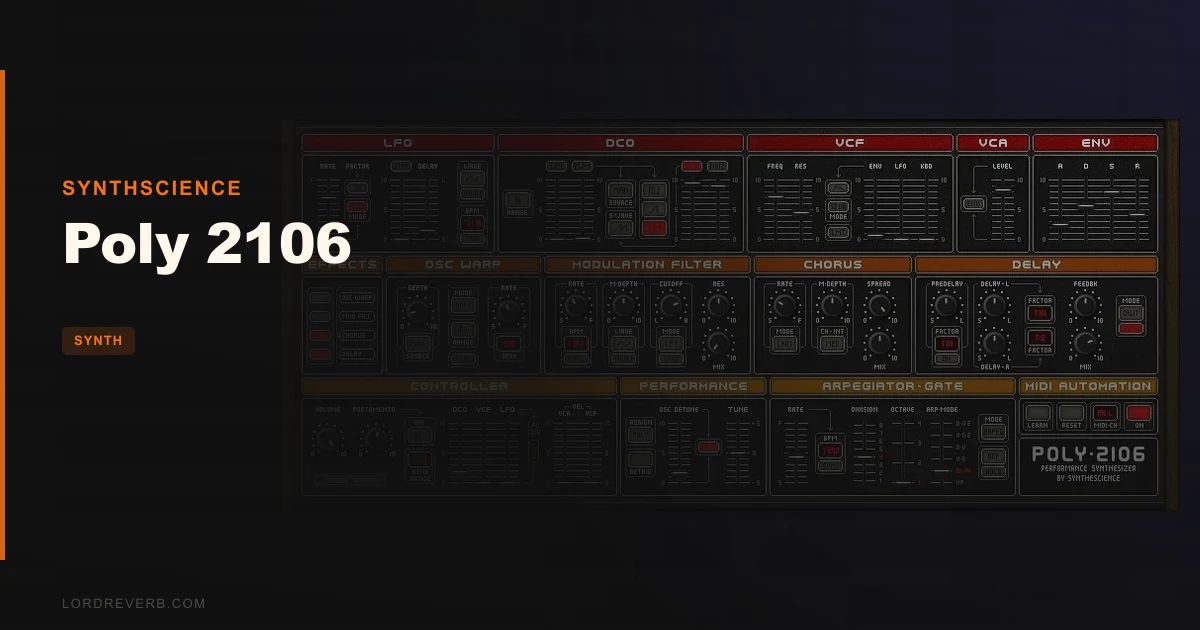
Is a free 32-bit synth from 2012 still worth installing in 2026? That depends entirely on your host, and if you’re on Windows with a bridge or a 32-bit-friendly DAW, yes, it’s worth the 3.2 MB.
Poly 2106 is a polyphonic, 80s-flavoured analog-style synth for PC only. It costs nothing.
That price covers a lot of forgiveness. It also doesn’t cover everything, and we’ll be straight about where it breaks.
This is for retro synth fans who want pads, brass stabs and arps without opening their wallet. It’s wrong for Mac users, 64-bit-only setups, and anyone who needs rock-solid stability on a deadline.
Does It Actually Deliver on the Vintage Promise?
Synthscience says it started as a recreation of an 80s object from the developer’s own studio. The goal was a knob-infested creation with a solid vintage backbone, built as a true performance synthesizer.
The feature list backs the pitch. You get a polyphonic analog-style engine, an arpeggiator, an LFO and a delay, all tempo-synced, plus a chorus and a big preset library.
It was a KVR Developers Challenge 2012 Runner-Up. That’s a respectable pedigree for a free plugin.
Owners describe an effective emulation of classic analog sounds, the kind retro fans go looking for. Honestly, that’s the whole job, and it does the job.
Where It Shines
The arpeggiator is the headline. Owners call it dead on, and tempo sync means it locks to your grid without drift.
Load a pad preset, switch the arp on, and sync it to your session tempo. A soft pad becomes a pulsing 80s bed in seconds. That’s the instant-gratification trick this synth does well.
The chorus gets the same love. It’s the ingredient that turns a plain saw tone into that wide, shimmering Juno-style wash, and owners call it nice.
Then there’s the preset library. A large bank means you can audition your way to a usable sound quickly. Classic synth tones, lots of choices, zero spend.
The interface is knob-laden but small and straightforward. Owners say it doesn’t overwhelm. Every control is on one screen, so tweaking by ear feels immediate.
Where It Falls Short
Here’s the big one. It’s 32-bit VST only, with no 64-bit version. If your DAW is 64-bit-only and you don’t have a bridge, you can’t load it. Hard stop.
Development apparently stopped after 2012. Version 1.2 is the end of the road, so don’t expect fixes.
Stability is the annoying part. Owners report crashes when editing MIDI in Reaper v6.36 and after previewing presets. Preview a few patches mid-session and you may be reloading your project.
The BPM slider is another frustration. Owners say it’s very hard to set values accurately, which is ridiculous for a synth built around tempo-synced arps and delays.
The interface is also tiny and can’t be resized. On a high-resolution display, you’ll squint.
And owners flag it as CPU-intensive, though they say it’s worth the sacrifice. Stack several instances and you’ll feel it.
How Does It Stack Up Against the Alternatives?
Owners compare it to TAL Noisemaker and the Togu Audio Line U-NO-LX. Here’s the quick read.
| Synth | Strongest point | Weakest point |
|---|---|---|
| Poly 2106 | Juno-like experience, free, great arp and chorus | 32-bit only, unmaintained, crashes in some hosts |
| TAL Noisemaker | Favoured for its layout | Less of the Juno-style feel |
| Togu Audio Line U-NO-LX | Juno 60 emulation, ranked above Poly 2106 | A step up in ambition from this free synth |
Noisemaker wins on layout. Owners prefer how it’s laid out, but Poly 2106 stands out for that Juno-like experience.
U-NO-LX wins the Juno 60 emulation contest. Poly 2106 sits below it but above U-NO-62.
Pick Poly 2106 if the vintage vibe is the goal and your host can load it. Pick the others if you need a modern, maintained plugin.
Is the Price Fair?
It’s free, so the question flips. What does free cost you in hassle?
If your setup loads 32-bit VSTs, nothing. You get a characterful retro synth for zero spend and a 3.2 MB footprint.
If you need a bridge, expect friction. Add the crash reports and a dead development line, and you’re paying in time instead of money. Worth a download. Not worth building a project around.
Specs & Technical Details
| Spec | Detail |
|---|---|
| Developer | Synthscience |
| Price | Free |
| Plugin Format | VST (32-bit only) |
| OS Support | Windows (PC only) |
| Activation | N/A |
| CPU Usage | Heavy (owners report CPU-intensive) |
| Trial Available | N/A (free) |
| Version Reviewed | 1.2 |
Score Breakdown
| Category | Score | Notes |
|---|---|---|
| Sound Quality | 4.0/5 | Owners praise the classic synth sound and chorus |
| Value for Money | 4.5/5 | Free, with a large preset library |
| Ease of Use | 3.0/5 | Clear layout, but tiny UI and a fiddly BPM slider |
| Features | 3.5/5 | Tempo-synced arp, LFO and delay plus chorus |
| CPU Efficiency | 2.0/5 | Owners report it's CPU-intensive |
| Overall | 3.4/5 | A characterful free retro synth held back by its 32-bit, unmaintained status |
Alternatives to Consider
TAL Noisemaker. Pick this if layout matters more to you than Juno-style character. Owners favour how it’s organised.
Togu Audio Line U-NO-LX. Pick this for a Juno 60 emulation that owners rank above Poly 2106. It’s the move if the Juno vibe is non-negotiable.
Togu Audio Line U-NO-62. Poly 2106 sits above it, so only consider it if you’re curious how the family compares.
The Verdict: Who Should Download It and Who Shouldn't
Download Poly 2106 if you’re on Windows, your host loads 32-bit VSTs, and you want Juno-flavoured pads and arps for. Free is hard to argue with.
Skip it if you’re on a Mac, run a 64-bit-only DAW, or need dependable stability under deadline. A project that crashes after a preset preview is no fun.
It’s a charming relic that does its one job well and asks you to tolerate its age.
Frequently Asked Questions
Is Poly 2106 free?
Yes. Poly 2106 is a free polyphonic virtual instrument from Synthscience. The download is 3.2 MB.
Does Poly 2106 work in 64-bit DAWs?
Not natively. It's a 32-bit VST only, with no 64-bit version. You'd need a bridging solution or a 32-bit-friendly host to load it.
Is Poly 2106 still being developed?
Development apparently stopped after 2012, and version 1.2 is the one available. Expect no updates, so crash reports owners have raised, such as in Reaper v6.36, are unlikely to be fixed.