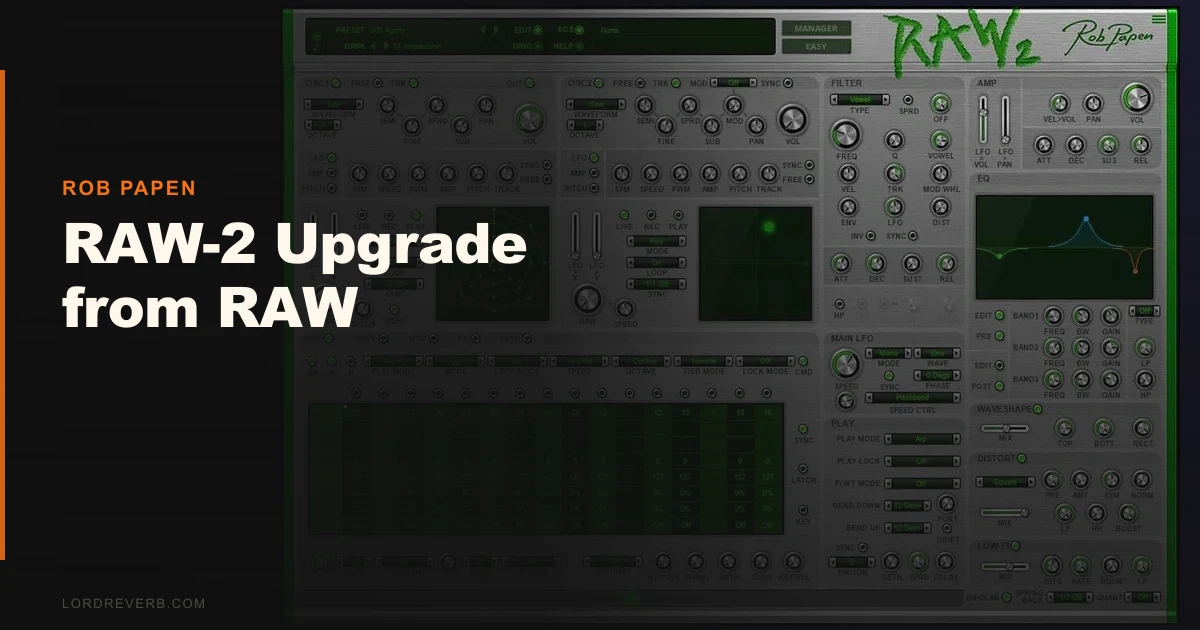
The RAW-2 upgrade from RAW is worth it if you produce Hardstyle, Hardcore, or any genre that lives on aggressive, distorted synth sounds, but it's not a must-buy for producers outside that world.
We were halfway through a Hardstyle lead when the original RAW started showing its age. The distortion was there. The attitude was there. But we wanted per-voice waveshaping without routing everything through a separate bus, and we wanted to draw a custom LFO shape that didn't exist in any preset dropdown. That's the moment RAW-2 made its case.
We pulled it into the session mid-track. The ribbon controller went straight onto a MIDI controller. Within 20 minutes, the lead was doing something the original RAW couldn't do without three extra plugins and a prayer. This is a real evolution, not a version bump with a new splash screen.
First Impressions
Installation is clean. Rob Papen's license system is annoying if you're activating offline, but it's no worse than most in this price tier. VST3, AU, and AAX all show up where they should.
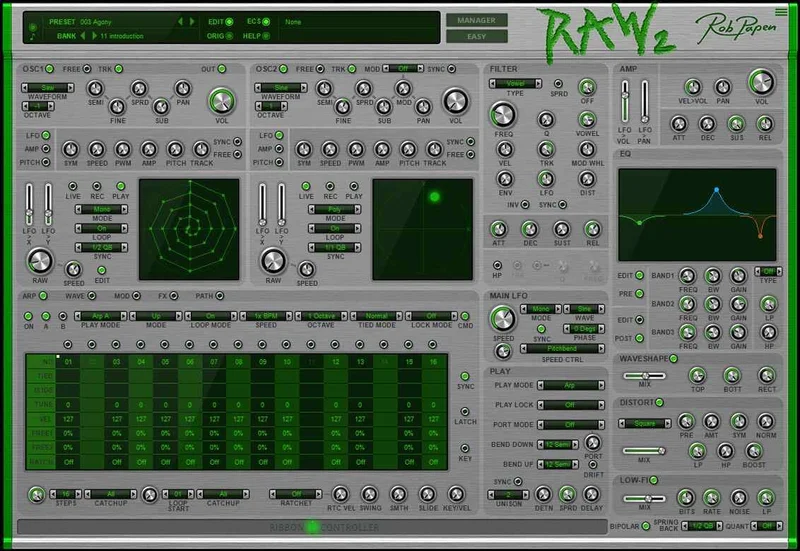
Open it for the first time and the UI is familiar if you've used RAW. The layout hasn't been gutted and rebuilt, which is good. The new per-voice effects section sits in a logical position below the oscillator section. You don't need a manual to find it.
The preset library loads fast. You'll spot contributions from well-known DJs and producers immediately, and about 40% of them are actually useful as starting points rather than finished sounds you'll never touch. That ratio is better than most synth libraries we've tested.
Getting It Into a Real Workflow
Here's where RAW-2 earns points and loses a few at the same time.
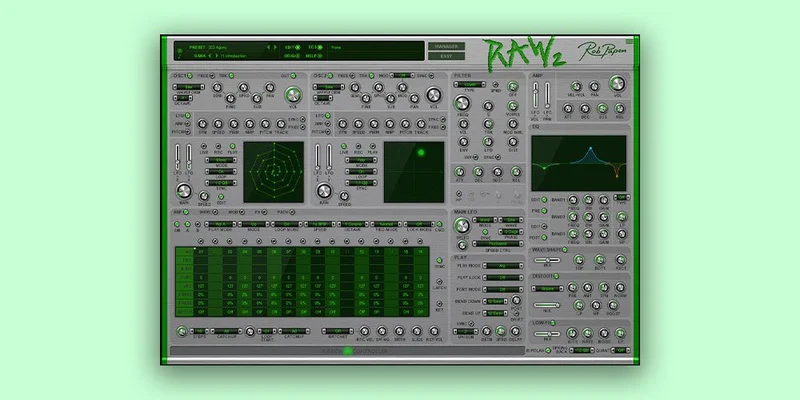
The per-voice effects architecture is the headline feature, and it delivers. EQ, Waveshaper, Distortion, and LoFi all running at the voice level means each note in a chord can be shaped individually before it hits the main signal chain. We stacked a LoFi effect on a pad with light polyphony and got an organic, degraded texture that would've taken us three plugins and a complicated routing scheme in any other synth.
The friction point is CPU. We ran eight voices with full per-voice effects active in a busy session at 256 samples. CPU usage climbed to a point where we had to freeze the track earlier than we'd like. Rob Papen doesn't publish a specific CPU benchmark, and that's a gap we wish they'd close. Budget a track freeze slot for RAW-2 in dense arrangements.
The 32-step arpeggiator and sequencer are solid. The stereo delay and HQ reverb are good enough that we didn't reach for an external send on most patches. That saves signal chain real estate.
What It's Genuinely Good At
The dual oscillator Phase Distortion engine is where RAW-2 separates itself from the original. The X/Y field for waveform distortion gives you tactile, visual control over harmonic content in a way that's satisfying to dial in. Push the X axis hard and you get aggressive upper harmonics. Pull back and the waveform closes up into something tighter and punchier.
We drew a custom LFO shape, a slow irregular ramp with two notches cut into the rise, and applied it to the Phase Distortion amount. The result was a wobble that sounded like nothing in the preset library. That's the kind of workflow that justifies an upgrade.
The Ribbon Controller deserves specific credit. The tempo-based spring-back, borrowed from BIT-2, is clever. Assign it to filter cutoff, push it during a drop, and it snaps back in time with your track. We used it on a Hardcore lead at 150 BPM. The spring-back hit the downbeat every time. That's a live performance trick with real value.
For producers who've been with RAW since it launched almost a decade ago, the distortion tools here go noticeably deeper than the original architecture allowed.
The Rough Edges
The CPU situation needs honesty. Per-voice effects are expensive to process. If you're running a modern M-series Mac or a high-core-count Windows rig at low latency, you'll be fine. If you're on older hardware, stack those effects carefully. We wish Rob Papen published a clear polyphony-vs-CPU chart. They don't. That's frustrating.
Upgrade pricing is opaque at the time of writing. The Rob Papen site requires you to log into your account to see the specific upgrade cost from RAW. The current price is shown in the buy box on this page. Don't trust any third-party number you see, including anything in an older review.
The genre-specific character is also a limitation if you're hoping to use RAW-2 across a wide range of styles. It's ugly in the best possible way for Hardstyle. For ambient work or jazz-adjacent production, that ugliness becomes a problem. It's not built for that, and it shows.
The chorus and phaser are good but not exceptional. We'd still reach for a dedicated chorus plugin on cleaner patches.
Who This Is Really For
- ✅ Buy if you produce Hardstyle, Hardcore, or agg
ressive EDM and already own RAW
- ✅ Buy if per-voice distortion and waveshaping without external routing is a workflow priority
- ✅ Buy if you're picking up eXplorer 10 anyway, RAW-2 is included, making the individual upgrade cost largely irrelevant
- ❌ Skip if you're outside aggressive electronic music genres, the character won't serve you
- ❌ Skip if your system is older hardware already struggling with CPU load in dense sessions
- ❌ Skip if you're a new producer looking for a first synth, this is not a beginner-friendly starting point
Score Breakdown
| Category | Score | Notes |
|---|---|---|
| Sound Quality | 4.3/5 | Phase Distortion engine and per-voice waveshaping produce genuinely aggressive, characterful tones |
| Value for Money | 3.8/5 | Strong if buying via eXplorer 10; standalone upgrade value depends on pricing clarity Rob Papen doesn't make easy |
| Ease of Use | 3.5/5 | Familiar layout for RAW owners, but per-voice effects add complexity that takes time to learn properly |
| Features | 4.0/5 | Ribbon Controller, custom LFO drawing, per-voice effects suite, and 32-step sequencer are all genuinely useful additions |
| CPU Efficiency | 3.3/5 | Per-voice effects stack costs processing; no published benchmarks make this hard to assess before you buy |
| Overall | 4.1/5 | A legitimate, focused upgrade for its intended audience, not a crossover synth, and better for it |
Alternatives to Consider
If RAW-2's genre focus is too narrow, here are three alternatives worth testing.
Serum (Xfer Records) covers similar wavetable distortion territory with broader genre flexibility. It's the go-to for producers who need aggressive sounds and clean sounds from one instrument. CPU usage is well-documented, which RAW-2's isn't.
Vital (Matt Tytel) has a free tier and a spectral warping engine that can get ugly in the right ways. If you're not locked into the Hardstyle sound and want modulation depth comparable to RAW-2 without the per-voice effects overhead, Vital is worth serious consideration.
Hive 2 (u-he) is the most underrated option on this list. The oscillator section is leaner but the distortion character is real, and CPU load is noticeably lighter than RAW-2 under heavy polyphony. For producers who want aggressive sound design with better CPU headroom, Hive 2 deserves a direct comparison.
Our Verdict
RAW-2 is a focused upgrade that does exactly what it says and nothing it doesn't. The per-voice effects architecture is the real win. The Ribbon Controller is clever. The custom LFO drawing is the kind of feature that changes how you work once you use it seriously.
But it's not a synth that apologises for what it is. It's loud, it's distorted, and it's built for producers who want that. If that's you, and if you're already in the Rob Papen world, this upgrade earns its cost.
The current price is shown in the buy box on this page. If you're picking up eXplorer 10, the conversation is over: RAW-2 is included, and that's a straightforward yes. If you're buying the standalone upgrade on older hardware, freeze a track slot before you load it in a dense session.
Ten years after the original RAW found its audience, RAW-2 gives that audience a real reason to come back. That's not a small thing.
Frequently Asked Questions
Is the RAW-2 upgrade free for existing RAW owners?
No. RAW-2 is a paid upgrade from the original RAW. The specific discount for existing owners is managed through your Rob Papen account. Check the manufacturer's site directly for current upgrade pricing, as third-party sources often list outdated figures.
What formats does RAW-2 support?
RAW-2 is available as VST, VST3, AU, and AAX, covering all major DAWs on both Mac and Windows. If you're on Pro Tools, Logic, Ableton, or FL Studio, you're covered. Activation goes through Rob Papen's account-based license system.
Is RAW-2 included in the Rob Papen eXplorer 10 bundle?
Yes. RAW-2 is part of eXplorer 10, the tenth version of Rob Papen's full bundle, which launched in March 2025 alongside the new SynFeX plugin. If you're considering the full bundle anyway, the RAW-2 upgrade cost becomes a non-issue.
How CPU-heavy is RAW-2 compared to the original RAW?
RAW-2 runs heavier than the original, primarily because of the per-voice EQ, Waveshaper, Distortion, and LoFi effects that process independently for each active voice. Rob Papen doesn't publish specific benchmark data, which is a gap we'd like to see addressed. On modern hardware at 256 samples or higher, you'll manage fine. On older systems, freeze RAW-2 tracks when your arrangement fills out.