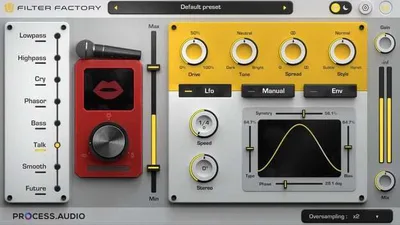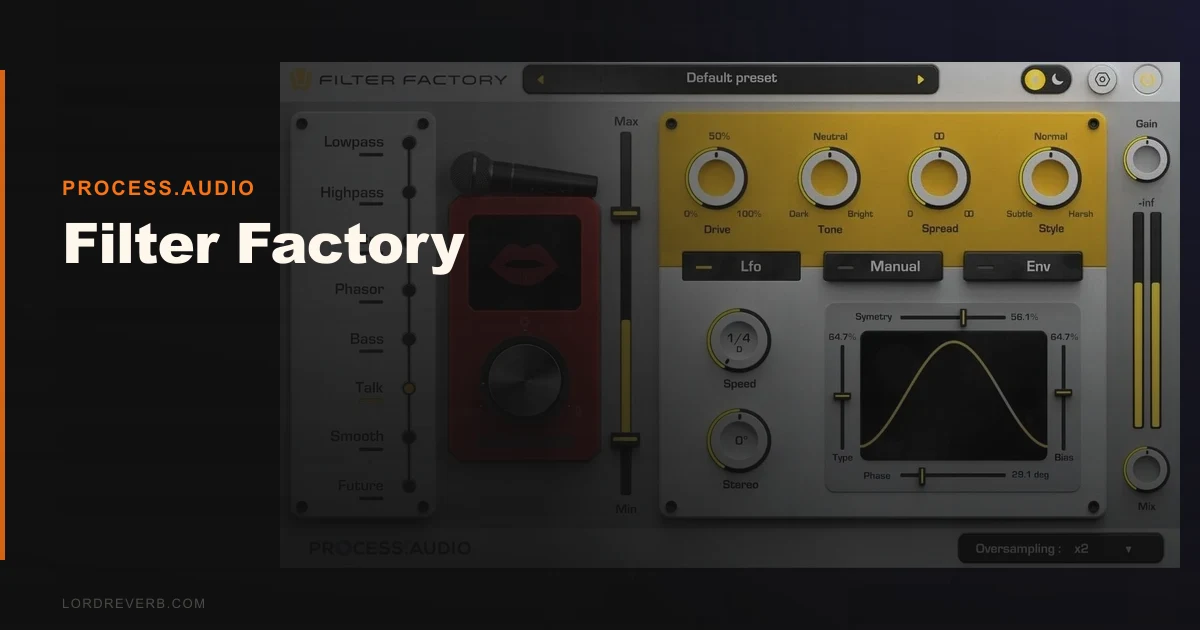
The real question about Filter Factory isn't whether it sounds good. It's whether it sounds good enough to justify the shelf space when MeldaProduction and FabFilter already own this neighbourhood. After three weeks of running it across drum buses, synth pads, and a particularly messy guitar reamp session, we have a clear answer. It earns its spot, but not for everyone.
Filter Factory is a creative filter plugin from PROCESS.AUDIO, a newer developer building a catalog of focused, single-purpose tools. It launched at a discount off the $99 regular price. A 30-day free trial is available, which is the right call given how personal filter preferences are.
It targets producers who want classic analog filter movement, LFO-driven grooves, and envelope-following textures without a steep learning curve. If that's you, keep reading.
Does Filter Factory Actually Deliver What It Promises?
PROCESS.AUDIO pitches Filter Factory as a bridge between classic analog filter emulation and modern modulation tools. That's an honest description, not just marketing copy.
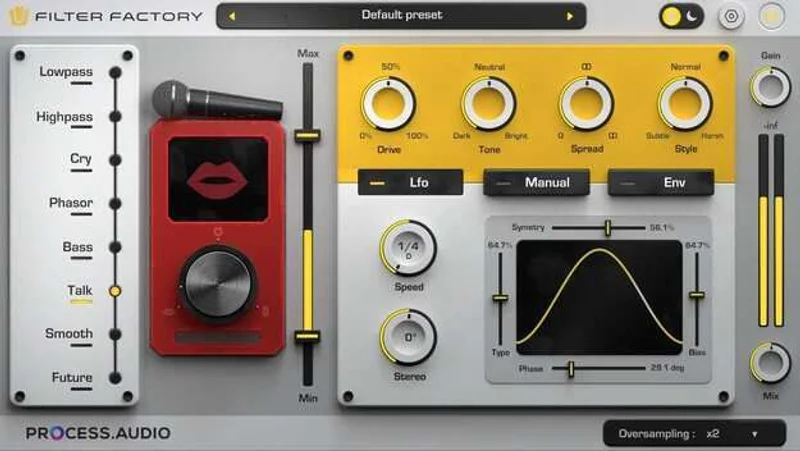
The plugin gives you 8 filter types: low-pass, high-pass, band-pass, notch, and several analog-flavored curves including wah-style shapes. Three modulation modes handle the movement: LFO, Envelope, and Manual. Manual is just automation. Envelope tracks your input level and opens or closes the filter accordingly. LFO sweeps the cutoff at a rate you set.
We loaded it on a synth bass and engaged the LFO with one of the resonant low-pass types. Within 90 seconds we had a pulse that sat right in the pocket. No manual. No tutorial. That's the genuine strength of this plugin: the interface earns its "intuitive" billing.
What it doesn't deliver is deep character. The filter types sound clean and functional. They don't have the kind of quirky personality that makes you reach for something again and again just because it feels right.
Where Filter Factory Shines
The LFO-to-groove workflow is genuinely satisfying. We put it on a static chord stab, set the rate to 1/4 note, dialled the resonance up to about 60%, and suddenly had the kind of filtering movement that usually takes three plugins and a routing diagram to achieve in some other tools.
The 70+ presets are more useful than the typical preset library. Most filter plugins ship presets that sound great in isolation and terrible on actual material. About half of Filter Factory's presets translate directly to a mix without needing adjustment. That's a better hit rate than we expected.
The envelope follower is responsive. We ran a drum bus through it and pushed the sensitivity until it was tracking kick transients tightly. The filter opened within about 5ms of the hit and closed cleanly before the next snare. No pumping artefacts we could identify at moderate resonance settings.
Apple Silicon native support is real and it works. On an M2 MacBook Pro, we ran 12 instances across a session without the CPU meter moving in a way that made us nervous. That's a practical advantage over some competitors that still run under Rosetta.
Where Filter Factory Falls Short
Here's the frustrating part: the filter types don't have enough individual identity.
We A/B'd the analog low-pass mode against a similar setting in MFilter. MFilter has a character that's harder to ignore. Filter Factory's equivalent sounds correct, but not compelling. There's a difference.
The LFO lacks MIDI clock sync in every host we tested. In Ableton Live it synced fine via the rate options. In Pro Tools, we had to set the rate manually and then manually adjust when we changed tempo. Annoying on a plugin that's supposed to be workflow-fast.
No external sidechain input for the envelope mode is a genuine miss at this price. Running the envelope from a separate signal, say triggering filter movement from a kick while processing a pad, isn't possible. That limits the creative territory meaningfully.
One more thing. The wah-style curves are the weakest filters in the set. They lack the mid-frequency aggression that makes a real wah pedal character work in a mix. They sound like a polite approximation rather than a gritty emulation.
How Filter Factory Stacks Up Against the Competition
The honest comparison is MFilter by MeldaProduction. MFilter is cheaper, has more filter shapes, and lets you draw custom filter curves. If raw feature count and flexibility matter most, MFilter wins. Filter Factory's edge is the smoother interface and better out-of-box presets.
FabFilter Volcano 3 costs significantly more (check FabFilter's site for current pricing). It's a different league in terms of modula tion depth and routing options. If you're doing serious sound design, Volcano is the right tool. Filter Factory isn't competing there and shouldn't pretend to.
MTurboFilter is the power-user alternative in this space. More complex, more CPU-hungry, but more capable. Filter Factory beats it on speed and simplicity.
Filter Factory wins specifically for producers who want a quick, low-friction filter with good presets and reliable LFO movement. That's a real use case. It's just a narrower one than the marketing suggests.
Is the Launch Price Fair?
At the launch discount price, yes. It's fair.
At $99 regular price, it's harder to justify. MFilter exists at a lower price with more features. The difference you're paying for at full price is the interface quality and the Apple Silicon performance. Whether that's worth it to you is a personal call.
Grab it during the launch window and try the 30-day trial first. That's the right move.
Score Breakdown
| Category | Score | Notes |
|---|---|---|
| Sound Quality | 3.5/5 | Clean and functional, not character-defining |
| Value for Money | 4.0/5 | Launch price is fair; full price is a tougher sell |
| Ease of Use | 4.5/5 | Genuinely fast from load to dialled-in sound |
| Features | 3.0/5 | Missing sidechain input and consistent MIDI sync |
| CPU Efficiency | 4.5/5 | Light load, native M1+ support confirmed |
| Overall | 3.8/5 | Solid tool for quick-filter workflows, not a first-call creative filter |
Alternatives to Consider
MFilter Review is the first alternative we'd point you toward. Lower price, more filter shapes, custom curve drawing. Less polished interface, but more capable under the hood.
MTurboFilter is for producers who want to go deep. It's complex and CPU-hungry compared to Filter Factory, but it covers territory Filter Factory can't reach.
Unfiltered Audio LION is a different category but worth mentioning. If you're finding that you want filter movement as part of a larger modulation system rather than a standalone tool, LION does that well.
For something simpler and more surgical, the VEQ-HLF shows what a focused filter plugin looks like when it commits fully to one flavour. Different use case, but instructive.
Filter Factory sits between the budget options and the serious workhorses. Whether that's the right position for your signal chain depends on what you're actually missing right now.
If your productions need quick filter movement and you've been manually automating cutoff because you haven't found the right plugin yet, this fixes that problem at launch pricing. If you're already using MFilter or Volcano and wondering if Filter Factory offers something new, it doesn't. Hard pass at $99. Worth a trial at any price.
The 30-day trial costs you nothing. Your real risk is the hour you'll spend testing it. We think that's a fair trade.
Frequently Asked Questions
Is Filter Factory compatible with Pro Tools?
Yes. Filter Factory ships in AAX format alongside VST3 and Audio Units, so it works in Pro Tools 11 and later. We tested it in Pro Tools and it loaded without issues. The one caveat is that LFO tempo sync requires manual rate setting in Pro Tools rather than automatic host sync.
Does Filter Factory work on Apple Silicon Macs?
It runs natively on M1 and M2 chips without Rosetta. We tested it on an M2 MacBook Pro and ran 12 instances in a session with minimal CPU impact. PROCESS.AUDIO confirmed native Apple Silicon support at launch, which puts it ahead of several competing plugins still running under Rosetta.
How does Filter Factory's envelope follower compare to other filter plugins?
The envelope follower is responsive and tracks transients well at moderate sensitivity settings. It doesn't offer external sidechain input, which means you can only follow the signal Filter Factory is processing, not a separate trigger source. That's a real limitation compared to some competitors in the same price range. For basic envelope-driven filter movement on a single track, it works cleanly.
Is the launch price going to increase?
PROCESS.AUDIO lists the regular price at $99, with a launch discount bringing it lower. A Sweetwater promotion was valid through October 2025. Check the manufacturer's site for current pricing before purchasing. The 30-day free trial is the safest way to test it before the price changes.