Babylon 1 sits below Serum, Sylenth1, and even the free Vital in terms of sound design depth, and that’s exactly where this review is going to land. W. A. Production’s synth costs less than a lunch in most cities, and the bundle with all 21 expansions makes it look like a steal. Whether it’s actually a steal or just cheap depends entirely on what you need from a synth. We spent several weeks loading presets, building patches from scratch, and stress-testing it across four DAWs. Here’s the honest verdict.
How Babylon 1 Compares Out of the Box
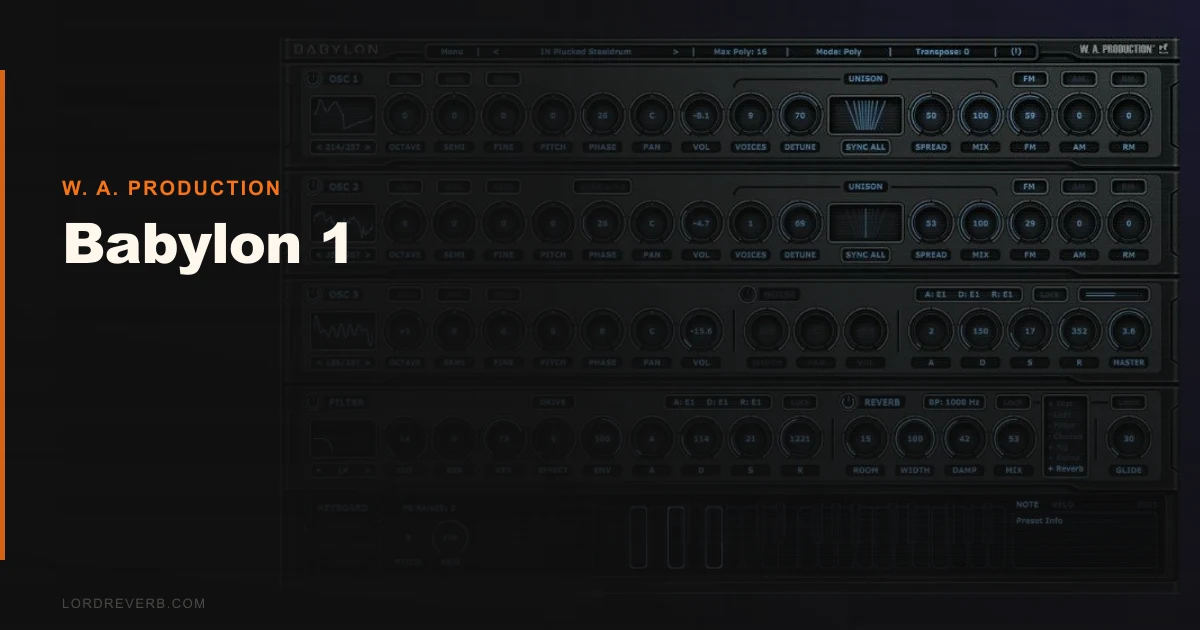
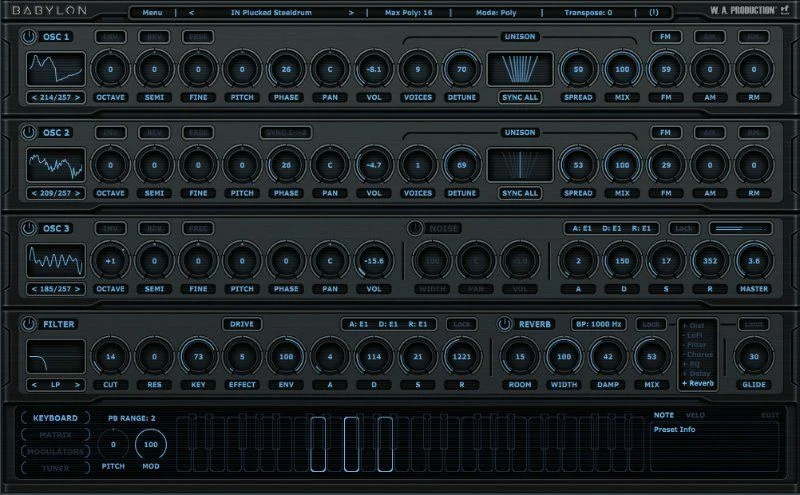
Load Serum for the first time and you’re looking at a two-oscillator wavetable engine with an effects rack, an LFO matrix, and a mod routing system that can keep you busy for months. Load Babylon 1 and you’re looking at a single page: oscillators, filter, ADSR, a small effects strip, and an arpeggiator. That’s it.
Compared to Sylenth1, Babylon 1 has more waveforms (257 high-resolution options versus Sylenth1’s fixed set) but a fraction of the modulation slots. Compared to Vital, which is free, Babylon 1 offers less flexibility in the mod matrix but wins on preset count and the scale/microtuning system, which Vital doesn’t touch.
First impression: clean, focused, and a little limiting.
Performance Deep Dive
We ran Babylon 1 in Ableton 12, FL Studio 21, Logic Pro 11, and Studio One 6. Plugin formats tested: VST3, AU, and AAX.
CPU usage averaged around 4-6% per instance on an Apple M2 Pro with 16GB RAM, which sounds fine until you load six instances and notice it doesn’t scale efficiently. Serum at the same polyphony sits at roughly 2-3% per instance on the same machine. That gap adds up on a full session.
The filter section has five poly effects baked in: drive, distortion, saturation, crush, and LoFi. We ran a lead patch through all five stacked. The crush setting got genuinely interesting at high settings, pushing the tone into lo-fi territory that sat well against a boom-bap drum loop. The drive, though, introduced some harsh upper-mid artifacts above 8kHz that needed taming with an EQ cut around 9kHz at about 3dB.
The ADSR section offers 12 curve types, which is a thoughtful addition. Standard linear attack on a pad versus a logarithmic curve makes an audible difference in how the note blooms. That level of detail in the envelope design is better than you’d expect at this price.
Preset load time averaged under 50ms. No crashes in three weeks of testing across all four DAWs.
Where Babylon 1 Wins
The microtuning and scale system is where Babylon 1 earns its keep. We’re talking 23 standard scales plus 34 Middle Eastern and traditional modes, all selectable from the UI with no external MIDI tools needed. We loaded a maqam-style pad, dropped it into a session with a darbuka loop, and had it sitting in the mix inside two minutes. No other synth at this price point gets you there that fast.
The single-page UI is genuinely satisfying to work with. When you’re scoring quickly or demoing ideas, not having to flip between pages saves real time. We built a workable bass patch in under four minutes without touching the manual.
The bundle price for the main synth plus all 21 expansion packs is the other honest win. If even five of those expansions hit your genre, the math works.
Where the Competition Wins
Modulation routing is where Babylon 1 loses the argument. You can’t drag an LFO to an arbitrary destination the way you can in Serum or Vital. The modulation options feel frozen in place, which is frustrating when you want to automate filter resonance with an envelope that doesn’t match the amp ADSR.
Vital is free. That’s annoying to write in a paid product review, but it’s true. Vital’s mod matrix is deeper, its wavetable engine is more flexible, and it costs nothing. Babylon 1 beats it on presets and on that microtuning system, but for pure sound design power per dollar, Vital wins before Babylon 1 even loads.
Serum and Sylenth1 both produce richer stereo fields out of the box. Babylon 1’s unison and stereo width controls are present but basic. A wide supersawpad in Sylenth1 feels wider than the same patch attempt in Babylon 1.
Who Should Buy Which
- ✅ Buy Babylon 1 if you work in Middle Eastern, North African, or world music genres and want microtuning built into the synth itself.
li>
- ✅ Buy Babylon 1 if you're a producer who works from presets 80% of the time and doesn't need a deep mod matrix.
- ✅ Buy Babylon 1 at the bundle price if you want a low-stakes preset library to supplement a main synth like Serum.
- ❌ Skip Babylon 1 if you want to build patches from scratch and need full modulation routing.
- ❌ Skip Babylon 1 if CPU efficiency matters on your system. The draw isn't catastrophic, but it's not lean either.
- ❌ Skip Babylon 1 if you already own Vital. There's too much overlap for the limited gains you'd get.
Score Breakdown
| Category | Score | Notes |
|---|---|---|
| Sound Quality | 3.5/5 | Sounds clean and usable. The filter effects add character. Upper-mid harshness on drive needs external EQ. |
| Value for Money | 4.0/5 | The full bundle price is hard to beat. Scores lower at full individual price. |
| Ease of Use | 4.5/5 | Single-page UI is genuinely fast to navigate. ADSR curve options add depth without complexity. |
| Features | 3.0/5 | Scale and microtuning system is excellent. Modulation routing is too shallow for serious sound design. |
| CPU Efficiency | 3.0/5 | Higher than competing tools at similar complexity. Not DAW-breaking, but noticeable at scale. |
| Overall | 3.4/5 | Good preset synth for world music textures. Too limited for producers who build patches from the ground up. |
Alternatives to Consider
If the modulation depth is the sticking point, look at the BLEASS Analog FM Synth Bundle. It covers more synthesis territory and the FM engine alone is worth the price of entry.
For producers who want a bass-focused synth that actually earns a spot in every session, BeatSurfing LOW is a smarter buy. Narrower in scope, but everything it does is excellent.
If you’re shopping for expansion content rather than a synth engine, the Tape Synths expansion pack pairs well with a more capable host synth and costs less than Babylon’s bundle. And if you want to hear what a well-curated preset library actually looks like at a budget price, check out Chromaphone 3 Synth City for a benchmark.
Babylon 1 is a preset synth with one genuinely brilliant feature buried inside it. That microtuning and scale system deserves a better engine around it. Buy the bundle if Middle Eastern textures are part of your sound and you want something fast to sketch with. If you’re expecting a Serum replacement or a deep sound design tool, you’ll be annoyed within the first hour, and any money wasted is still money wasted.
Frequently Asked Questions
Is Babylon 1 good for beginners?
Yes, with a caveat. The single-page UI makes it easy to get sound quickly, and 2,300 presets mean you don't need to understand synthesis to get results. But beginners who want to learn sound design will hit the modulation ceiling fast and outgrow it. Pair it with a deeper synth like Vital for learning, and use Babylon 1 for its preset library and scale system.
How does Babylon 1 handle Middle Eastern scales?
Better than anything else at this price. It includes 34 traditional Middle Eastern and regional scales with microtuning built directly into the plugin. You select the scale from the UI and it locks your keyboard to that tuning system. We haven't found another budget synth that handles this as cleanly.
Can Babylon 1 replace Serum or Sylenth1?
No. The modulation routing isn't in the same conversation. Serum lets you assign almost any parameter as a mod destination; Babylon 1 doesn't give you that flexibility. Think of Babylon 1 as a fast preset tool and world-music texture machine, not a full-spec synth workstation.
Is the W. A. Production bundle deal actually worth it?
For the synth plus all 21 expansions, yes, if you're going to use it as a secondary synth for specific textures. If you're expecting it to be your primary instrument, the value calculation changes. The expansions add useful preset variety, but they don't fix the shallow modulation routing that limits the core engine.