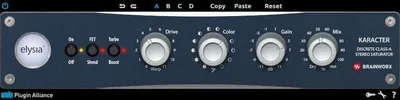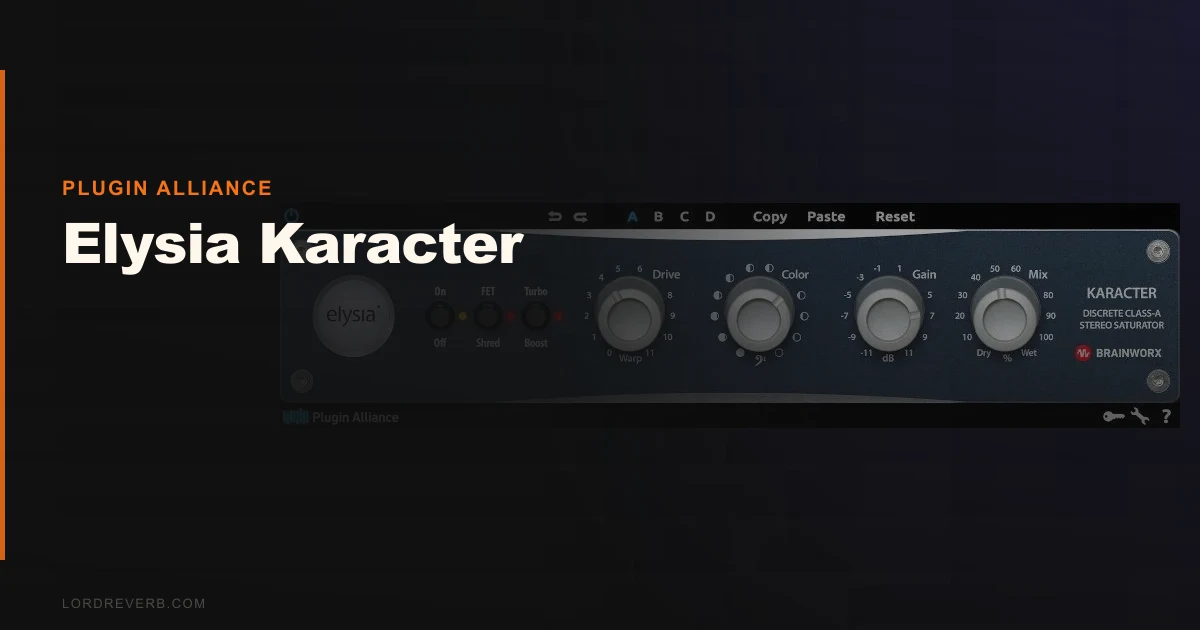
The Elysia Karacter plugin is a discrete Class A saturation tool modelled on a hardware unit that costs much more, and the plugin version earns a lot of that pedigree.
We pulled it up mid-session on a drum bus that was sitting flat and lifeless after eight hours of tracking. The room mics had picked up nothing useful. The overhead pair was clean but cold. We needed presence without noise, punch without limiting. We loaded the Karacter Mix version on the bus, pushed the Drive to about 40%, flipped on FET Shred, and watched the stereo image tighten and the transients snap forward like someone had adjusted a monitor stand. The cymbals stopped feeling apologetic. That moment is the whole argument for this plugin.
It’s built for producers and engineers who already know what they want and need a tool that gets there fast. It’s not a beginner’s plugin. It doesn’t hand-hold. But if you understand gain staging and want hardware-grade saturation in the box, this is worth your attention.
First Impressions: Opening the Box That Costs a Fraction of the Rack
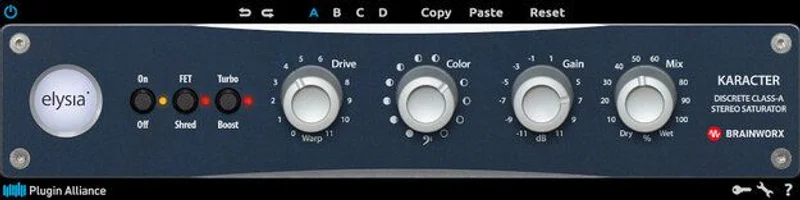
The UI is dark grey with orange accents. It’s handsome in a reserved way, not flashy.
The hardware unit costs more for the 19” rack version and less for the standard unit. Opening the plugin for the first time, it’s clear that Elysia’s designers wanted the GUI to feel like staring at real hardware. Large rotary controls, a passive-looking layout, no skeuomorphic excesses.
First confusion: the Drive and Character knobs interact in ways that aren’t immediately obvious. There’s no tooltip system. You’ll spend 20 minutes learning that the Character control shapes harmonic content while Drive pushes signal into the circuit model. That learning curve is real. It’s annoying if you’re working fast. Worth accepting if you can sit with it.
Getting It Into a Real Workflow
We tested both versions over three weeks across four different sessions: a hip-hop mix, a mastering chain for an indie rock EP, a film score stem mix, and a solo bass recording session.
The Karacter plugin ships in two flavours: Mix and Master. Mix is the one you reach for on individual tracks or buses. Master is tuned for full-program material, with slightly tighter saturation behaviour and better gain compensation at high drive settings. They’re not interchangeable, and that’s a smart design choice.
Dropping the Mix version on a bass DI track is where it clicked for us. We ran a mid-range-heavy fretted bass through it with Drive at 55% and FET Shred engaged. The saturation added 2nd and 3rd order harmonics that filled the 1kHz-2kHz range and made the bass audible on smaller speakers without boosting the low end. We didn’t touch the EQ. The Karacter did it by changing the harmonic structure alone.
One friction point: you can’t automate the Shred mode on/off smoothly in every DAW. In Logic, toggling it mid-playback clicks. Plan your settings before pressing play.
What It's Genuinely Good At
FET Shred mode is the standout feature. Full stop.
It produces asymmetrical saturation, meaning it processes positive and negative signal cycles differently. The result is a harmonic signature that sits closer to a pushed tube preamp than a clean FET limiter. We ran a snare through it at 60% Drive with FET Shred on. The transient retained its crack at 4kHz. The body at 200Hz got a subtle harmonic push. The tail got nothing. That’s exactly what drums need.
On the master bus, the Karacter Master version is underrated as a limiter replacement for the first stage of a mastering chain. It brought peaks down by 1.5-2dB through saturation-based gain reduction rather than hard limiting. The mix sounded louder at the same ceiling. No pumping. No audible compression artifacts.
Compared to the Soundtoys Decapitator, which is the most likely alternative at a similar price, the Karacter is cleaner in the high end and more controlled. Decapitator has more modes and a wilder range of character. Karacter is more surgical. Different tools.
The best saturation plugins for mixing we’ve tested put the Karacter comfortably in the top tier for hardware-modelled colour.
The Rough Edges
The price is the first rough edge. $49 is hard to defend in 2026 when Plugin Alliance runs frequent sales that can drop it well below that. If you’re paying full price, check the sale calendar first. Paying full price for something regularly available at a fraction of that feels like a bad deal on a timeline.
The UI, while handsome, has a real accessibility problem. The contrast between the dark background and the parameter labels is genuinely frustrating in a dimly lit studio. We squinted more than once.
The Mix version on a full mix bus isn’t great. We tried it in place of the Master version out of curiosity, and it over-emphasised the mid-range saturation in a way that narrowed the stereo field by about 15-20% perception-wise. The versions exist for a reason. Respect the distinction.
We also wish the plugin had a mid-side processing option. The hardware rack version has CV controls over drive and mix parameters, which the plugin doesn’t replicate. That’s a genuine capability gap for mastering engineers who work in M-S regularly.
Who T his Is Really For
- ✅ Buy if you work primarily on drum buses and bass tracks and want hardware-grade harmonic saturation ITB without buying the rack unit.
- ✅ Buy if you're a mastering engineer who wants a saturation stage before your limiter that doesn't colour the high end negatively.
- ✅ Buy if you're already in the Plugin Alliance ecosystem and can catch it on sale at $49.
- ❌ Skip if you need a wide variety of saturation characters in one plugin. Decapitator or Technocolor by Karanyi Sounds gives you more range.
- ❌ Skip if you need mid-side processing built into the saturation stage. It's not here.
- ❌ Skip if you're buying at full price without catching a sale. The value maths don't work until the price drops.
Score Breakdown
| Category | Score | Notes |
|---|---|---|
| Sound Quality | 4.5/5 | FET Shred asymmetrical saturation is genuinely class-leading for drums and bass |
| Value for Money | 3.5/5 | Brilliant on sale, hard to justify at full price |
| Ease of Use | 3.5/5 | Parameter interaction takes time to learn; no tooltips |
| Features | 3.5/5 | Two-version system is clever but no M-S mode is a real gap |
| CPU Efficiency | 4.5/5 | Barely moves the meter even with multiple instances on a bus |
| Overall | 4.2/5 | A brilliant saturation tool held back by price and minor UI frustrations |
Alternatives to Consider
Soundtoys Decapitator
If you want more variety, Decapitator is the answer. Five amp-style modes, a Punish button for aggressive drive, and a tone control give you a wider palette than the Karacter. It’s wilder and less controlled in the top end. If you’re on drums and need chaos, it wins. If you need mastering-grade precision, Karacter wins.
Karanyi Sounds Technocolor
We reviewed Technocolor in full here and it’s a credible option at a lower price point. More visual, more beginner-friendly, and covers more saturation types. It doesn’t have the hardware modelling depth of the Karacter, but if you’re starting out, it’s a smarter first purchase.
Waves Abbey Road Saturator
Built for bus and mastering work, with a similar philosophy to the Karacter Master version. It has better M-S capability and a more forgiving learning curve. If M-S processing matters in your signal chain, this is worth comparing directly. Check our saturation plugins guide for a full breakdown of where each one fits.
Our Verdict
We’d buy the Elysia Karacter on sale without hesitation. At $49 during Plugin Alliance promotions, it’s one of the best saturation tools you can own ITB. The FET Shred mode alone justifies the discounted price for anyone who works seriously with drums or bass.
At full price though? We’d wait.
It’s not wrong for experienced engineers who need precision and hardware character. It is wrong for producers who want variety, mid-side processing, or an easy learning curve. The plugin won’t teach you anything. It’ll reward what you already know.
The hardware unit costs far more. The plugin costs a fraction of that and captures most of the character. That sentence is either all the argument you need, or it isn’t.
Frequently Asked Questions
What's the difference between the Karacter Mix and Master versions?
The Mix version is built for individual tracks and buses, with a saturation character that suits drums, bass, and instrument groups. The Master version is tuned for full-program material, with tighter gain compensation and a smoother high-end response at higher drive settings. They're sold as a bundle. Use them for what they're named after and you'll get the best results from both.
What is FET Shred mode and why does it matter?
FET Shred engages asymmetrical saturation, which processes positive and negative signal cycles differently. This produces harmonic content that behaves more like a pushed tube circuit than a standard FET clipper. For drums, it adds crack and presence without destroying transients. It's the main reason engineers reach for this plugin over cheaper saturation options.
Is the Elysia Karacter plugin worth it at full price?
Not for most producers. Plugin Alliance runs regular sales that drop the price significantly, and the plugin appears in their subscription bundles regularly. Set a price alert and wait. The sound quality is worth the sale price easily. At full price, the competition from Soundtoys Decapitator and others makes the decision harder to justify.
Does the Elysia Karacter plugin have a free trial?
Yes. Plugin Alliance offers a 14-day free trial on the Karacter. You can download both the Mix and Master versions and test them in your sessions before committing. We'd recommend putting the Mix version on a drum bus with FET Shred engaged in the first five minutes. That test tells you everything you need to know about whether it fits your workflow.