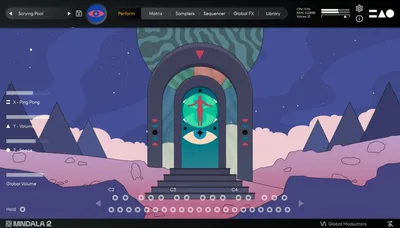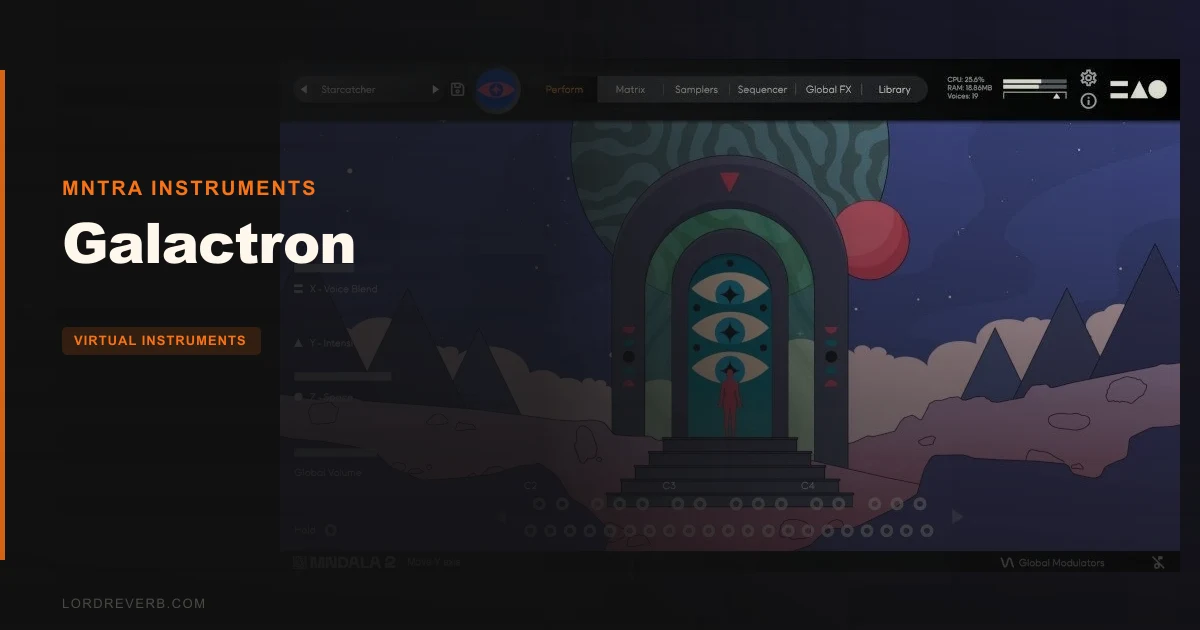
Galactron gets compared most often to Arturia's V Collection FM patches and Native Instruments' vintage keys libraries, and here's where this review lands: it's not in the same technical league, but it's also not trying to be. MNTRA Instruments built Galactron as a sampled snapshot of 80s FM and phase-distortion synthesis, run through a sound-shaping engine that adds motion and colour the originals never had. At $49, it's a mood library, not a synthesis deep-dive. Whether that's a compliment or a caution depends entirely on what you're trying to do.
This review is for producers who've seen the "cosmic digital dust" tagline and wondered if there's any real signal underneath the aesthetic. There is. Some of it is genuinely satisfying. Some of it is frustrating in ways we'll name directly.
How Does Galactron Stack Up Out of the Box?
Load Galactron into a session beside something like Output's Analog Brass and Winds or Arturia's DX7 V, and the first difference you notice is intent. Arturia gives you a synthesiser you programme. Galactron gives you a palette you paint with.
The library covers 40 instrument sample maps across keys, bass, stabs, leads, and pads. Keys categories include FM piano, crystalline plucks, metallic tines, and harpsichord-adjacent sounds. Pads run from "Mothership Organ" to "Starlost," which is labelled as a warm VHS pad.
Out of the box, the presets load fast and sound immediately characterful. That's the good news. The honest news is that a chunk of the 133 presets are pad variations on similar harmonic content. Load five of them back to back and you'll start hearing the family resemblance.
Where Galactron pulls ahead of a basic sample pack is MNDALA 2, the engine running underneath. It transforms what could have been a static ROM throwback into something that moves.
Performance Deep Dive: MNDALA 2 and the XYZ Controls
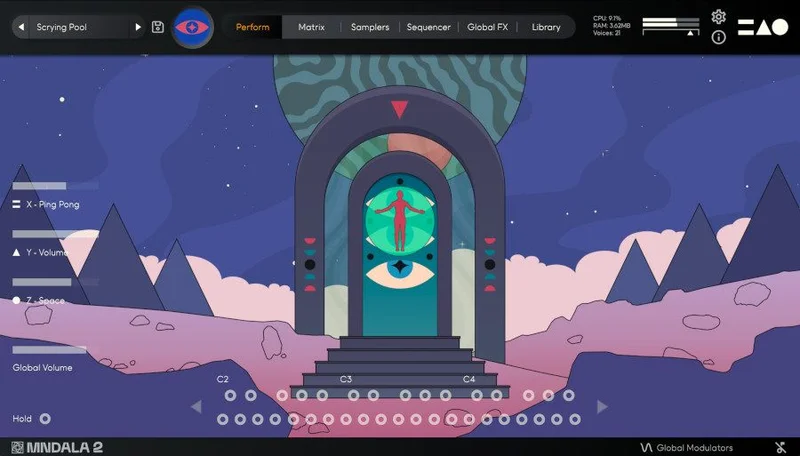
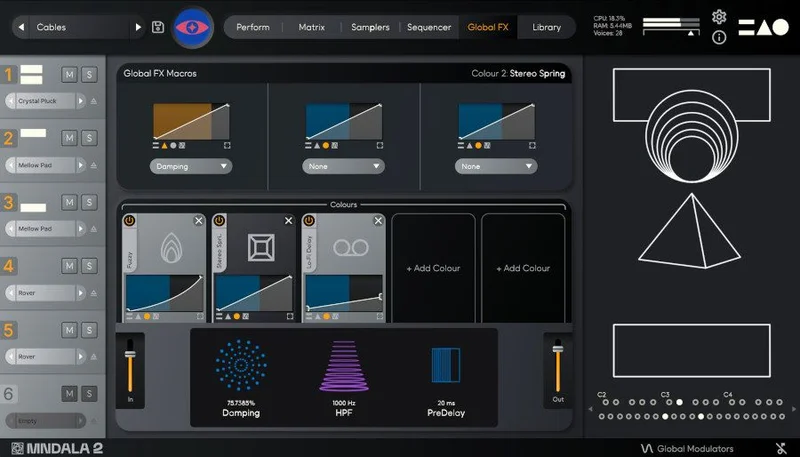
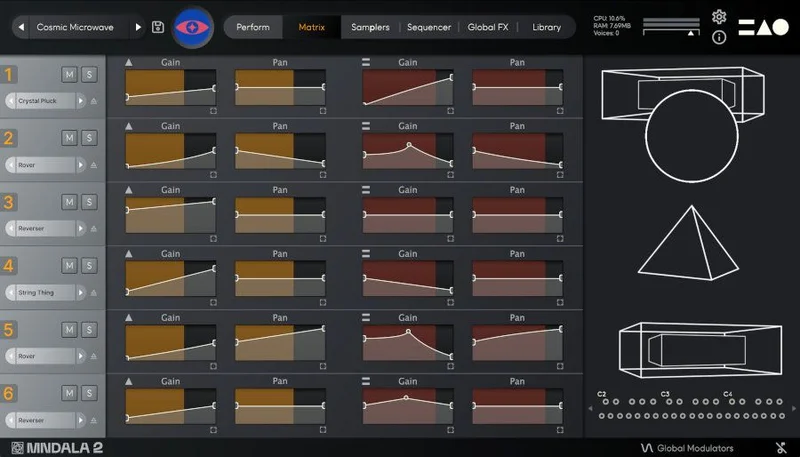
MNDALA 2 is where most of the interesting work happens. The engine uses a 3-axis (XYZ) global control system to morph sounds as you play. Each axis maps to a different dimension of the sound, so shifting X might sweep the filter character while Y controls stereo movement and Z affects harmonic content or reverb depth. The exact mapping varies by preset, which means you're discovering behaviours, not programming them.
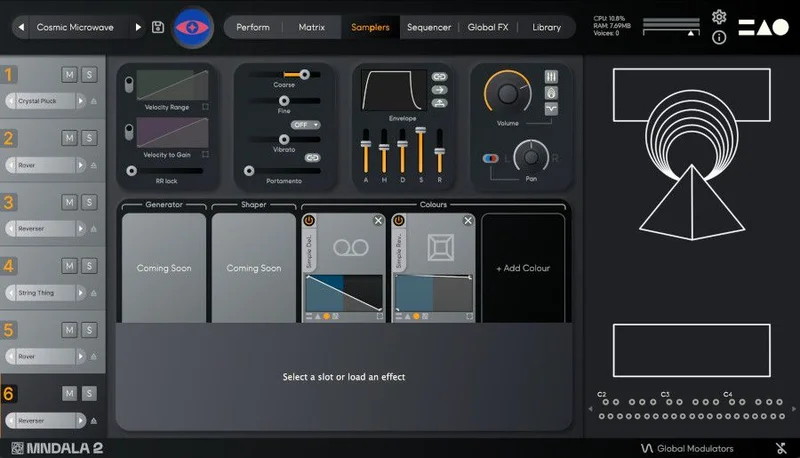
We loaded "Air," described as a floating buzzy pad with lots of motion, and pushed the XYZ axes while holding a chord. The pad breathed. It didn't stay static the way a one-shot sample would. The stereo field widened and pulled back in a cycle that felt organic rather than mechanical. That's the promise of MNDALA 2 working at its best.
Then we tried "Hollow," the phasey harmonic pad with treble bite. Same approach: chord held, axes swept. The result was more aggressive. The high-frequency content surged in a way that sat oddly in a busy mix. It didn't self-destruct, but it needed EQ work to find its place in a track before it was usable.
The samples are recorded at 24-bit/48kHz. That's clean enough that the lofi character you're hearing in presets like "Dusty Bells" or "Crystal Pluck" is an intentional design choice, not a quality floor. There's a meaningful difference between resolution and aesthetic, and Galactron makes that distinction correctly.
CPU load on our test rig (Intel i7, 32GB RAM, Ableton Live 11) was light to medium. Nothing alarming. No preset we tested caused a CPU spike. The system requirement of a minimum i5 and 8GB RAM feels honest rather than conservative.
The 6GB installed footprint is real. Budget your drive space accordingly.
Where Galactron Wins
The FM synthesis territory is genuinely well-covered. "Scorched Keys" delivers that buzzy, slightly aggressive FM string-key texture that defined early Yamaha DX-era productions. Load it under a synth bass line and it fills the upper-midrange slot without fighting for space. We ran it against a DX7 V preset doing similar duty. Galactron's version had more immediate grit without requiring any programming. That's the trade-off, and in this case it's worth it.
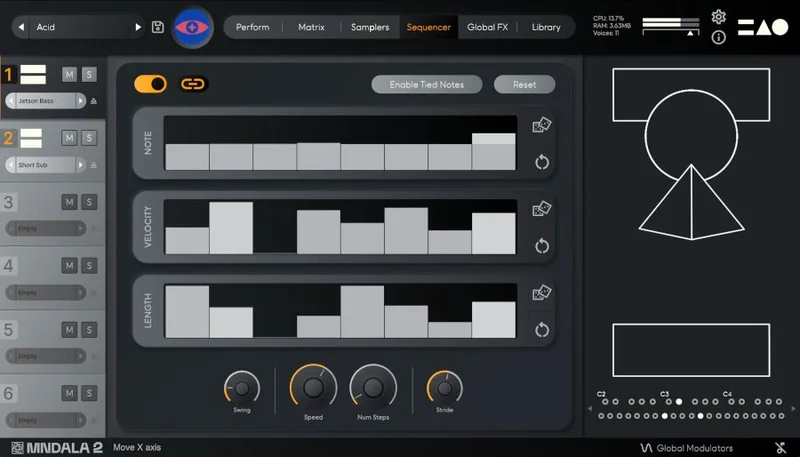
The phase-distortion bass sounds are a highlight. "Jetson Bass" is thick and usable from the low octaves up into mid-range territory. "Swoop Bass" has a squelchy acid quality with a sub-octave tail that fills out a track in a specific way that's hard to find elsewhere in a library this small.
The copy protection approach is a genuine win. No iLok, no challenge-response circus. Install, register your MNTRA account, and the instrument is encrypted to your system. Updates pull through MNDALA 2 directly. In 2026, that's still not universal practice, and MNTRA deserves credit for not making you work for the right to use something you already paid for.
M1 Mac support is confirmed and works without Rosetta workarounds. That matters for anyone on Apple Silicon.
Where the Competition Wins
The frustrating truth is that Galactron's depth is hidden and its documentation is thin. If you don't know what you're doing with MNDALA 2, you're navigating an engine with limited guidance. Arturia's V Collection instruments, in comparison, ship with detailed manuals and tutorial content that actually explains the signal path. With Galactron, you're reverse-engineering the XYZ controls by ear.
There's no trial available. For a library with this specific an aesthetic, that's a real problem. Buying without hearing it in context is a gamble. Output and Native Instruments both offer demo periods. MNTRA doesn't, at least not through Plugin Boutique.
The pad collection is also where the library feels padded. "Lush Pad," "Mellow Pad," "Angelo," and "Digi Pad" share enough harmonic territory that the distinction between them requires careful listening. A competitor like Spitfire's LABS series delivers more clearly differentiated sounds within a smaller count.
VST3, AU, and AAX are all supported. But if you need standalone operation, you won't find it here. It lives inside your DAW, full stop.
Who Should Buy Galactron (and Who Should Skip It)
- ✅ Buy if you produce synthwave, lo-fi, or retro-futurist music and want characterful 80s digital textures without programming a DX7.
- ✅ Buy if you want bass and pad sounds that sit in a mix with personality rather than generic smoothness.
- ✅ Buy if you're on M1 Mac and need a lightweight retro-keys library with zero activation headaches.
- ❌ Skip if you want deep synthesis control. There's no filter cutoff to grab, no envelope to tweak in the traditional sense. You're working with samples shaped by MNDALA 2, not a fully parametric synth.
- ❌ Skip if you need to audition before committing. No trial means no safety net.
- ❌ Skip if your productions sit in a contemporary pop or EDM context where these sounds would need heavy processing to fit. They're built for a specific vibe, not general-purpose deployment.
Specs and Technical Details
| Developer | MNTRA Instruments |
| Price | $49 |
| Plugin Format | VST3 / AU / AAX |
| OS Support | Mac (10.11+, M1 native) / Windows 64-bit |
| Activation | System-linked encryption via MNTRA account (no iLok) |
| CPU Usage | Light to medium |
| Trial Available | No |
| Version Reviewed | MNDALA 2 engine (current as of 2026) |
| Install Size | 6GB installed, 12GB recommended for setup |
| RAM Requirement | 8GB minimum |
| Presets | 133 |
| Sample Maps | 40 |
| Sample Resolution | 24-bit / 48kHz |
Score Breakdown
| Category | Score | Notes |
|---|---|---|
| Sound Quality | 4.0/5 | 24-bit recordings with genuine character; some pads feel repetitive |
| Value for Money | 3.5/5 | Competitive price point but no trial makes it a harder sell |
| Ease of Use | 3.0/5 | XYZ controls are intuitive in concept, underdocumented in practice |
| Features | 3.5/5 | 40 maps and MNDALA 2 engine are strong; no standalone mode or trial |
| CPU Efficiency | 4.0/5 | Light footprint on tested hardware; no performance issues encountered |
| Overall | 3.5/5 | A clever, characterful library that rewards the right producer and frustrates the wrong one |
Alternatives to Consider
If you want programmable FM synthesis rather than sampled FM aesthetics, Arturia's DX7 V is the direct comparison. You get a full synthesiser engine with deep parameter control, and the learning curve is steep but rewarding. It's a different tool entirely, but if you've been frustrated by Galactron's limited programmability, that's where we'd point you.
For lo-fi and retro texture libraries with a more generous trial policy, Spitfire Audio's LABS instruments are worth exploring. Individual LABS instruments are free, the sound quality is consistently high, and the range covers similar atmospheric territory. The aesthetic leans more cinematic than retro-digital, but the overlap is real.
If the phase-distortion bass sounds in Galactron were what caught your attention, look at Output's Analog Brass and Winds or explore dedicated bass synthesis virtual instrument options where you'll find more tweakability at a similar price.
For producers who want the full 80s digital synth experience with every parameter exposed, Native Instruments' Retro Machines Mk2 covers similar hardware ground with a more traditional preset-plus-controls approach. Less morphing, more direct access.
The Final Verdict on Galactron
Here's the scenario where Galactron earns its place: you're building a synthwave or lo-fi beat at 2am, you need an FM piano that sounds like it's been dragged through a cassette deck, and you want it in your session in under 30 seconds. Load "Dusty Bells." Push the X axis. Done. That's the library working exactly as designed.
Here's the scenario where it doesn't: you're trying to dial in a specific character you heard in your head, you want to shape the filter, you want to understand what the XYZ axis is doing to the harmonic content, and you want a manual that explains it. You'll be frustrated. The engine is capable, but it's not transparent about how it works.
The no-iLok activation is brilliant. The no-trial policy is annoying. Those two facts cancel each other out at the purchase stage.
At $49, we'd buy it specifically for the FM bass sounds and the better pad presets. "Swoop Bass," "Jetson Bass," and "Air" alone would justify a portion of that cost in the right production context. The rest of the library is a bonus that occasionally surprises you.
It's underrated in a niche way: producers who need exactly this sound will love it. Everyone else will load it twice and forget it's installed.
If you produce anything touching retro-digital aesthetics, add it to your toolkit. If you don't, skip it without guilt. This one knows exactly what it is.
Frequently Asked Questions
What type of sounds does Galactron include?
Galactron covers 40 instrument sample maps across keys, bass, stabs, leads, and pads. The sounds are sampled from 80s digital and digitally-controlled synthesisers, covering FM synthesis and phase-distortion territory. Specific patches include FM piano, crystalline plucks, phase-distorted bass, and a wide range of evolving pads. You get 133 presets total built from those 40 maps.
What is MNDALA 2 and does it come included with Galactron?
MNDALA 2 is MNTRA Instruments' proprietary sampling and sound-shaping engine that hosts Galactron. It's required to run the library and handles download, installation, and updates through your MNTRA account. The XYZ global controls that animate Galactron's sounds are part of MNDALA 2's architecture. You don't pay for MNDALA 2 separately; it comes with your Galactron purchase.
Is Galactron compatible with Apple Silicon Macs?
Yes. Galactron runs natively on M1 (and later) Apple Silicon Macs without needing Rosetta 2. It supports Mac OS 10.11 and above across VST3, AU, and AAX formats. For Windows users, it's a 64-bit plugin compatible with all major VST3/AU/AAX-supporting DAWs.
Is there a free trial for Galactron?
No free trial is currently available through Plugin Boutique. This is one of our main criticisms of the library, because the aesthetic is specific enough that you really want to hear it in your session before committing. Watch demo videos and listen carefully to audio previews before purchasing if you're unsure.
How is Galactron copy-protected?
MNTRA Instruments uses a system-linked encryption method. Once you register your MNTRA account and install Galactron, the instrument is encrypted to your specific system. There's no iLok, no challenge-response codes, and no third-party activation software required. Learn more about plugin activation methods if you want to compare approaches across different developers.